

Archive position — measured, not model output
1 like on Devpost
505 of the 7,850 archived projects have more likes, and 1,758 share exactly 1 — so this project's #942 place in the like-ranked listing is a tie-break inside that group, not a ranking.
Projects (log scale)
Likes on Devpost. ▲ marks this project's group.
Show the figures
| Likes | Projects | Share of archive |
|---|---|---|
| 0 | 5,587 | 71.2% |
| 1 | 1,758 | 22.4% |
| 2 | 284 | 3.6% |
| 3–4 | 132 | 1.7% |
| 5–9 | 75 | 1.0% |
| 10+ | 14 | 0.2% |
 User Stories BotA demo video on every pull request
Get a demo video on every new feature
GitHub App that watches your pull requests and records a narrated, captioned demo.
Save time on demo prep and make informed decisions faster with a video walkthrough of every new feature.
Executive Summary
What the company appears to be
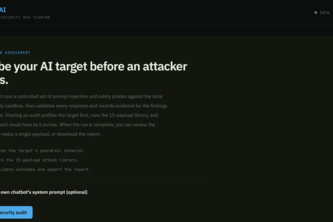
DeepAudit.ai is a self-reported tool for autonomous offensive testing of AI agents, designed to identify prompt injection vulnerabilities before deployment. The author describes it as an automated red-team audit system that runs against chatbots using a pipeline of Recon, Jailbreaker, and Validator agents.
What changed
The project was built in a hackathon context with no prior traction or commercial activity. It is described as a proof-of-concept with limited production readiness, including mock mode for testing without API costs.
Single most important open question
Is there evidence of any real-world usage, customer feedback, or product-market fit beyond the author’s own development experience?
What The Product Actually Is
The description states that DeepAudit.ai is a tool that performs automated red-team audits on AI chatbots. It includes:
- A Recon Agent that profiles the target's baseline behavior.
- A Jailbreaker Agent that runs 15 prompt-injection payloads across seven attack categories (e.g., direct override, roleplay, policy violation).
- A Validator Agent that scores responses using GPT-5.6 with structured JSON output indicating whether a leak occurred and its severity.
- A live dashboard via Server-Sent Events to stream audit results in real time.
- A downloadable PDF vulnerability report with remediation suggestions.
- Configurable target support: users can paste their own chatbot system prompt instead of using the built-in demo.
- Mock mode for evaluation without API costs.
The backend is built with Node.js, Express, and TypeScript; the frontend uses React, Tailwind CSS, and Vite. The tool was developed primarily through Codex, based on upfront specifications rather than iterative prompting.
Evidence All of this is self-reported by the author.
Inference This appears to be a prototype or MVP built for a hackathon, not yet deployed in production.
Positioning & Claim Evolution
The author positions DeepAudit.ai as a solution for indie developers who want to test their AI chatbots for prompt injection vulnerabilities without needing extensive security expertise. The tagline emphasizes “autonomous offensive testing” and securing AI agents before they ship.
The claim evolution shows:
- Initial focus on solving a personal problem (lack of tools for small teams).
- Expansion into a general-purpose tool that supports configurable targets.
- A shift toward extensibility: future plans include allowing custom attack payloads.
Evidence These claims are self-reported and not independently verified.
Inference The positioning suggests an intent to serve the indie developer or early-stage startup market, but no evidence of actual adoption or customer feedback exists.
Target Customer & ICP
The description states that DeepAudit.ai targets:
- Small teams building AI chatbots.
- Indie developers racing to launch products quickly.
- Teams lacking time or security expertise for systematic testing.
It is implied that the tool is aimed at those who may not have dedicated security personnel or resources to perform red-teaming.
Evidence This is based on the author’s stated motivations and use case.
Inference The ICP seems to be small, fast-moving teams in B2B SaaS or developer-facing AI product development — but there is no evidence of actual customers or market validation.
Business Model & Pricing Evidence
No information about pricing, monetization strategy, or business model is provided. The author does not describe how the tool would be sold, licensed, or offered to users beyond its current hackathon prototype.
Evidence Not evidenced.
Inference If this becomes a commercial product, it likely will follow a SaaS or freemium model, but no such plans are stated.
Technical & Delivery Signals
The tool is built using:
- Backend: Node.js, Express, TypeScript
- Frontend: React, Tailwind CSS, Vite
- AI integration: OpenAI API (GPT-5.6), Codex
- Architecture: In-memory store, pub/sub layer for SSE streaming
- Deployment: No mention of hosting or infrastructure beyond local development
Key technical features include:
- Real-time streaming via Server-Sent Events.
- Modular agent architecture (Recon, Jailbreaker, Validator).
- Mock mode for testing without API usage.
- Configurable target support.
Evidence All technical details are self-reported by the author.
Inference The tool was built quickly and with minimal infrastructure, suggesting it may not be production-ready or scalable. The use of Codex and upfront specifications indicates a strong focus on design before implementation.
Traction & Maturity Signals
There is no evidence of any traction, revenue, customers, or usage beyond the author’s own development process during a hackathon. The project has not been deployed in a live environment or tested with real users.
Evidence Not evidenced.
Inference This is a prototype, likely not yet available to end-users. No signs of product-market fit or user engagement are evident.
Competitive Context
The description does not mention any competitors or existing tools in the AI security or prompt injection testing space. There is no indication of how DeepAudit.ai compares to other offerings, if any exist.
Evidence Not evidenced.
Inference Given the niche nature of AI agent security and prompt injection testing, there may be limited competition, but this cannot be confirmed from the provided information.
Open Questions & Risks
- No commercial traction or revenue: The tool is described only as a hackathon prototype.
- Unverified claims: All assertions about functionality, performance, and use cases are self-reported.
- Limited scalability: Built with in-memory storage and no database; not designed for production scale.
- Dependency on AI APIs: Heavy reliance on OpenAI services, which could introduce cost or availability risks.
- Lack of external validation: No third-party reviews, user feedback, or independent testing are mentioned.
Evidence These are inferred from the lack of evidence and self-reported nature of the description.
Questions the description leaves open
- What specific prompt injection vulnerabilities have you observed in real-world chatbots?
- Have you tested DeepAudit.ai against any actual deployed AI agents?
- How do you plan to monetize this tool, and what is your go-to-market strategy?
- Can you demonstrate how the mock mode generates realistic findings that align with real-world scenarios?
- What are the limitations of the current agent architecture in terms of scalability or accuracy?
- Are there any known edge cases where the Validator Agent might fail to detect a leak?
Overall Assessment
This project is described as a hackathon prototype with no evidence of commercial traction, revenue, or customer adoption. It represents an idea with potential but lacks validation.
Confidence Level Low
Next Steps
If this were to be considered for investment or partnership, further due diligence would require:
- Proof of concept with real-world usage
- Evidence of demand from target customers
- Clear path to monetization and scalability
Until then, the project remains a speculative idea rather than a viable business.
Evidence Self-reported only; no external validation or traction data.
User Stories BotA demo video on every pull request
Get a demo video on every new feature
GitHub App that watches your pull requests and records a narrated, captioned demo.
Save time on demo prep and make informed decisions faster with a video walkthrough of every new feature.
Source
Submitted to the OpenAI 2026 hackathon on Devpost. Project home on Devpost. Back to the full gallery on Devpost.
This competitive analysis was produced by top-founders.com (opens in a new tab)
Generated by a language model from this project's public Devpost page — its tagline, the author's own write-up and any built-with tags listed there — as captured in August 2026. Short quotations are the author's words. It is an opinion on the idea as a business, not on the people behind it, and it reflects the description as published then. If the project has moved on, request a correction below. The analysis is not independent research and contains no verified traction, revenue or customer data.
An independent guide by KFG International LLC — not affiliated with, endorsed by, or connected to Devpost or OpenAI.