

Archive position — measured, not model output
0 likes on Devpost
2,263 of the 7,850 archived projects have more likes, and 5,587 share exactly 0 — so this project's #4,868 place in the like-ranked listing is a tie-break inside that group, not a ranking.
Projects (log scale)
Likes on Devpost. ▲ marks this project's group.
Show the figures
| Likes | Projects | Share of archive |
|---|---|---|
| 0 | 5,587 | 71.2% |
| 1 | 1,758 | 22.4% |
| 2 | 284 | 3.6% |
| 3–4 | 132 | 1.7% |
| 5–9 | 75 | 1.0% |
| 10+ | 14 | 0.2% |
 User Stories BotA demo video on every pull request
Get a demo video on every new feature
GitHub App that watches your pull requests and records a narrated, captioned demo.
Save time on demo prep and make informed decisions faster with a video walkthrough of every new feature.
Executive Summary
What the company appears to be
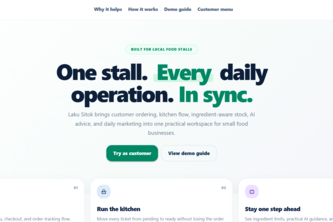
Laku Sitok is a self-reported AI-assisted daily operations hub for small food stalls, built as a hackathon project by one developer (Dhiya Najwa). It integrates customer ordering, kitchen workflow management, ingredient-aware inventory tracking, and marketing tools into a single workspace. The product is described as being grounded in real-world stall operations and designed to support local kampung businesses without requiring separate tools or large teams.
What changed
The project was submitted to the OpenAI 2026 hackathon on Devpost. It represents an early-stage prototype with no evidence of commercial traction, revenue, or customer adoption beyond its own author's account.
Single most important open question — the commercial due-diligence read
Is there a viable path from this demo-level product to a scalable SaaS offering that can serve real food stall vendors at scale?
What The Product Actually Is
The description states that Laku Sitok is:
- An AI-assisted daily operations hub for small food stalls.
- A platform that allows customers to open a digital menu, place an order, and track its progress.
- A system where vendors receive orders in a kitchen workflow (Pending, Preparing, Ready, Completed).
- A tool with ingredient-aware inventory that shows how many servings of a recipe-based menu item can still be made and identifies the limiting ingredient.
- A system that updates stock only when an order is completed.
- Equipped with a grounded AI Manager and Business Advisor that use vendor data to provide practical guidance.
- Capable of creating promotional posts and sharing them directly to WhatsApp.
It also includes:
- A React + Vite frontend
- An Express.js backend
- Supabase for authentication, PostgreSQL data, and transactional order processing
- Qwen model used through an API provider, grounded in real sales and stock context
Inference The product appears to be a minimal viable prototype built for a hackathon, not yet a commercial-grade solution.
Positioning & Claim Evolution
The author claims:
- Laku Sitok is designed for kampung businesses and street food stalls.
- It aims to help vendors operate more smoothly without needing separate tools or large teams.
- The product brings together ordering, kitchen workflows, inventory, and marketing into one workspace.
- It focuses on improving customer experience while helping vendors manage their business with confidence.
Inference The positioning is rooted in empathy for local vendors but lacks evidence of market validation or competitive differentiation. The claim that it solves a “frustrating” customer experience is self-reported and unverified.
Target Customer & ICP
The description states:
- The target customers are small food stalls, particularly those in kampung areas.
- These are businesses often run by individuals without full teams.
- Customers include families buying dinner, friends lepaking, and people enjoying midnight snacks.
Inference There is no evidence of segmentation beyond “small food stalls.” No specific buyer personas or use cases beyond the author’s personal experience were provided.
Business Model & Pricing Evidence
The description does not state:
- Whether Laku Sitok has a pricing model.
- If it charges vendors, customers, or both.
- How revenue would be generated (e.g., subscription, transaction fees, etc.).
Inference No business model or pricing evidence is available. The project is described as a hackathon submission with no indication of monetization strategy.
Technical & Delivery Signals
The description states:
- Built using React + Vite frontend and Express.js backend.
- Uses Supabase for authentication, PostgreSQL data, and transactional order processing.
- AI powered by Qwen model via API provider.
- Grounded in real sales and stock context.
- Operational actions like restocking require vendor approval.
- Deployment includes public frontend and backend for end-to-end testing.
Inference The technical stack is standard for modern web apps, but there is no evidence of scalability or production-grade infrastructure. The AI integration seems limited to advisory functions rather than automation.
Traction & Maturity Signals
The description states:
- This is a hackathon project submitted to OpenAI Build Week.
- It was built by one developer (Dhiya Najwa).
- No revenue, customers, or adoption data are mentioned.
- The author notes that the next steps include supporting more real-world workflows and expanding beyond a single demo vendor.
Inference There is no evidence of traction, users, or revenue. The project is at an early prototype stage with no commercial deployment or user feedback.
Competitive Context
The description does not mention:
- Any competitors.
- Existing solutions in the local food stall management space.
- Whether similar tools exist for small businesses or street vendors.
Inference No competitive landscape is described. The author does not reference any existing platforms or market players, nor does she assess how Laku Sitok compares to them.
Open Questions & Risks
Key risks and open questions based on the self-reported description:
- No commercial traction or revenue: The project is a hackathon submission with no evidence of real-world usage.
- Single-person development team: No indication of team size beyond one person, raising concerns about scalability and long-term maintenance.
- Unverified claims: All features and benefits are self-reported without independent verification.
- Limited AI functionality: The AI is described as grounded and advisory, not autonomous or transformative.
- No pricing or monetization strategy: There is no indication of how the product will generate revenue.
- No market validation: No evidence of customer interviews, feedback loops, or demand signals.
Inference This is a demo-level prototype with no commercial viability demonstrated. It lacks any signs of traction, scalability, or business model clarity.
Questions the description leaves open
- What specific problems do you observe in current stall operations that Laku Sitok addresses?
- Have you spoken to actual vendors or tested the product with real users?
- How do you plan to scale beyond a single demo vendor?
- What is your go-to-market strategy for reaching small food stalls?
- Do you have any plans for monetization or pricing models?
- What are the key technical challenges in moving from prototype to production?
- Are there any existing tools in this space, and how does Laku Sitok differ?
Overall Assessment
Assessment Not evidenced.
The description provides no evidence of commercial traction, revenue, customers, or a clear path to monetization. It is a self-reported hackathon project with no indication of viability as a business or product. The author’s claims about solving real-world problems are unverified and lack supporting data.
Confidence Level Very low — the entire analysis is based on one person's account, with no external corroboration or evidence of impact.
Next Steps (if pursuing further)
- Request additional documentation or user feedback.
- Explore whether the author has engaged with real vendors or conducted any market research.
- Assess if there are any early adopters or pilot programs underway.
User Stories BotA demo video on every pull request
Get a demo video on every new feature
GitHub App that watches your pull requests and records a narrated, captioned demo.
Save time on demo prep and make informed decisions faster with a video walkthrough of every new feature.
Source
Submitted to the OpenAI 2026 hackathon on Devpost. Project home on Devpost. Back to the full gallery on Devpost.
This competitive analysis was produced by top-founders.com (opens in a new tab)
Generated by a language model from this project's public Devpost page — its tagline, the author's own write-up and any built-with tags listed there — as captured in August 2026. Short quotations are the author's words. It is an opinion on the idea as a business, not on the people behind it, and it reflects the description as published then. If the project has moved on, request a correction below. The analysis is not independent research and contains no verified traction, revenue or customer data.
An independent guide by KFG International LLC — not affiliated with, endorsed by, or connected to Devpost or OpenAI.