

Archive position — measured, not model output
2 likes on Devpost
221 of the 7,850 archived projects have more likes, and 284 share exactly 2 — so this project's #469 place in the like-ranked listing is a tie-break inside that group, not a ranking.
Projects (log scale)
Likes on Devpost. ▲ marks this project's group.
Show the figures
| Likes | Projects | Share of archive |
|---|---|---|
| 0 | 5,587 | 71.2% |
| 1 | 1,758 | 22.4% |
| 2 | 284 | 3.6% |
| 3–4 | 132 | 1.7% |
| 5–9 | 75 | 1.0% |
| 10+ | 14 | 0.2% |
 User Stories BotA demo video on every pull request
Get a demo video on every new feature
GitHub App that watches your pull requests and records a narrated, captioned demo.
Save time on demo prep and make informed decisions faster with a video walkthrough of every new feature.
Executive Summary
Company: Sneeze
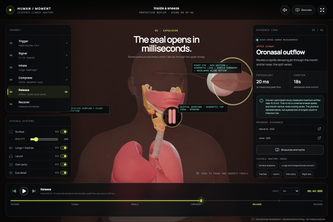
Tagline: Step inside a sneeze: a source-linked 3D anatomy atlas built from aligned NIH models, with a deterministic six-stage journey, evidence confidence.
Author's Claim: A 3D interactive experience of a sneeze, built for educational or exploratory purposes using open-source anatomical data and modern web technologies.
The description states that Sneeze is an interactive 3D anatomy experience focused on the mechanics of a sneeze, using NIH Human Reference Atlas models. It is described as a single-developer project built with React and WebGL-based libraries, submitted to a hackathon. No revenue, customers, or traction are evidenced.
What Changed: The author describes a personal curiosity-driven project that evolved into an interactive 3D visualization tool. There is no evidence of prior version, product evolution, or commercial activity beyond the hackathon submission.
Single Most Important Open Question: Is there any indication of commercial intent, user adoption, or monetization strategy beyond the initial prototype?
What The Product Actually Is
The description states that Sneeze is a source-linked 3D anatomy experience focused on a six-stage sneeze process, including:
- Trigger
- Neural signal
- Inspiration
- Compression
- Release
- Recovery
It allows users to:
- Play a slowed 72-second sequence
- Scrub through time
- Jump between stages
- Orbit the anatomy
- Isolate body systems
- Adjust skin opacity
- Inspect source claims
The experience uses NIH Human Reference Atlas geometry for body surface, lungs, trachea, larynx, mouth, and eye. The description notes that neural signals, pressure, diaphragm motion, eyelid closure, and airflow are labeled as explanatory schematics, not "fake 'perfectly measured' animation."
Technology Stack: React, TypeScript, Vite, Three.js, React Three Fiber, Drei, Meshopt for model compression.
Inference: The product is a prototype or proof-of-concept, built in a hackathon context. It is not described as a commercial product or platform with ongoing development or user base.
Positioning & Claim Evolution
The author states that the project was inspired by a personal curiosity: “I sneezed and wondered how it worked.” The positioning is educational and exploratory, aiming to make the mechanics of a sneeze tangible through an interactive 3D experience.
There is no evidence of prior positioning or evolution in claims. The project is described as a single-developer hackathon submission with no indication of market research, branding, or strategic direction beyond its initial form.
Inference: The product is positioned as a curiosity-driven educational tool, not a commercial offering. It does not appear to have evolved from an earlier version or business model.
Target Customer & ICP
The description does not state any specific target customer or ideal customer profile (ICP). It is described as a personal curiosity project with no evidence of user personas, market segmentation, or audience targeting.
Inference: The product may appeal to:
- Medical students
- Educators
- Curious individuals
- Developers interested in 3D visualization
However, these are speculative inferences. No evidence supports any defined customer segment or commercial targeting.
Business Model & Pricing Evidence
There is no evidence of a business model or pricing strategy. The project is described as a hackathon submission, and no revenue streams, monetization plans, or pricing information are provided.
Inference: The product appears to be non-commercial at this stage. It is not evident whether the author intends to commercialize it or if it has any monetization plan.
Technical & Delivery Signals
The project is built with:
- React
- TypeScript
- Vite
- Three.js
- React Three Fiber
- Drei
- Meshopt for model compression
It uses NIH Human Reference Atlas geometry and is described as a browser-based 3D experience, likely delivered via WebGL.
Inference: The technical stack suggests a modern, web-native approach to 3D visualization. The use of open-source anatomical models and compression techniques indicates attention to performance and accessibility.
Traction & Maturity Signals
The project is described as a single-developer hackathon submission, with no evidence of:
- Revenue
- Customers
- User engagement
- Product iteration
- Market traction
The author states, “Not much, I already sneezed,” suggesting limited follow-up or development.
Inference: The product is at an early prototype stage, with no signs of maturity or traction. It is not evident that it has been used beyond its initial build.
Competitive Context
There is no evidence of competitors or market context in the description. No mention of similar tools, platforms, or products in the 3D anatomy or educational space is provided.
Inference: The project appears to be unique within its own scope, but there is no indication of a competitive landscape or prior market presence.
Open Questions & Risks
- No commercial intent or traction — the product is described as a hackathon submission with no evidence of monetization or user adoption.
- Single developer — limited capacity for scaling, iteration, or long-term development.
- No business model — unclear how this would be monetized if at all.
- Unproven market demand — no indication of target audience or use case beyond personal curiosity.
Questions the description leaves open
- What is the intended use case for Sneeze beyond a prototype?
- Are there any plans to expand beyond the sneeze model into other anatomical systems or processes?
- Is there any interest in partnering with educational institutions or medical organizations?
- How would you monetize this product if at all?
- What is the long-term vision for Sneeze, and how does it differ from existing 3D anatomy tools?
Overall Assessment
Not evidenced — There is no evidence of commercial traction, revenue, or a clear path to monetization. The project is described as a single-developer hackathon submission, with no indication of a business model, target market, or user base.
Confidence Level: Low
Inference: This is a conceptual prototype with no demonstrated commercial viability or strategic direction. It may be an interesting curiosity but does not appear to be a viable investment or partnership opportunity at this stage.
User Stories BotA demo video on every pull request
Get a demo video on every new feature
GitHub App that watches your pull requests and records a narrated, captioned demo.
Save time on demo prep and make informed decisions faster with a video walkthrough of every new feature.
Source
Submitted to the OpenAI 2026 hackathon on Devpost. Project home on Devpost. Back to the full gallery on Devpost.
This competitive analysis was produced by top-founders.com (opens in a new tab)
Generated by a language model from this project's public Devpost page — its tagline, the author's own write-up and any built-with tags listed there — as captured in August 2026. Short quotations are the author's words. It is an opinion on the idea as a business, not on the people behind it, and it reflects the description as published then. If the project has moved on, request a correction below. The analysis is not independent research and contains no verified traction, revenue or customer data.
An independent guide by KFG International LLC — not affiliated with, endorsed by, or connected to Devpost or OpenAI.