

Archive position — measured, not model output
0 likes on Devpost
2,263 of the 7,850 archived projects have more likes, and 5,587 share exactly 0 — so this project's #6,789 place in the like-ranked listing is a tie-break inside that group, not a ranking.
Projects (log scale)
Likes on Devpost. ▲ marks this project's group.
Show the figures
| Likes | Projects | Share of archive |
|---|---|---|
| 0 | 5,587 | 71.2% |
| 1 | 1,758 | 22.4% |
| 2 | 284 | 3.6% |
| 3–4 | 132 | 1.7% |
| 5–9 | 75 | 1.0% |
| 10+ | 14 | 0.2% |
 User Stories BotA demo video on every pull request
Get a demo video on every new feature
GitHub App that watches your pull requests and records a narrated, captioned demo.
Save time on demo prep and make informed decisions faster with a video walkthrough of every new feature.
Executive Summary
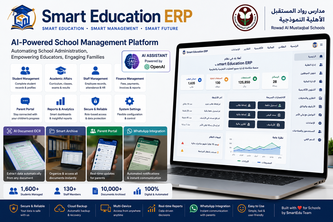
The company appears to be a single-person project submitted to the OpenAI 2026 hackathon. The author describes SmartEdu ERP as an AI-powered school management platform integrating student, employee, finance, and communication functions into one desktop system. The platform uses AI for identity document processing and includes features like WhatsApp notifications and digital archiving.
What changed
This is a hackathon submission with no evidence of prior development or commercial traction. It represents an initial concept rather than a developed product.
The single most important open question
Is this a prototype that will evolve into a commercial product, or a one-off hackathon project with no further development intent?
What The Product Actually Is
The description states: "SmartEdu ERP is an AI-powered school management platform designed to simplify and modernize educational administration."
The author describes it as:
- A desktop ERP system
- Integrated platform combining student management, employee management, finance, digital archiving, parent communication, reporting, and intelligent document processing
- Built with Python, PyQt6, PostgreSQL, OpenAI APIs, OCR, and WhatsApp integration
Inference The product is described as a desktop application using AI for identity document processing, but there's no evidence of cloud deployment or web-based access.
Positioning & Claim Evolution
The author states: "Many schools still depend on paper-based workflows and disconnected software. Our goal was to build one intelligent platform that connects every department and improves efficiency."
Claim
The product positions itself as a unifying solution for school administration, addressing inefficiencies in traditional systems.
Inference The positioning evolved from a hackathon idea to a potential commercial offering, but there's no evidence of market validation or customer feedback.
Target Customer & ICP
The description states: "SmartEdu ERP – AI-Powered School Management Platform" and "designed to simplify and modernize educational administration."
Claim
The primary customers are schools seeking to digitize their operations.
Inference No specific school size, type, or geographic focus is mentioned. The ICP appears to be educational institutions generally, but no segmentation is evident.
Business Model & Pricing Evidence
The description does not state any pricing model, revenue streams, or business model details.
Not evidenced No information about monetization strategy, subscription tiers, per-user costs, or licensing arrangements.
Technical & Delivery Signals
The author states: "The platform was developed as a desktop ERP system with modern technologies and AI integration."
Built with:
- Technologies: Python, PyQt6, PostgreSQL, OpenAI APIs, OCR
- Integration points: WhatsApp, QR codes, REST APIs
- AI use case: Identity document processing with human review workflow
Inference The technical stack suggests a desktop application with AI components. No evidence of cloud infrastructure or scalable deployment.
Traction & Maturity Signals
The description states: "This project was submitted to the OpenAI 2026 hackathon on Devpost."
Not evidenced No revenue, customer adoption, usage metrics, or product maturity indicators beyond a hackathon submission.
Competitive Context
The description does not mention any competitors or market positioning relative to existing school management platforms.
Not evidenced No competitive analysis, market share claims, or differentiation from other solutions.
Open Questions & Risks
- Single-person team: The project is described as built by one person (Ahmad Diyan), raising questions about scalability and execution capability.
- Hackathon origin: This is a hackathon submission with no evidence of prior development or commercial traction.
- Desktop-only approach: No mention of cloud deployment or web-based access, which may limit adoption in modern educational environments.
- AI integration scope: AI is used for document processing but remains under human control; unclear if this limits scalability or automation potential.
Questions the description leaves open
- What specific problems in school administration are you solving that existing tools don't?
- How do you plan to scale from a single-person hackathon project to a commercial product?
- Are there any schools or educational institutions interested in testing or purchasing this platform?
- What is your roadmap for moving from desktop to cloud-based deployment?
- How will you monetize the platform, and what pricing model are you considering?
Overall Assessment
Not evidenced No financials, traction data, or commercial viability indicators are provided.
Inference This appears to be a hackathon prototype with no demonstrated market need, revenue, or customer base. The single-founder status and lack of evidence for product-market fit raise significant concerns about its potential as an investment or partnership opportunity at this stage.
User Stories BotA demo video on every pull request
Get a demo video on every new feature
GitHub App that watches your pull requests and records a narrated, captioned demo.
Save time on demo prep and make informed decisions faster with a video walkthrough of every new feature.
Source
Submitted to the OpenAI 2026 hackathon on Devpost. Project home on Devpost. Back to the full gallery on Devpost.
This competitive analysis was produced by top-founders.com (opens in a new tab)
Generated by a language model from this project's public Devpost page — its tagline, the author's own write-up and any built-with tags listed there — as captured in August 2026. Short quotations are the author's words. It is an opinion on the idea as a business, not on the people behind it, and it reflects the description as published then. If the project has moved on, request a correction below. The analysis is not independent research and contains no verified traction, revenue or customer data.
An independent guide by KFG International LLC — not affiliated with, endorsed by, or connected to Devpost or OpenAI.