

Archive position — measured, not model output
1 like on Devpost
505 of the 7,850 archived projects have more likes, and 1,758 share exactly 1 — so this project's #902 place in the like-ranked listing is a tie-break inside that group, not a ranking.
Projects (log scale)
Likes on Devpost. ▲ marks this project's group.
Show the figures
| Likes | Projects | Share of archive |
|---|---|---|
| 0 | 5,587 | 71.2% |
| 1 | 1,758 | 22.4% |
| 2 | 284 | 3.6% |
| 3–4 | 132 | 1.7% |
| 5–9 | 75 | 1.0% |
| 10+ | 14 | 0.2% |
 User Stories BotA demo video on every pull request
Get a demo video on every new feature
GitHub App that watches your pull requests and records a narrated, captioned demo.
Save time on demo prep and make informed decisions faster with a video walkthrough of every new feature.
Executive Summary
Company: CrewOS
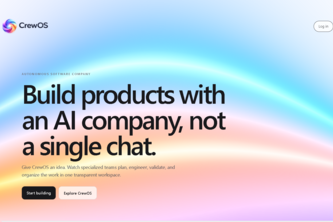
Self-reported purpose: An AI Company as a Service platform that uses autonomous AI departments to transform a single prompt into a production-ready software project through collaborative AI.
What changed: The author describes CrewOS as an event-driven, multi-agent system designed to simulate an AI organization rather than a single assistant. It is positioned as a platform for building software using AI departments that collaborate in real time, with shared memory and transparent workflows.
Single most important open question: Is there evidence of any actual development or usage beyond the author's own account?
This analysis is based entirely on the self-reported description provided by the author. No external verification, traction data, revenue figures, or customer information are available.
What The Product Actually Is
The description states that CrewOS is an autonomous AI software company built as a modular AI Operating System. It simulates a real-world software organization with specialized departments (CEO, Project Manager, Engineering, QA) working together through:
- An event-driven multi-agent runtime
- Shared organizational memory
- Autonomous agent registry
- AI reasoning engine
- Live collaboration layer
- Project planning engine
- Engineering workflow
- Quality assurance pipeline
- Mission Control dashboard
It is described as a system where users enter a single prompt (e.g., “Build me a Netflix-style streaming platform”) and the platform automatically forms an AI organization to execute that idea from planning to engineering and QA.
Inference: The product appears to be a conceptual or prototype system, not yet a commercial offering. It is described as built for the OpenAI 2026 hackathon, suggesting it may be early-stage or experimental.
Positioning & Claim Evolution
The author positions CrewOS as a platform that transforms prompts into full software projects by simulating an AI company with departments working in coordination.
Key claims:
- “We believe the next generation of AI applications will be organizations rather than assistants.”
- “Instead of talking to one AI assistant, you hired an entire AI software company.”
- The platform is designed to automate the entire software development lifecycle—not just code generation.
- It aims to replace coordination problems in software development, not just individual tasks.
The positioning evolves from a single-use prompt tool to a multi-agent system for autonomous AI organizations, with potential applications beyond software (e.g., healthcare, finance, marketing).
Inference: The author is making a strong strategic claim about the future of AI tools, but no evidence of actual adoption or commercial traction exists.
Target Customer & ICP
The description states that startup founders are the primary users who don’t just need an AI that writes code—they need product strategy, planning, architecture, engineering, QA, and collaboration across disciplines.
It also implies a broader audience:
- Users who want to automate complex software projects
- Teams or individuals who want to reduce coordination burden in development
Inference: The ICP is likely early-stage developers, startups, or product teams looking for AI-driven project orchestration. However, no evidence of actual customer base or user personas is provided.
Business Model & Pricing Evidence
The description does not state anything about:
- Revenue model
- Pricing structure
- Monetization strategy
- Customer acquisition or retention plans
Not evidenced: No information on how the product would be sold or who pays for it.
Technical & Delivery Signals
The author states that CrewOS was built using:
- Technologies: axios, codex, css, docker, fastapi, git, gpt-5.6, jwt, mongodb, motor, openai, pydantic, pytest, python, query, react, redis, tailwind, tanstack, typescript, vite, vitest, websockets, zustand
- Architecture: Event-driven multi-agent runtime, shared memory, autonomous agents, reasoning engine, live collaboration layer, mission control dashboard
Inference: The system is built with modern development stack and appears to be a prototype or proof-of-concept. No evidence of production deployment or scalability.
Traction & Maturity Signals
The description states:
- This project was submitted to the OpenAI 2026 hackathon
- It is described as a modular AI Operating System built for an experimental use case
- The author mentions challenges in building it, such as shared memory, agent coordination, and real-time collaboration
Not evidenced: No evidence of:
- Revenue or monetization
- Customers or user adoption
- Product-market fit
- Real-world usage or testing
- Production deployment or scalability
Competitive Context
The description does not mention any competitors. It is self-contained in its own narrative, without reference to existing tools or platforms that might do similar things.
Not evidenced: No competitive analysis, market positioning, or comparison with other AI development tools or platforms.
Open Questions & Risks
- No evidence of traction or adoption: The project is described as a hackathon submission with no commercial or user data.
- Unproven concept: The idea of autonomous AI departments working in real-time is conceptual and not demonstrated in practice.
- Unclear business model: No information on how the product would be monetized or sold.
- Self-reported only: Everything is based on author’s own account, with no external validation.
- No production-ready evidence: The system appears to be a prototype or experimental architecture.
Questions the description leaves open
- What specific problem are you solving that existing AI tools don’t?
- Have you tested this concept with any real users or teams?
- How do you plan to scale the event-driven runtime for larger projects?
- What is your roadmap for monetization and product development beyond the hackathon?
- Can you demonstrate a working prototype or alpha version of the system?
Overall Assessment
Not evidenced: No data on financials, traction, or commercial viability.
Inference: This appears to be an experimental or conceptual project submitted for a hackathon. It is not yet a product with demonstrated market demand or revenue potential. The author’s claims about AI organizations and autonomous departments are ambitious but unproven in practice.
Confidence level: Low — based entirely on self-reported narrative, no external validation or evidence of traction.
User Stories BotA demo video on every pull request
Get a demo video on every new feature
GitHub App that watches your pull requests and records a narrated, captioned demo.
Save time on demo prep and make informed decisions faster with a video walkthrough of every new feature.
Source
Submitted to the OpenAI 2026 hackathon on Devpost. Project home on Devpost. Back to the full gallery on Devpost.
This competitive analysis was produced by top-founders.com (opens in a new tab)
Generated by a language model from this project's public Devpost page — its tagline, the author's own write-up and any built-with tags listed there — as captured in August 2026. Short quotations are the author's words. It is an opinion on the idea as a business, not on the people behind it, and it reflects the description as published then. If the project has moved on, request a correction below. The analysis is not independent research and contains no verified traction, revenue or customer data.
An independent guide by KFG International LLC — not affiliated with, endorsed by, or connected to Devpost or OpenAI.