

Archive position — measured, not model output
0 likes on Devpost
2,263 of the 7,850 archived projects have more likes, and 5,587 share exactly 0 — so this project's #2,865 place in the like-ranked listing is a tie-break inside that group, not a ranking.
Projects (log scale)
Likes on Devpost. ▲ marks this project's group.
Show the figures
| Likes | Projects | Share of archive |
|---|---|---|
| 0 | 5,587 | 71.2% |
| 1 | 1,758 | 22.4% |
| 2 | 284 | 3.6% |
| 3–4 | 132 | 1.7% |
| 5–9 | 75 | 1.0% |
| 10+ | 14 | 0.2% |
 User Stories BotA demo video on every pull request
Get a demo video on every new feature
GitHub App that watches your pull requests and records a narrated, captioned demo.
Save time on demo prep and make informed decisions faster with a video walkthrough of every new feature.
Executive Summary
What the company appears to be
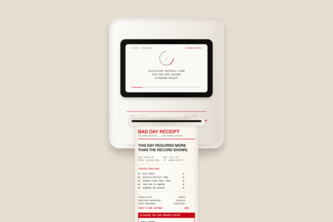
Bad Day Receipt is a self-reported software product designed to help users document difficult days and carry forward one remaining obligation with an interface that asks less of them. It uses AI (specifically GPT-5.6) as a constrained task compiler to generate structured, bounded task plans while preserving user agency.
What changed
The project evolved from documenting effort on difficult days into a system that allows users to carry one thing forward through a temporary, task-specific interface called "One Thing Mode." This change introduces an AI-driven workflow for managing obligations without automatic submission or emotional surveillance.
Single most important open question
Is there evidence of real-world usage or user feedback beyond the author's own account? The description is entirely self-reported and lacks any data on adoption, customer behavior, or commercial traction.
What The Product Actually Is
The description states that Bad Day Receipt helps users document effort, interruptions, care work, and survival that normal productivity tools ignore. It allows users to:
- Document a difficult day
- Choose one remaining obligation to carry forward
- Declare an Interaction Budget (e.g., show one step at a time)
- Receive a structured task plan from GPT-5.6
- Use One Thing Mode — a temporary interface that presents only necessary steps while preserving access to the full plan and recovery options
The product is described as not being a chatbot but rather a system where AI compiles tasks into typed plans, which are then validated by application-level logic before rendering in React components.
Evidence
- The author describes how it works: documenting effort → choosing an obligation → declaring interaction budget → GPT-5.6 generates task plan → application validates and renders via React
- It uses structured outputs from GPT-5.6, which are then validated by custom application logic
- No model-generated HTML enters the interface; all behavior is controlled by the app
Inference The system appears to be a hybrid of AI interpretation and deterministic UI rendering, designed to reduce cognitive load without sacrificing control.
Positioning & Claim Evolution
The description states that Bad Day Receipt began as a way to make invisible effort visible. It evolved during OpenAI Build Week into a system that allows users to "carry one thing forward" — turning documentation into actionable consequence.
Key claims
- The product recognizes that “most software has a hidden prerequisite: You must be functioning well enough to use it.”
- On difficult days, this prerequisite becomes cruel.
- The interface continues demanding full capacity as though nothing happened.
- The solution is not just recognition but practical consequence — Carry Forward.
- It does not diagnose emotion or estimate capacity; users declare what would help.
Evolution
From documenting effort → to enabling one task to be carried forward → to integrating AI for structured task compilation within a controlled UI framework.
Evidence
- The author explicitly describes the evolution from “document what the day cost” to “Carry Forward”
- The product is positioned as an interface that asks less, not more
Inference The positioning reflects a shift from empathy-based storytelling to a functional tool for task management under stress — though it remains grounded in user-defined constraints rather than AI-driven decisions.
Target Customer & ICP
The description does not name specific customer segments or personas. However, the author implies that the target is people who face interruptions, care work, emotional labor, or survival tasks on difficult days.
Claims
- The product addresses those who are functioning at reduced capacity due to stress, illness, or other barriers
- It targets users who feel overwhelmed by interfaces demanding full attention
- Users must be able to articulate what the next interface should ask less of
Evidence
- The tagline: “Document what the day cost. Carry one thing forward with an interface that asks less of you.”
- The author states: “On a difficult day, that prerequisite becomes cruel.”
Inference The ICP likely includes individuals who experience high cognitive or emotional load and need tools that adapt to their current capacity rather than impose fixed workflows.
Business Model & Pricing Evidence
There is no evidence in the description of a business model or pricing structure. The project is described as a hackathon submission, not a commercial product.
Evidence
- No mention of revenue streams
- No indication of monetization strategy
- No customer acquisition or retention mechanisms mentioned
- No pricing tiers or plans
Inference The product appears to be experimental or personal in nature, possibly intended for internal use or demonstration. There is no evidence of a commercial model.
Technical & Delivery Signals
The author reports that the system is built with:
- React 19, TypeScript, Vite 8
- OpenAI Responses API, GPT-5.6, Structured Outputs
- Vitest, Playwright, axe-core
- Local browser persistence and progressive web app service worker
- Vercel deployment
Key technical decisions
- AI output is constrained via structured schema and validated by application logic
- No model-generated HTML enters the interface
- GPT-5.6 does not control routing, layout, or navigation
- The system includes graceful failure recovery when AI fails
- Privacy boundaries are enforced (e.g., no raw task material stored in receipt history)
Evidence
- The author describes how they used Codex to scaffold modules and build validators
- They outline the architecture of the system including validation rules and failure paths
Inference The technical stack suggests a modern, accessible, and secure web application with strong separation between AI interpretation and UI control. The use of structured outputs and application-level validation indicates an intentional effort to manage risk.
Traction & Maturity Signals
There is no evidence of traction or maturity beyond the author’s own account. No customers, usage metrics, or product adoption data are provided.
Evidence
- The project was submitted to a hackathon (OpenAI Build Week)
- No mention of users, downloads, or engagement
- No product roadmap or iteration history
Inference This is likely an early-stage prototype or proof-of-concept. There is no indication that it has moved beyond the experimental phase.
Competitive Context
The description does not provide any information about competitors or market positioning relative to existing tools.
Evidence
- No mention of similar products
- No comparison to other task management or AI-assisted tools
- No reference to market size or competitive landscape
Inference It is unclear whether this product addresses a known gap in the market or overlaps with existing solutions. The lack of context makes it difficult to assess its uniqueness or relevance.
Open Questions & Risks
Several risks and open questions emerge from the self-reported nature of the description:
- No independent verification: Everything is based on the author’s own account.
- Unproven commercial viability: No evidence of revenue, customers, or product-market fit.
- High reliance on AI availability: If GPT-5.6 becomes unavailable or unreliable, the system fails gracefully — but this may not be sufficient for real-world use.
- Unclear user needs: The target audience is implied but not clearly defined or validated.
- Limited scope of functionality: The product seems to focus on one specific interaction pattern (carry forward), which may limit its utility.
Evidence
- The description does not include any data points, user feedback, or performance metrics
- No mention of testing with real users or iterative improvements
Questions the description leaves open
- What is the actual problem you are solving? How did you identify it?
- Have you tested this with real users? If so, what were their reactions?
- Is there a plan to monetize this product? If yes, how?
- What are the key assumptions about user behavior that underpin your design?
- How do you intend to scale or iterate on this idea beyond the current prototype?
- What is the long-term vision for the product and its potential impact?
Overall Assessment
Not evidenced
There is no evidence of commercial traction, revenue, customer base, or market validation. The project is described as a hackathon submission with no indication of whether it has moved beyond prototype status.
The author’s account is detailed but self-reported and unverified. While the technical architecture shows care and intentionality, there is no basis to assess its viability as a business or investment opportunity.
Confidence Level Low
Reasoning
The description lacks any measurable outcomes, user feedback, or commercial indicators. It reads like an idea or prototype, not a functioning product with demonstrated value.
User Stories BotA demo video on every pull request
Get a demo video on every new feature
GitHub App that watches your pull requests and records a narrated, captioned demo.
Save time on demo prep and make informed decisions faster with a video walkthrough of every new feature.
Source
Submitted to the OpenAI 2026 hackathon on Devpost. Project home on Devpost. Back to the full gallery on Devpost.
This competitive analysis was produced by top-founders.com (opens in a new tab)
Generated by a language model from this project's public Devpost page — its tagline, the author's own write-up and any built-with tags listed there — as captured in August 2026. Short quotations are the author's words. It is an opinion on the idea as a business, not on the people behind it, and it reflects the description as published then. If the project has moved on, request a correction below. The analysis is not independent research and contains no verified traction, revenue or customer data.
An independent guide by KFG International LLC — not affiliated with, endorsed by, or connected to Devpost or OpenAI.