

Archive position — measured, not model output
1 like on Devpost
505 of the 7,850 archived projects have more likes, and 1,758 share exactly 1 — so this project's #1,950 place in the like-ranked listing is a tie-break inside that group, not a ranking.
Projects (log scale)
Likes on Devpost. ▲ marks this project's group.
Show the figures
| Likes | Projects | Share of archive |
|---|---|---|
| 0 | 5,587 | 71.2% |
| 1 | 1,758 | 22.4% |
| 2 | 284 | 3.6% |
| 3–4 | 132 | 1.7% |
| 5–9 | 75 | 1.0% |
| 10+ | 14 | 0.2% |
 User Stories BotA demo video on every pull request
Get a demo video on every new feature
GitHub App that watches your pull requests and records a narrated, captioned demo.
Save time on demo prep and make informed decisions faster with a video walkthrough of every new feature.
Executive Summary
What the company appears to be: A self-reported AI-powered marketing decision system that adds a governance layer to analytical recommendations, distinguishing between evidence-based observations and policy-bound actions.
What changed: The project evolved from an existing analytical agent into a new "Campaign IC" governance module that evaluates what evidence supports claims, identifies unsupported assumptions, and enforces organizational policy limits before allowing action.
Single most important open question: Does the system actually enforce policy boundaries in practice, or is it a demonstration of capability with no real-world operational use?
What The Product Actually Is
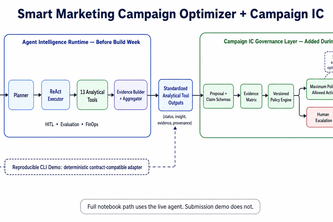
The description states that Smart Marketing Campaign Optimizer is an AI agent for marketing analytics that includes:
- A Planner for intent classification and task contracts
- A ReAct Executor
- 13 specialized marketing analytics tools
- SQLite-based campaign data
- Standardized tool outputs using {status, insight, evidence, provenance}
- Evidence-grounded response generation
- Human-in-the-loop escalation rules
- Session-level cost controls
During OpenAI Build Week, the author added Campaign IC as a governance boundary that:
- Evaluates four questions: supported evidence, unsupported claims, policy permissions, and human judgment requirements
- Identifies when a recommendation exceeds risk thresholds
- Generates limited action envelopes instead of full rollouts
- Produces structured audit records and decision memos
The system is built in Python using tools like Codex with GPT-5.6, LangGraph, Pydantic, Jupyter, and SQLite.
Confidence: Low — this is a self-reported technical architecture without evidence of implementation or operational use.
Positioning & Claim Evolution
The author states that the system helps marketing teams move from raw campaign data to "governed, auditable decisions."
It was inspired by the problem of AI agents generating recommendations without sufficient evidence for immediate action. The original agent could analyze performance and recommend budget changes, but Campaign IC adds a governance layer to determine what an AI recommendation is actually allowed to do.
The system is positioned as:
- Evidence-aware
- Policy-bounded
- Human-approved
- Audit-trail complete
It evolved from a basic analytical agent into a system that answers not just "what should we do?" but also "what does the evidence justify, what does policy allow, and who is authorized to decide?"
Confidence: Low — claims are self-reported and unverified. No third-party validation or customer feedback.
Target Customer & ICP
The description states that the system targets marketing teams using AI agents for performance analysis and budget allocation.
It is designed for organizations that:
- Use AI agents for campaign analytics
- Want to govern AI-generated recommendations
- Require audit trails and human approval for major changes
- Operate within defined risk and policy boundaries
Confidence: Low — no evidence of actual customers, use cases, or market validation.
Business Model & Pricing Evidence
Not evidenced. The description does not mention any pricing model, revenue streams, or commercialization plans.
Confidence: None — no business model or pricing information provided.
Technical & Delivery Signals
The system is built in Python and uses:
- Codex with GPT-5.6
- LangGraph
- Pydantic
- Jupyter
- SQLite
- OpenAI APIs
- SQL queries
- Test-driven development (pytest)
- Standardized tool outputs with {status, insight, evidence, provenance}
It includes:
- Proposal and claim normalization
- Evidence Matrix construction
- Evidence-sufficiency checks
- Unsupported-claim detection
- Versioned policy evaluation
- Materiality and risk-threshold gates
- Action-envelope generation
- Human-input requirements
- Structured IC memo generation
- Machine-readable audit records
A deterministic local adapter is included for reproducibility.
Confidence: Medium — technical details are provided, but no evidence of production deployment or scalability.
Traction & Maturity Signals
Not evidenced. The description does not mention any customers, revenue, usage metrics, or adoption data.
The system has a 60-case evaluation framework and 13 governance tests that all pass, but these are internal validation mechanisms, not external traction.
Confidence: None — no evidence of real-world use or impact.
Competitive Context
Not evidenced. The description does not mention competitors, market positioning, or competitive landscape.
Confidence: None — no competitive analysis or market context provided.
Open Questions & Risks
- Unproven operational use: The system is described as a demonstration and local adapter, with no evidence of real-world deployment.
- Self-reported capability: All claims are self-reported without independent verification.
- No commercialization path: No pricing, revenue, or customer data provided.
- Limited scope: The system appears to be a proof-of-concept for one specific use case (marketing budgeting), with no indication of broader applicability.
- Dependency on AI tools: Heavy reliance on Codex and GPT-5.6 may limit scalability or reproducibility outside the author’s environment.
Confidence: Medium — risks are inferred from lack of evidence, not direct observation.
Questions the description leaves open
- What is the actual policy framework that governs decision-making in your system? Is it configurable by organizations?
- How does the system handle edge cases where policy and evidence conflict?
- Has Campaign IC been tested with real-world data or live campaign platforms?
- What are the limitations of the current governance layer in terms of scalability or integration with existing tools?
- Can you demonstrate how the system enforces human judgment requirements in practice, not just in theory?
- How does the system handle versioning and updates to organizational policies?
- Are there any known issues with the deterministic local adapter when used in production?
Overall Assessment
Not evidenced. No information is provided about funding, valuation, or investment interest.
Confidence: None — no commercial or financial data available beyond self-reporting.
User Stories BotA demo video on every pull request
Get a demo video on every new feature
GitHub App that watches your pull requests and records a narrated, captioned demo.
Save time on demo prep and make informed decisions faster with a video walkthrough of every new feature.
Source
Submitted to the OpenAI 2026 hackathon on Devpost. Project home on Devpost. Back to the full gallery on Devpost.
This competitive analysis was produced by top-founders.com (opens in a new tab)
Generated by a language model from this project's public Devpost page — its tagline, the author's own write-up and any built-with tags listed there — as captured in August 2026. Short quotations are the author's words. It is an opinion on the idea as a business, not on the people behind it, and it reflects the description as published then. If the project has moved on, request a correction below. The analysis is not independent research and contains no verified traction, revenue or customer data.
An independent guide by KFG International LLC — not affiliated with, endorsed by, or connected to Devpost or OpenAI.