

Archive position — measured, not model output
0 likes on Devpost
2,263 of the 7,850 archived projects have more likes, and 5,587 share exactly 0 — so this project's #5,876 place in the like-ranked listing is a tie-break inside that group, not a ranking.
Projects (log scale)
Likes on Devpost. ▲ marks this project's group.
Show the figures
| Likes | Projects | Share of archive |
|---|---|---|
| 0 | 5,587 | 71.2% |
| 1 | 1,758 | 22.4% |
| 2 | 284 | 3.6% |
| 3–4 | 132 | 1.7% |
| 5–9 | 75 | 1.0% |
| 10+ | 14 | 0.2% |
 User Stories BotA demo video on every pull request
Get a demo video on every new feature
GitHub App that watches your pull requests and records a narrated, captioned demo.
Save time on demo prep and make informed decisions faster with a video walkthrough of every new feature.
Executive Summary
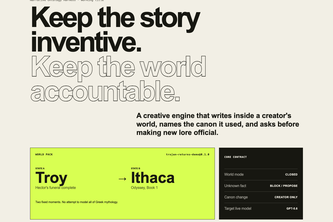
What the company appears to be: Penelope Ontology is a self-reported narrative simulation tool for creators working within bounded, canonical worlds. It allows users to load a "World Pack" (a structured JSON definition of a fictional world), make decisions, and see causal consequences within that world's logic. The system is described as a "story engine" with a focus on creator control over narrative direction while maintaining plausibility and consistency through deterministic validation.
What changed: The project description indicates development of a tool that simulates narrative causality using structured world definitions, with an emphasis on traceability, creator ownership, and bounded decision-making. It was submitted to the OpenAI 2026 hackathon.
Single most important open question: Is there evidence of real-world usage or traction beyond the author's own demonstration? The description contains no data about revenue, customers, adoption, or product-market fit — only self-reported claims about functionality and design.
What The Product Actually Is
The description states that Penelope Ontology is a portable, creator-governed causal story simulator. It operates from a "sealed, versioned World Pack" and allows creators to load a bounded world, change a decision, and observe the effects through character knowledge, motives, reactions, and consequences.
Key elements:
- The system uses World Packs — structured JSON definitions of fictional worlds.
- It distinguishes between A/B alternatives, C (creator-defined), and canonical execution.
- It includes tools like:
- The Loom: shows world processing of actions.
- World Aftermath: exposes only consequences recorded by causal receipts.
- World Codex: gathers dramatic questions, character desires, relationship history, event chains, etc.
- Fork Compare: contrasts completed branches from shared checkpoints.
- It supports imported schema-valid JSON (up to 262KB) and ships with two public packs: The Odyssey, Book 19 and The Wonderful Wizard of Oz, Chapter XV.
- The system is described as not a TRPG rules engine, nor an unlimited next-paragraph generator.
Inference: The tool appears to be a simulation framework for narrative design, not a text generation or AI writing assistant. It emphasizes deterministic world logic over open-ended prose generation.
Positioning & Claim Evolution
The description states that Penelope Ontology is:
- A story engine
- Designed for narrative designers, quest teams, professional game masters, and writers
- Focused on keeping creators in charge while controlling world logic and consequences
- Not a TRPG rules engine, unlimited next-paragraph generator, or long-running agent society
Inference: The positioning is that of a narrative simulation tool for creative professionals, not an AI writing assistant or general-purpose storytelling platform. It positions itself as a structured, deterministic narrative engine with a focus on world consistency and traceability.
Target Customer & ICP
The description states the target users are:
- Narrative designers
- Quest teams
- Professional game masters
- Writers working inside a bounded canon
Inference: The tool is aimed at creative professionals who work within fixed fictional worlds, such as tabletop RPGs, game design, or narrative-driven writing. It is not positioned for general audiences or casual users.
Business Model & Pricing Evidence
Not evidenced.
The description does not mention:
- Any pricing model
- Revenue streams
- Monetization strategy
- Customer acquisition plans
- Subscription tiers or usage-based billing
Inference: No business model or pricing information is provided in the self-reported description.
Technical & Delivery Signals
The description states that the tool was built with:
- Codex
- Typescript, Next.js, React, Zod, Vitest, Playwright, GitHub Actions
It also mentions:
- Use of GPT-5.6 (via Codex CLI) for structured scene candidates
- Deterministic validation via validators, schemas, and causal ledgers
- Local self-hosted copy recommended for sensitive IP
- Demo is hosted but not a confidential manuscript store
Inference: The tool uses modern web stack and AI integration (via Codex), with an emphasis on deterministic behavior, traceability, and validation. It is described as a self-contained simulation engine, not a text generation service.
Traction & Maturity Signals
Not evidenced.
The description does not contain:
- Any data about users or customers
- Revenue or ARR
- Product adoption metrics
- Growth trends
- Customer testimonials or case studies
Inference: There is no evidence of traction, adoption, or maturity beyond the author’s own demonstration and development work.
Competitive Context
Not evidenced.
The description does not:
- Name competitors
- Describe competitive advantages
- Compare to existing tools in the space
- Discuss market size or positioning
Inference: No competitive context is provided. The tool appears to be positioned in a niche space — narrative simulation within bounded worlds — but no reference to similar products is made.
Open Questions & Risks
- No traction or revenue evidence: The description contains no data on adoption, customers, or monetization.
- Self-reported only: All claims are unverified and based on the author’s own account.
- Unclear commercial viability: No pricing, business model, or customer base is described.
- Limited use case scope: The tool appears to be for a narrow set of creative professionals working within fixed fictional worlds.
- No external validation: No third-party reviews, user feedback, or independent verification.
Inference: The project is in early development and lacks commercial evidence. It may not yet have a viable path to market or monetization.
Questions the description leaves open
- What is the intended business model for Penelope Ontology?
- Are there any real-world users or customers currently using the tool?
- How does the tool differentiate from existing narrative design tools or TRPG systems?
- What are the technical limitations of the current implementation, and how might they scale?
- Is there a plan to expand beyond the current two public World Packs?
- What is the long-term vision for monetization and product development?
Overall Assessment
Not evidenced.
The description does not contain:
- Valuation or funding information
- Investor interest or partnership discussions
- Strategic fit or market opportunity data
- Exit potential or scalability assumptions
Inference: There is no evidence to support a conclusion on investment or partnership viability. The project appears to be an early-stage prototype with no commercial traction or clear path to monetization.
User Stories BotA demo video on every pull request
Get a demo video on every new feature
GitHub App that watches your pull requests and records a narrated, captioned demo.
Save time on demo prep and make informed decisions faster with a video walkthrough of every new feature.
Source
Submitted to the OpenAI 2026 hackathon on Devpost. Project home on Devpost. Back to the full gallery on Devpost.
This competitive analysis was produced by top-founders.com (opens in a new tab)
Generated by a language model from this project's public Devpost page — its tagline, the author's own write-up and any built-with tags listed there — as captured in August 2026. Short quotations are the author's words. It is an opinion on the idea as a business, not on the people behind it, and it reflects the description as published then. If the project has moved on, request a correction below. The analysis is not independent research and contains no verified traction, revenue or customer data.
An independent guide by KFG International LLC — not affiliated with, endorsed by, or connected to Devpost or OpenAI.