

Archive position — measured, not model output
0 likes on Devpost
2,263 of the 7,850 archived projects have more likes, and 5,587 share exactly 0 — so this project's #5,877 place in the like-ranked listing is a tie-break inside that group, not a ranking.
Projects (log scale)
Likes on Devpost. ▲ marks this project's group.
Show the figures
| Likes | Projects | Share of archive |
|---|---|---|
| 0 | 5,587 | 71.2% |
| 1 | 1,758 | 22.4% |
| 2 | 284 | 3.6% |
| 3–4 | 132 | 1.7% |
| 5–9 | 75 | 1.0% |
| 10+ | 14 | 0.2% |
 User Stories BotA demo video on every pull request
Get a demo video on every new feature
GitHub App that watches your pull requests and records a narrated, captioned demo.
Save time on demo prep and make informed decisions faster with a video walkthrough of every new feature.
Executive Summary
What the company appears to be
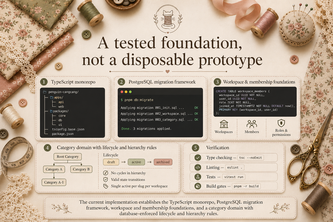
Penguin CangCang is a self-reported local-first, photo-driven sewing inventory system for home sewists and makers. The author describes it as a privacy-first tool that models physical relationships between materials using a three-tiered data structure: item style, purchase batch, and physical stock unit. It supports offline use, secure synchronization, and detailed tracking of fabric remnants, thread spools, and other sewing supplies.
What changed
The project is described as an ongoing personal development effort, not yet a product with customers or revenue. The author states it began from their own need to organize a growing collection of sewing materials and evolved into a structured system with database invariants, cross-platform reproducibility, and AI-assisted design.
Single most important open question
Is there evidence that the system has been used by others beyond the founder, or that it addresses real market demand for such tools?
What The Product Actually Is
The description states that Penguin CangCang is a local-first, photo-driven sewing inventory system designed to help makers find, track, and use materials they already own. It models physical relationships using a three-tiered data structure:
- Item Style: e.g., “black silk crepe”
- Purchase Batch: e.g., fabric purchased from two shops at different times
- Physical Stock Unit: e.g., remaining pieces with quantity, dimensions, condition, photograph, and storage location
It also supports:
- hierarchical storage locations
- quantities, availability, and reservations
- immutable inventory events
- sewing projects and material boards
- import/export, backup/recovery
- offline use and secure cross-device synchronization
The system is built as a TypeScript monorepo, using technologies like React, Fastify, PostgreSQL, Drizzle ORM, Docker Compose, Caddy, and AI tools such as GPT-5.6 and Codex.
Positioning & Claim Evolution
The author positions Penguin CangCang as:
- A privacy-first and local-first system
- Designed for home sewists and makers
- A tool that models real physical relationships, not generic spreadsheets
- An alternative to traditional inventory apps that treat items as simple names and quantities
It is described as evolving from a personal solution into a structured, scalable system with:
- Stable identifiers
- Transactional domain invariants
- Cross-platform reproducibility
- Offline behavior without silent data loss
The claim is that it bridges the gap between a maker’s physical collection and their creative projects—offering private, searchable, dependable, and useful access at the moment a material is needed.
Target Customer & ICP
The description states that Penguin CangCang targets:
- Home sewists and makers
- Users who own a growing collection of sewing materials (fabrics, lace, elastic, ribbons, thread, buttons, hardware, tools)
- People struggling with scattered information about their materials across storage boxes, photographs, purchase records, spreadsheets, labels, and memory
There is no evidence of segmentation beyond this broad category. No specific personas or buyer profiles are described.
Business Model & Pricing Evidence
Not evidenced.
The description does not mention:
- Revenue streams
- Pricing models
- Monetization strategy
- Customer acquisition plans
- Subscription or licensing details
It is a self-reported personal project, not a commercial product with customers or sales.
Technical & Delivery Signals
The system is built as a TypeScript monorepo, using:
- React and Vite for the web app
- Fastify for API
- PostgreSQL for structured data
- Drizzle ORM and explicit SQL migrations
- IndexedDB and an outbox for offline operations
- Docker Compose for local deployment
- Caddy for HTTPS
- GPT-5.6 and Codex for development assistance
Key technical features include:
- Separation of structured data from photographs/attachments
- Database-enforced invariants
- Transactional inventory events
- Cross-platform reproducibility
- Offline synchronization with conflict resolution
- Reversible database migrations
- Idempotent operations for inventory commands
The author emphasizes that the system is not a demo but intended to support a real personal material library.
Traction & Maturity Signals
Not evidenced.
There is no evidence of:
- Customers or users beyond the founder
- Revenue or monetization
- Product adoption or usage metrics
- Market traction or growth indicators
- Product-market fit validation
The project is described as still under active development, with a foundation built but not yet fully implemented. It is presented as an ongoing personal effort, not a commercial product.
Competitive Context
Not evidenced.
There is no mention of:
- Competitors in the sewing inventory or maker tools space
- Market size or competitive landscape
- Differentiation from existing solutions
- Industry trends or positioning relative to other tools
The description focuses on internal design and functionality rather than external market context.
Open Questions & Risks
Risk 1: Lack of Traction or Market Validation
There is no evidence of users beyond the founder. The system is described as a personal project, not validated in the market.
Risk 2: Overly Technical for Non-Technical Users
The architecture involves complex database constraints, offline behavior, and AI-assisted development. This may limit adoption among average home sewists who lack technical expertise.
Risk 3: Limited Scalability or Commercial Viability
The system is designed for a single user (local-first) and uses a Windows-based server model. It’s unclear how it would scale to multiple users or commercial settings.
Risk 4: AI Dependency Without Clear Product Ownership
The use of GPT-5.6 and Codex in development raises questions about whether the product is truly owned by the founder or heavily influenced by AI tools, potentially affecting long-term control and clarity.
Questions the description leaves open
- What specific problems do you observe in current sewing inventory systems that your solution addresses?
- Have you tested this system with other users beyond yourself? If so, what feedback did they give?
- How do you plan to monetize or scale this product if it gains traction?
- What are the key assumptions about user behavior and needs that underpin your design decisions?
- Can you describe how you would handle multi-user scenarios or enterprise adoption?
- What is the timeline for moving from a prototype to a usable product for others?
- How do you intend to ensure data portability and prevent vendor lock-in?
Overall Assessment
Not evidenced.
There is no evidence of:
- Funding rounds
- Valuation or investment interest
- Strategic partnerships
- Commercial traction or revenue
The project is described as a personal, self-driven effort with no indication of external commercial interest or support. It remains in early development and lacks any demonstration of market demand or product-market fit.
User Stories BotA demo video on every pull request
Get a demo video on every new feature
GitHub App that watches your pull requests and records a narrated, captioned demo.
Save time on demo prep and make informed decisions faster with a video walkthrough of every new feature.
Source
Submitted to the OpenAI 2026 hackathon on Devpost. Project home on Devpost. Back to the full gallery on Devpost.
This competitive analysis was produced by top-founders.com (opens in a new tab)
Generated by a language model from this project's public Devpost page — its tagline, the author's own write-up and any built-with tags listed there — as captured in August 2026. Short quotations are the author's words. It is an opinion on the idea as a business, not on the people behind it, and it reflects the description as published then. If the project has moved on, request a correction below. The analysis is not independent research and contains no verified traction, revenue or customer data.
An independent guide by KFG International LLC — not affiliated with, endorsed by, or connected to Devpost or OpenAI.