

Archive position — measured, not model output
1 like on Devpost
505 of the 7,850 archived projects have more likes, and 1,758 share exactly 1 — so this project's #1,953 place in the like-ranked listing is a tie-break inside that group, not a ranking.
Projects (log scale)
Likes on Devpost. ▲ marks this project's group.
Show the figures
| Likes | Projects | Share of archive |
|---|---|---|
| 0 | 5,587 | 71.2% |
| 1 | 1,758 | 22.4% |
| 2 | 284 | 3.6% |
| 3–4 | 132 | 1.7% |
| 5–9 | 75 | 1.0% |
| 10+ | 14 | 0.2% |
 User Stories BotA demo video on every pull request
Get a demo video on every new feature
GitHub App that watches your pull requests and records a narrated, captioned demo.
Save time on demo prep and make informed decisions faster with a video walkthrough of every new feature.
Executive Summary
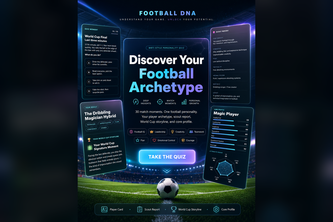
What the company appears to be: Soccer DNA is a self-reported, AI-powered web application that presents users with a football (soccer) personality quiz. Based on their answers, it assigns them one of 30 original archetypes and generates a personalized report using GPT-5.6. The author states this is intended for both amateur players and casual fans.
What changed: This project was submitted as part of the OpenAI 2026 hackathon. It represents an early-stage prototype built over a short timeframe (likely a hackathon week), with no evidence of prior development or commercial traction.
Single most important open question: Is there any evidence that users are engaging with the quiz beyond its initial release, or that there is demand for a more developed version of this platform?
Note: All claims in this report are based on self-reported information from the author. No independent verification or third-party data has been used.
What The Product Actually Is
The description states that Soccer DNA is an AI-powered football personality quiz. It includes:
- A quiz with scenario-based questions
- Deterministic scoring logic to assign one of 30 archetypes
- GPT-5.6 integration for generating personalized reports and development plans
- A web application built using Next.js, React, Node.js, and OpenAI technologies
The author describes it as a tool that transforms user decisions into "football archetypes" rather than traditional personality labels.
Inference: The product appears to be a prototype or MVP built for a hackathon, not a commercial offering with ongoing user engagement or monetization.
Positioning & Claim Evolution
The author positions Soccer DNA as:
- An alternative to traditional soccer player labeling (e.g., by position or stats)
- A way to understand how someone thinks and behaves on the pitch
- A tool for both casual fans and amateur players
- Designed around real game situations such as decision-making, communication, and risk-taking
It is described as aiming to make the experience enjoyable for general audiences while still offering tactical depth.
Claim: The author claims this is more than a novelty quiz — it combines archetypes, scoring logic, visual design, and AI guidance.
Inference: This positioning suggests an intent to evolve into a broader platform for player identity and development, but no evidence supports current adoption or traction.
Target Customer & ICP
The author states that the target audience includes:
- Amateur players
- Youth athletes
- School or community team members
- Casual fans of football (soccer)
They also note it should work for both experienced players and those who primarily watch soccer, suggesting a broad but not deeply segmented customer base.
Claim: The product is designed to be accessible to non-experts while still providing value to more knowledgeable users.
Inference: There is no evidence of specific buyer personas or segmentation beyond general categories; the ICP remains undefined in terms of behavior or usage patterns.
Business Model & Pricing Evidence
There is no mention of pricing, monetization, or business model in the description. The author does not describe any revenue streams or paid features.
Not evidenced: No evidence of a business model or pricing structure exists.
Technical & Delivery Signals
The project was built using:
- Technologies: JavaScript, Next.js, React, Node.js, OpenAI APIs (including GPT-5.6 and Codex)
- Framework: Responsive web application
- Architecture: Hybrid system combining deterministic scoring with generative AI for interpretation
- Features:
- Scenario-based quiz
- Structured archetype assignment
- Personalized report generation via GPT-5.6
- UI components designed for responsiveness
Claim: The author used Codex to refactor code, improve prompts, and manage edge cases.
Inference: The technical stack indicates a modern frontend/backend setup with AI integration, but no evidence of scalability or production deployment.
Traction & Maturity Signals
There is no evidence of user engagement, adoption metrics, or product maturity beyond the hackathon submission. The author notes that this is an early-stage prototype and that future features are planned, but no data on usage or retention exists.
Not evidenced: No traction signals such as active users, downloads, signups, or performance indicators.
Competitive Context
The description does not mention competitors or similar products in the market. The author focuses on the uniqueness of their approach — using behavioral scenarios and archetypes instead of standard labels — but provides no context about existing tools or platforms in this space.
Not evidenced: No competitive landscape or comparison with other quiz or identity tools is provided.
Open Questions & Risks
- Unproven commercial viability: The project is described as a hackathon submission with no evidence of user traction or monetization.
- Unclear path to scale: While the author envisions future features like team dashboards and progress tracking, there’s no indication of how these would be developed or funded.
- AI dependency without clear value proposition: The use of GPT-5.6 is central, but it's unclear whether the added AI layer significantly improves outcomes over a purely deterministic system.
- No feedback loop or iteration mechanism: There is no evidence that user responses are collected or used to refine the archetypes or scoring logic.
Inference: Without any data on usage or customer feedback, there is no basis for assessing product-market fit or long-term sustainability.
Questions the description leaves open
- What specific user behaviors or outcomes have you observed from people who completed the quiz?
- How do you plan to validate that your archetypes are meaningful and distinct?
- Are there any early adopters or pilot users beyond yourself?
- What is your roadmap for monetization, if any?
- Have you tested the AI-generated reports with real players or coaches?
- How do you intend to grow beyond a single-person development effort?
Overall Assessment
There is no evidence of traction, revenue, or customer engagement. The project appears to be an early-stage prototype built for a hackathon, with no indication of commercial viability or scalability.
Assessment: Not ready for investment or partnership at this stage. A follow-up analysis would require evidence of user engagement, product-market fit, and clear monetization strategy.
User Stories BotA demo video on every pull request
Get a demo video on every new feature
GitHub App that watches your pull requests and records a narrated, captioned demo.
Save time on demo prep and make informed decisions faster with a video walkthrough of every new feature.
Source
Submitted to the OpenAI 2026 hackathon on Devpost. Project home on Devpost. Back to the full gallery on Devpost.
This competitive analysis was produced by top-founders.com (opens in a new tab)
Generated by a language model from this project's public Devpost page — its tagline, the author's own write-up and any built-with tags listed there — as captured in August 2026. Short quotations are the author's words. It is an opinion on the idea as a business, not on the people behind it, and it reflects the description as published then. If the project has moved on, request a correction below. The analysis is not independent research and contains no verified traction, revenue or customer data.
An independent guide by KFG International LLC — not affiliated with, endorsed by, or connected to Devpost or OpenAI.