

Archive position — measured, not model output
1 like on Devpost
505 of the 7,850 archived projects have more likes, and 1,758 share exactly 1 — so this project's #1,952 place in the like-ranked listing is a tie-break inside that group, not a ranking.
Projects (log scale)
Likes on Devpost. ▲ marks this project's group.
Show the figures
| Likes | Projects | Share of archive |
|---|---|---|
| 0 | 5,587 | 71.2% |
| 1 | 1,758 | 22.4% |
| 2 | 284 | 3.6% |
| 3–4 | 132 | 1.7% |
| 5–9 | 75 | 1.0% |
| 10+ | 14 | 0.2% |
 User Stories BotA demo video on every pull request
Get a demo video on every new feature
GitHub App that watches your pull requests and records a narrated, captioned demo.
Save time on demo prep and make informed decisions faster with a video walkthrough of every new feature.
Executive Summary
What the company appears to be
SnipMatch is an AI-powered web application that analyzes differences between a user’s current hairstyle and a reference image, generating structured, barber-ready instructions for barbers. It was built as a hackathon project by a single developer (Zhang Lisa) using AI tools like GPT-5.6 and Codex.
What changed
The author pivoted from an initial idea of generating hairstyle simulations to focusing on improving communication between customers and barbers through precise, actionable instructions derived from image comparison.
The single most important open question
Is there a viable market demand for this tool, or is it a one-off personal project with no commercial traction?
What The Product Actually Is
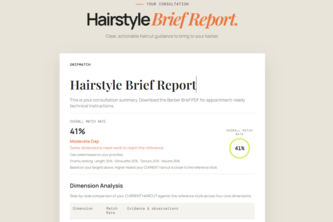
The description states that SnipMatch is an AI-powered tool designed to help customers and barbers communicate more clearly about desired hairstyles. It works by analyzing two images — the user's current hairstyle and a reference image — and generating a structured report that includes:
- A match rate across four dimensions: Volume, Length, Texture, and Silhouette.
- Specific guidance on how to adjust each dimension.
- A downloadable PDF (Barber Brief) containing professional terminology for barbers.
It also allows users to personalize the importance of different dimensions and set non-negotiable instructions.
Evidence The write-up describes the functionality in detail, including technical implementation using Node.js, Express, HTML/CSS/JS, and GPT-5.6 for image analysis.
Inference The product appears to be a lightweight web app built for personal use rather than enterprise or scale.
Positioning & Claim Evolution
The author claims SnipMatch addresses a common problem in barbershop communication — the gap between what customers intend and what barbers understand due to lack of professional terminology.
Initially, the idea was to simulate hairstyles using AI. However, after exploring technical feasibility and safety concerns, the team pivoted toward providing clear, actionable instructions based on image comparison.
Evidence The write-up explicitly mentions the original plan to generate simulations and the decision to shift focus.
Inference This pivot suggests a pragmatic approach to product development but does not indicate any prior market validation or user testing beyond personal experience.
Target Customer & ICP
The target customer is someone who wants a specific hairstyle but struggles to communicate their preferences effectively to a barber. The tool is intended for individuals seeking precise haircut guidance, particularly those who have experienced mismatches between expected and actual results.
Evidence The inspiration section describes the author’s own experience and similar issues faced by friends.
Inference There is no evidence of defined personas, segmentation, or customer interviews beyond anecdotal feedback. The ICP remains undefined in the description.
Business Model & Pricing Evidence
There is no mention of pricing, monetization strategy, or business model in the provided description.
Evidence Not evidenced.
Inference As a hackathon project with no revenue data, it's unclear whether any commercial model exists or is being considered.
Technical & Delivery Signals
SnipMatch was built as a full-stack web application using:
- Frontend: HTML5, CSS3, JavaScript
- Backend: Node.js, Express.js
- AI tools: GPT-5.6, Codex
- Deployment platform: Render
- PDF generation: jsPDF
The system uses deterministic logic for calculating match rates instead of relying solely on AI outputs to improve consistency.
Evidence The "How we built it" section details the architecture and tooling used.
Inference The use of AI tools like Codex and GPT-5.6 indicates a developer-centric approach, possibly indicating limited scalability or long-term sustainability without further investment.
Traction & Maturity Signals
There is no evidence of revenue, users, customers, or adoption metrics beyond the author’s personal account.
Evidence Not evidenced.
Inference The project appears to be at an early stage (hackathon submission), with no signs of traction or product-market fit.
Competitive Context
No competitive analysis or market positioning is provided in the description.
Evidence Not evidenced.
Inference Without any reference to existing solutions or competitors, it's impossible to assess the competitive landscape or differentiation strategy.
Open Questions & Risks
- Single-person development: The entire product was built by one person (Zhang Lisa), raising questions about scalability and long-term maintenance.
- Lack of commercial traction: No evidence of users, revenue, or adoption beyond personal use.
- Unproven market demand: The problem described is based on personal experience rather than market research.
- AI dependency without clear value proposition: While AI is used, its role in delivering core value isn’t clearly demonstrated outside of prototype form.
- No pricing or monetization strategy: No indication of how the product would be monetized if developed further.
Evidence These are inferred from lack of data and self-reported nature of the description.
Questions the description leaves open
- What specific feedback have you received from real users (barbers or clients)?
- Have you validated the need for this tool through surveys, interviews, or early usage?
- Are there any plans to expand beyond the current scope (e.g., support more hair types, languages, or regions)?
- How do you plan to scale beyond a single developer?
- What would be your go-to-market strategy if you were to commercialize this?
- Do you have any data on how often users return or engage with the tool?
Overall Assessment
At this stage, SnipMatch appears to be a hackathon prototype with no demonstrated traction, revenue, or customer base. The author has not provided evidence of market validation or commercial viability.
Confidence Level Low — based on limited self-reported information and absence of external data.
Assessment Not ready for investment or partnership at this time. Further due diligence would require evidence of user engagement, market demand, and a clear path to monetization.
User Stories BotA demo video on every pull request
Get a demo video on every new feature
GitHub App that watches your pull requests and records a narrated, captioned demo.
Save time on demo prep and make informed decisions faster with a video walkthrough of every new feature.
Source
Submitted to the OpenAI 2026 hackathon on Devpost. Project home on Devpost. Back to the full gallery on Devpost.
This competitive analysis was produced by top-founders.com (opens in a new tab)
Generated by a language model from this project's public Devpost page — its tagline, the author's own write-up and any built-with tags listed there — as captured in August 2026. Short quotations are the author's words. It is an opinion on the idea as a business, not on the people behind it, and it reflects the description as published then. If the project has moved on, request a correction below. The analysis is not independent research and contains no verified traction, revenue or customer data.
An independent guide by KFG International LLC — not affiliated with, endorsed by, or connected to Devpost or OpenAI.