

Archive position — measured, not model output
2 likes on Devpost
221 of the 7,850 archived projects have more likes, and 284 share exactly 2 — so this project's #372 place in the like-ranked listing is a tie-break inside that group, not a ranking.
Projects (log scale)
Likes on Devpost. ▲ marks this project's group.
Show the figures
| Likes | Projects | Share of archive |
|---|---|---|
| 0 | 5,587 | 71.2% |
| 1 | 1,758 | 22.4% |
| 2 | 284 | 3.6% |
| 3–4 | 132 | 1.7% |
| 5–9 | 75 | 1.0% |
| 10+ | 14 | 0.2% |
 User Stories BotA demo video on every pull request
Get a demo video on every new feature
GitHub App that watches your pull requests and records a narrated, captioned demo.
Save time on demo prep and make informed decisions faster with a video walkthrough of every new feature.
Executive Summary
What the company appears to be
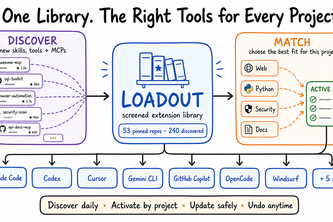
Loadout is a self-reported open-source command-line interface (CLI) tool designed to help developers manage AI coding agent extensions — including skills, MCP servers, and runtime tools — across multiple platforms like Codex, Claude Code, Cursor, and others. It offers four installation workflows: Stable, Power, Maximum, and Custom.
What changed
The project evolved from an initial idea of downloading all popular repositories to a more nuanced approach that focuses on discovery, safety, and selective installation through a package manager-like system for AI coding agent extensions.
The single most important open question
Does Loadout have any real-world usage or adoption beyond the authors’ own testing? There is no evidence of revenue, customers, or user traction beyond its development by a team of three during a hackathon.
What The Product Actually Is
- The description states that Loadout is a local, open-source CLI built with TypeScript and Node.js, using tools like Commander, Zod, and Vitest.
- It is described as a package manager for AI coding agent extensions, including skills, MCP servers, and runtime tools.
- It supports four installation workflows:
- Stable: installs a focused set of 30 skills from pinned public sources.
- Power: prepares a broader toolkit across projects.
- Maximum: downloads thousands of screened skill copies into a disabled local library, then activates a smaller relevant set.
- Custom: allows users to install one exact package without replacing everything else.
- It includes features such as:
- Scanning existing skills
- Detecting collisions
- Recommending tools based on repository context
- Checking for updates in managed sources
- Watching newly popular GitHub projects through a discovery queue
- Previewing changes before applying them
- Safely rolling back configurations
- Protecting user files and recording what it manages
Inference: The tool is not a hosted service but a local CLI, meaning developers must install and run it themselves. It is positioned as a utility for managing AI agent extensions, not as an extension itself.
Positioning & Claim Evolution
- The original inspiration was to solve the problem of hunting through GitHub, Reddit, X, and bookmarks to find useful AI coding tools.
- Early idea: download everything popular, which was quickly abandoned due to issues with safety, maintainability, compatibility, and usability.
- Shifted focus: build a package manager for AI agent extensions, emphasizing discovery, trust, and safe installation.
- The product now positions itself as:
- A local CLI tool
- For managing AI coding agent skills, MCP servers, and runtime tools
- With four distinct workflows tailored to different user needs
- Designed for developer control, not automation
Inference: The positioning evolved from a brute-force approach to a more thoughtful, modular, and safe system. However, the description does not indicate whether this evolution reflects market feedback or just internal design decisions.
Target Customer & ICP
- The target customer is developers working with AI coding agents, such as those using Codex, Claude Code, Cursor, etc.
- The tool is designed for:
- Users who want to improve their AI agent setup
- Those who are not satisfied with current discovery mechanisms
- Developers who need safe and reversible extension management
Inference: There is no evidence of a defined ICP beyond "developers using AI coding agents." No segmentation or persona data is provided.
Business Model & Pricing Evidence
- The description states that Loadout is an open-source CLI published on npm.
- It does not mention any commercial offering, pricing model, or monetization strategy.
- There is no indication of paid features, subscriptions, or enterprise tiers.
Inference: No business model or pricing evidence is provided. The tool appears to be open source and free to use.
Technical & Delivery Signals
- Built with:
- TypeScript
- Node.js
- Tools: Commander, Zod, Vitest
- Uses agent adapters for 12 coding agents (Codex, Claude Code, etc.)
- Supports:
- Catalog of 53 pinned repositories across 39 categories
- Discovery snapshot observing 240 repositories
- Snapshot-backed rollback and uninstall
- Filesystem checks and manifest management
- Project-aware recommendations
- Has:
- 625 automated tests
- CLI journeys
- Performance gate for 1,000 skills
Inference: The technical stack is standard for a Node.js CLI. The architecture shows attention to safety, modularity, and scalability.
Traction & Maturity Signals
- The project was built during OpenAI Build Week by a team of three.
- It is published on npm as a real CLI.
- It includes:
- A catalog of 53 repositories
- Discovery snapshot observing 240 repositories
- 625 automated tests
- Support for 12 coding agents
- Snapshot-backed rollback and uninstall
- The authors state they used Loadout on their own Codex and Claude Code profiles and safely rolled back changes.
Inference: There is no evidence of user adoption, revenue, or customer base. The maturity signal comes from internal testing and development, not external usage.
Competitive Context
- The description does not mention direct competitors.
- It implies that current AI agent extension management lacks:
- Discovery
- Safety
- Reversibility
- Project-awareness
Inference: No competitive landscape is described. The tool appears to address a gap in the ecosystem, but there is no evidence of existing solutions or market dynamics.
Open Questions & Risks
- No user traction or adoption: The only usage mentioned is by the authors themselves.
- Unproven market demand: There is no evidence that developers are actively seeking this type of tool.
- Limited scope: The tool is a CLI and does not appear to integrate with IDEs or agent UIs.
- Self-reported maturity: All claims about functionality and performance are self-reported without external validation.
- No monetization strategy: No indication of how the project will generate revenue.
Inference: The risk of failure is high if there is no real-world demand for this tool beyond its creators’ internal use.
Questions the description leaves open
- What specific pain points are you solving, and how do you know users have them?
- How many developers are currently using Loadout outside of your own testing?
- Are there any early adopters or beta testers? If so, what feedback have they given?
- What is the plan for monetization or long-term sustainability?
- How do you intend to scale beyond a hackathon-level prototype?
- What are the technical challenges in integrating with more coding agents or platforms?
- Are there any known compatibility issues with current AI agent setups?
Overall Assessment
- Not evidenced: There is no evidence of revenue, customers, or traction.
- The project is described as a hackathon prototype that has been published to npm and tested internally.
- It is not clear whether there is any commercial interest or market demand for the tool beyond its creators’ own use.
Inference: At this stage, Loadout appears to be an experimental tool with no demonstrated commercial viability or user adoption. It may have potential as a future product, but it lacks current evidence of traction or scalability.
User Stories BotA demo video on every pull request
Get a demo video on every new feature
GitHub App that watches your pull requests and records a narrated, captioned demo.
Save time on demo prep and make informed decisions faster with a video walkthrough of every new feature.
Source
Submitted to the OpenAI 2026 hackathon on Devpost. Project home on Devpost. Back to the full gallery on Devpost.
This competitive analysis was produced by top-founders.com (opens in a new tab)
Generated by a language model from this project's public Devpost page — its tagline, the author's own write-up and any built-with tags listed there — as captured in August 2026. Short quotations are the author's words. It is an opinion on the idea as a business, not on the people behind it, and it reflects the description as published then. If the project has moved on, request a correction below. The analysis is not independent research and contains no verified traction, revenue or customer data.
An independent guide by KFG International LLC — not affiliated with, endorsed by, or connected to Devpost or OpenAI.