

Archive position — measured, not model output
0 likes on Devpost
2,263 of the 7,850 archived projects have more likes, and 5,587 share exactly 0 — so this project's #2,335 place in the like-ranked listing is a tie-break inside that group, not a ranking.
Projects (log scale)
Likes on Devpost. ▲ marks this project's group.
Show the figures
| Likes | Projects | Share of archive |
|---|---|---|
| 0 | 5,587 | 71.2% |
| 1 | 1,758 | 22.4% |
| 2 | 284 | 3.6% |
| 3–4 | 132 | 1.7% |
| 5–9 | 75 | 1.0% |
| 10+ | 14 | 0.2% |
 User Stories BotA demo video on every pull request
Get a demo video on every new feature
GitHub App that watches your pull requests and records a narrated, captioned demo.
Save time on demo prep and make informed decisions faster with a video walkthrough of every new feature.
Executive Summary
What the company appears to be
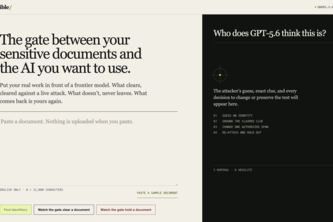
The description states that admissible is a tool designed to gate sensitive documents before they are sent to AI systems. It claims to run a real attack against documents using GPT-5.6, and only allows sanitized versions through if the attacker cannot identify the subject. The system uses local processing with a remote model (GPT-5.6) as an adversary, and includes a local controller that checks claims against original text.
What changed
The author describes building this tool in response to observing people inadequately scrubbing sensitive documents for AI use — e.g., removing names but leaving enough context for models to re-identify subjects. The project evolved from a basic idea into a system where the attacker is actively used to test and validate safety.
Single most important open question
Is there any evidence that admissible has been tested or validated in real-world use cases beyond the author’s own experiments? The description does not state whether it has been deployed, used by others, or evaluated for performance or adoption.
What The Product Actually Is
The description states that admissible is a gate between sensitive documents and AI systems. It allows users to paste a document and specify what they want the AI to do with it. Then, it runs a real attack using GPT-5.6 as an adversary to identify the subject of the document. A local controller checks every claim made by the attacker against the original document before any sanitized version is allowed through. If the attacker can’t identify the subject or if clues don’t resolve exactly, the document is held back.
It also includes a local model (Qwen 3.5 4B via Ollama) for rewriting clues that can be safely blurred, and a React UI for interaction. The system runs locally except for GPT-5.6, which acts as an external attacker.
Evidence
- The product is described as running a real attack using GPT-5.6.
- It uses a local controller to validate claims from the attacker.
- A local model rewrites safe clues; the UI is built with React.
- Backend is FastAPI; frontend is React; remote model used for adversarial testing.
Inference The system appears to be a proof-of-concept or prototype, not yet a commercial product. It is not evidenced that it has been scaled beyond the author’s own development and testing.
Positioning & Claim Evolution
The description states that admissible is positioned as a privacy tool that “decides” rather than just scrubbing documents. It claims to be different from other tools because it doesn’t just say “clean,” but instead evaluates whether a document can be safely used for a given task.
Key Claims
- The system refuses to allow documents through if they cannot be made safe.
- It uses an adversarial model (GPT-5.6) to test safety.
- It provides exact restoration of original content after processing.
- It is built with transparency in mind — the rules are code, not prompts.
Inference The positioning suggests a shift from traditional data scrubbing tools toward a more principled approach to privacy that evaluates risk based on task and reader. However, this is a self-stated claim without evidence of adoption or market validation.
Target Customer & ICP
The description does not explicitly state the target customer or ideal customer profile (ICP). It implies that admissible is for individuals or teams who handle sensitive documents and use AI systems like ChatGPT, but no specific persona or industry is named.
Evidence
- The author mentions lawyers with client files, HR complaints, and medical notes as examples.
- The tool is described as addressing a common behavior: people deleting names from documents before pasting into AI.
Inference The ICP likely includes professionals who work with sensitive data and use AI tools, but no explicit segmentation or targeting is stated.
Business Model & Pricing Evidence
There is no evidence in the description of any business model or pricing structure. The project is described as a hackathon submission, not a commercial offering.
Evidence
- No mention of monetization.
- No indication of pricing tiers or subscription models.
- No reference to customer acquisition or revenue streams.
Inference It is unclear whether admissible intends to become a paid product or service. The description implies it is a prototype, not a commercial offering.
Technical & Delivery Signals
The author states that the system was built from scratch using:
- FastAPI backend
- React frontend
- Local model (Qwen 3.5 4B via Ollama)
- GPT-5.6 as an external attacker
It includes evaluation harnesses and a local controller to validate claims.
Evidence
- Built with CSS, HTML, Python, TypeScript.
- Uses Codex for code generation under author direction.
- The system is described as running locally except for the remote model.
Inference The technical stack suggests a developer-focused prototype. No evidence of scalability or production deployment is provided.
Traction & Maturity Signals
There is no evidence of traction, revenue, customers, or adoption beyond the author’s own development and testing.
Evidence
- The project was submitted to a hackathon.
- No mention of users, customers, or usage metrics.
- No indication of product-market fit or market validation.
Inference The system is at an early stage — likely a prototype or MVP. No evidence of real-world deployment or user feedback.
Competitive Context
The description does not provide any information about competitors or the competitive landscape. It does not reference existing tools for document sanitization or AI privacy.
Evidence
- No mention of competing products.
- No comparison to other privacy or data scrubbing tools.
Inference It is unclear whether admissible addresses a gap in the market or overlaps with existing solutions. The competitive context is unknown.
Open Questions & Risks
- Unproven commercial viability: The tool is described as a hackathon submission, not a product.
- No evidence of real-world use: No customers, users, or feedback are mentioned.
- Unclear scalability: The system runs locally and uses a remote model for adversarial testing — no indication of how it would scale to enterprise or high-volume use.
- Unvalidated assumptions: The author states that the first version was “quietly broken,” suggesting early-stage development with untested assumptions.
Inference The project is in an exploratory phase, not a commercial one. Risks include lack of product-market fit, scalability issues, and limited validation.
Questions the description leaves open
- What real-world use cases have you tested admissible with?
- How does the system handle edge cases or ambiguous documents?
- Are there any plans to make this available beyond a local prototype?
- How do you plan to scale this for enterprise or high-volume use?
- Have you considered how to integrate this into existing AI workflows or platforms?
- What are the limitations of using GPT-5.6 as an attacker, and how might those be addressed?
Overall Assessment
The description states that admissible is a hackathon submission and not yet a commercial product. There is no evidence of revenue, customers, or traction. The tool appears to be a prototype exploring a novel approach to document privacy in AI use.
Confidence Level Low This analysis is based entirely on self-reported information. No third-party validation, user data, or financials are available.
Assessment Not evidenced as a viable investment or partnership opportunity at this time. It may be an interesting concept for further development, but lacks commercial maturity and evidence of traction.
User Stories BotA demo video on every pull request
Get a demo video on every new feature
GitHub App that watches your pull requests and records a narrated, captioned demo.
Save time on demo prep and make informed decisions faster with a video walkthrough of every new feature.
Source
Submitted to the OpenAI 2026 hackathon on Devpost. Project home on Devpost. Back to the full gallery on Devpost.
This competitive analysis was produced by top-founders.com (opens in a new tab)
Generated by a language model from this project's public Devpost page — its tagline, the author's own write-up and any built-with tags listed there — as captured in August 2026. Short quotations are the author's words. It is an opinion on the idea as a business, not on the people behind it, and it reflects the description as published then. If the project has moved on, request a correction below. The analysis is not independent research and contains no verified traction, revenue or customer data.
An independent guide by KFG International LLC — not affiliated with, endorsed by, or connected to Devpost or OpenAI.