

Archive position — measured, not model output
0 likes on Devpost
2,263 of the 7,850 archived projects have more likes, and 5,587 share exactly 0 — so this project's #4,298 place in the like-ranked listing is a tie-break inside that group, not a ranking.
Projects (log scale)
Likes on Devpost. ▲ marks this project's group.
Show the figures
| Likes | Projects | Share of archive |
|---|---|---|
| 0 | 5,587 | 71.2% |
| 1 | 1,758 | 22.4% |
| 2 | 284 | 3.6% |
| 3–4 | 132 | 1.7% |
| 5–9 | 75 | 1.0% |
| 10+ | 14 | 0.2% |
 User Stories BotA demo video on every pull request
Get a demo video on every new feature
GitHub App that watches your pull requests and records a narrated, captioned demo.
Save time on demo prep and make informed decisions faster with a video walkthrough of every new feature.
Executive Summary
What the company appears to be
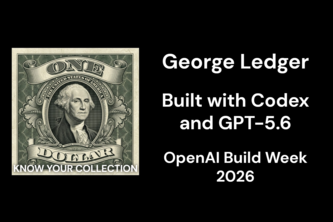
The project described is a mobile application named George Ledger: $1 Federal Reserve Note Collection Tracker, built for collectors of U.S. $1 Federal Reserve Notes. It functions as an offline-first catalog and collection tracker, allowing users to manage physical specimens, track ownership, generate reports, and maintain local data storage.
What changed
The author states that during the OpenAI Build Week hackathon, they used Codex with GPT-5.6 to extend the existing application rather than build a prototype from scratch. Key additions included Ukrainian localization, specimen-level tracking, hierarchical reporting, and improved backup compatibility.
Single most important open question — the commercial due-diligence read
There is no evidence of any revenue model, customer base, or product-market fit beyond the author's personal use case. The project is self-reported as a tool for one individual collector, with no indication of broader adoption or monetization strategy.
What The Product Actually Is
The description states that George Ledger is an offline-first Android catalog and collection tracker for U.S. $1 Federal Reserve Notes. It allows collectors to:
- Browse the catalog by Federal Reserve district or banknote series;
- Mark positions as owned;
- Record condition and comments for collected notes;
- Maintain multiple physical specimens per catalog position;
- View statistics and completion rates;
- Generate PDF reports, including missing-only reports;
- Back up and restore collection data locally using SQLite.
The application was built with React Native, Expo, TypeScript, SQLite, and uses Codex and GPT-5.6 as development tools during the OpenAI Build Week event.
Positioning & Claim Evolution
The author claims that George Ledger evolved from a simple catalog-position tracker into a more realistic collection-management application capable of distinguishing between:
- Catalog positions;
- Collected positions;
- Individual physical banknotes.
This evolution reflects an expansion in functionality beyond basic tracking to include specimen-level data management, reporting, and localization. The project was initially focused on one collecting domain (U.S. $1 Federal Reserve Notes), but the author intends to expand it into a reusable architecture for other specialized catalog applications.
Inference The positioning appears to be that of a niche tool for collectors, with potential for broader reuse in similar domains.
Target Customer & ICP
The description states that the app targets collectors of U.S. $1 Federal Reserve Notes, particularly those who value structured workflows and offline usability.
It also mentions that the app supports both English and Ukrainian languages, suggesting a possible audience in regions where these are spoken.
There is no evidence of segmentation beyond this single collecting domain or demographic targeting.
Business Model & Pricing Evidence
The description does not provide any information about pricing, monetization, or business model. The app works without registration, cloud accounts, or internet connection, and the author emphasizes that it is a personal tool for collectors.
There is no indication of paid features, subscriptions, or sales channels.
Technical & Delivery Signals
The application is built using:
- React Native
- Expo
- TypeScript
- SQLite
- Codex and GPT-5.6 (used only as development tools)
Key technical signals include:
- Offline-first design;
- Local data storage via SQLite;
- Support for multiple physical specimens per catalog position;
- Backup and restore functionality;
- Localization support (English/Ukrainian);
- Use of feature branches and repository audits during development.
The author notes that Codex was used to audit repositories before major changes, helping identify dependencies across layers such as database schema, UI, services, and reporting logic.
Traction & Maturity Signals
There is no evidence of traction, revenue, or customer adoption beyond the author’s own use. The project is described as a personal tool developed over a short period (OpenAI Build Week), with no mention of user feedback, downloads, or usage metrics.
The app has not been released publicly beyond its submission to Devpost.
Competitive Context
The description does not provide any information about competitors or market context. It only mentions that collectors often use spreadsheets, paper lists, or general note-taking apps, but does not compare George Ledger to existing tools in the space.
No competitive analysis or differentiation strategy is evident.
Open Questions & Risks
- No commercial traction or revenue model: The app is described as a personal tool with no evidence of monetization.
- Single-person team: Only one developer is involved, which may limit scalability and long-term maintenance.
- Limited scope: The product is narrowly focused on U.S. $1 Federal Reserve Notes, with no indication of plans to expand beyond this niche.
- Unproven market demand: There is no evidence that other collectors are interested in such a tool or would pay for it.
- AI dependency: While Codex was used as a development tool, there is no indication that AI integration will be part of the final product or commercial offering.
Questions the description leaves open
- What is your plan to validate market demand outside of personal use?
- Are you aware of any existing tools for collecting U.S. $1 Federal Reserve Notes? How does George Ledger differ from them?
- Do you have a strategy for monetization or scaling beyond one niche domain?
- How do you intend to onboard users or promote the app if it remains a personal tool?
- What is the long-term vision for expanding this into reusable collection-management architecture?
Overall Assessment
There is no evidence of commercial viability, traction, or market demand beyond the author’s own use case. The project is described as a personal tool, built during a hackathon, with no indication of revenue, customers, or product-market fit.
The app is technically functional and shows some architectural sophistication, but lacks any commercial dimension or evidence of adoption.
Assessment Not commercially viable at this stage; likely not suitable for investment or partnership unless there is a clear path to market traction or monetization.
User Stories BotA demo video on every pull request
Get a demo video on every new feature
GitHub App that watches your pull requests and records a narrated, captioned demo.
Save time on demo prep and make informed decisions faster with a video walkthrough of every new feature.
Source
Submitted to the OpenAI 2026 hackathon on Devpost. Project home on Devpost. Back to the full gallery on Devpost.
This competitive analysis was produced by top-founders.com (opens in a new tab)
Generated by a language model from this project's public Devpost page — its tagline, the author's own write-up and any built-with tags listed there — as captured in August 2026. Short quotations are the author's words. It is an opinion on the idea as a business, not on the people behind it, and it reflects the description as published then. If the project has moved on, request a correction below. The analysis is not independent research and contains no verified traction, revenue or customer data.
An independent guide by KFG International LLC — not affiliated with, endorsed by, or connected to Devpost or OpenAI.