

Archive position — measured, not model output
0 likes on Devpost
2,263 of the 7,850 archived projects have more likes, and 5,587 share exactly 0 — so this project's #4,300 place in the like-ranked listing is a tie-break inside that group, not a ranking.
Projects (log scale)
Likes on Devpost. ▲ marks this project's group.
Show the figures
| Likes | Projects | Share of archive |
|---|---|---|
| 0 | 5,587 | 71.2% |
| 1 | 1,758 | 22.4% |
| 2 | 284 | 3.6% |
| 3–4 | 132 | 1.7% |
| 5–9 | 75 | 1.0% |
| 10+ | 14 | 0.2% |
 User Stories BotA demo video on every pull request
Get a demo video on every new feature
GitHub App that watches your pull requests and records a narrated, captioned demo.
Save time on demo prep and make informed decisions faster with a video walkthrough of every new feature.
Executive Summary
What the company appears to be
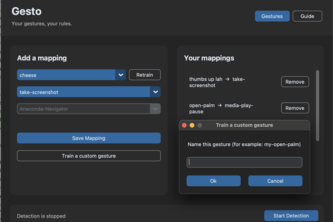
Gesto is a self-reported personal project that turns hand gestures into Mac shortcuts using computer vision and machine learning. The author describes it as a gesture-based automation tool for macOS, built with Python and open-source libraries.
What changed
The project was submitted to the OpenAI 2026 hackathon on Devpost. It is described as a personal prototype with no commercial traction or revenue evidence.
Single most important open question
Is there any evidence of user adoption, market demand, or product-market fit beyond the author’s own development and submission?
What The Product Actually Is
The description states that Gesto:
- Turns hand gestures into Mac shortcuts.
- Allows users to train custom gestures and map them to actions like opening apps, controlling media, switching tabs, taking screenshots, and locking the Mac.
- Uses MediaPipe for landmark extraction, a K-nearest-neighbours classifier for gesture recognition, and scikit-learn for ML.
- Is built with Python, CustomTkinter, OpenCV, MediaPipe, and scikit-learn.
- Runs locally on macOS, stores models and mappings under
~/.gesto/. - Is packaged as a downloadable
.appfile.
Confidence Low. The product is described as a prototype or personal project, not a commercial offering.
Positioning & Claim Evolution
The author states:
- Gesto was inspired by an open-source project that turned laptop space into virtual buttons.
- It aims to make everyday Mac tasks more accessible through natural hand gestures.
- It supports user-trained gestures instead of fixed labels.
- It is privacy-focused, processing data locally.
Confidence Low. These are claims about intent and design, not evidence of traction or market positioning.
Target Customer & ICP
The description does not state:
- Who the target customer is.
- Whether there’s a defined ideal customer profile (ICP).
- Any segmentation or persona development.
Confidence Not evidenced.
Business Model & Pricing Evidence
The description does not mention:
- A pricing model.
- Revenue streams.
- Monetisation strategy.
- Subscription, licensing, or transactional models.
Confidence Not evidenced.
Technical & Delivery Signals
The author states:
- The app uses MediaPipe for landmark detection and scikit-learn for classification.
- It is built with Python, CustomTkinter, OpenCV, and other open-source tools.
- It runs locally on macOS.
- It handles camera permissions, confidence thresholds, and retraining.
- It supports system-level actions via local controls.
- It is distributed as a downloadable
.appfile.
Confidence Medium. Technical details are provided but not validated or independently verified.
Traction & Maturity Signals
The description does not state:
- Any user base or adoption metrics.
- Customer feedback or usage data.
- Product maturity beyond prototype stage.
- Revenue, ARR, or funding information.
Confidence Not evidenced.
Competitive Context
The description does not mention:
- Competitors.
- Market landscape.
- How Gesto compares to existing tools or platforms.
Confidence Not evidenced.
Open Questions & Risks
Inferences based on the description:
- The project is a solo effort (team size: 1), which may limit scalability and long-term maintenance.
- It relies on macOS permissions, which can be fragile and require frequent user interaction or app signing.
- It uses open-source tools and local processing, which may not scale well for broader adoption.
- There is no evidence of commercial viability or monetisation strategy.
Confidence Medium. These are inferences from the self-reported nature of the project.
Questions the description leaves open
- What problem are you solving, and how do you know users care about it?
- How many people have tried Gesto, and what feedback have you received?
- Are there any plans to monetize or commercialize this tool?
- What are the technical limitations of the current implementation that might prevent broader adoption?
- How do you plan to handle macOS permission issues at scale?
- Have you considered integrating with other platforms beyond macOS?
Overall Assessment
The description states that Gesto is a personal project submitted to a hackathon, built by one person using open-source tools. There is no evidence of:
- Revenue or customer traction.
- A defined business model.
- Market demand or competitive positioning.
Confidence Very low. This is not a commercial product with demonstrated market fit or scalability.
Assessment Not evidenced as a viable investment or partnership opportunity at this stage.
User Stories BotA demo video on every pull request
Get a demo video on every new feature
GitHub App that watches your pull requests and records a narrated, captioned demo.
Save time on demo prep and make informed decisions faster with a video walkthrough of every new feature.
Source
Submitted to the OpenAI 2026 hackathon on Devpost. Project home on Devpost. Back to the full gallery on Devpost.
This competitive analysis was produced by top-founders.com (opens in a new tab)
Generated by a language model from this project's public Devpost page — its tagline, the author's own write-up and any built-with tags listed there — as captured in August 2026. Short quotations are the author's words. It is an opinion on the idea as a business, not on the people behind it, and it reflects the description as published then. If the project has moved on, request a correction below. The analysis is not independent research and contains no verified traction, revenue or customer data.
An independent guide by KFG International LLC — not affiliated with, endorsed by, or connected to Devpost or OpenAI.