

Archive position — measured, not model output
0 likes on Devpost
2,263 of the 7,850 archived projects have more likes, and 5,587 share exactly 0 — so this project's #6,263 place in the like-ranked listing is a tie-break inside that group, not a ranking.
Projects (log scale)
Likes on Devpost. ▲ marks this project's group.
Show the figures
| Likes | Projects | Share of archive |
|---|---|---|
| 0 | 5,587 | 71.2% |
| 1 | 1,758 | 22.4% |
| 2 | 284 | 3.6% |
| 3–4 | 132 | 1.7% |
| 5–9 | 75 | 1.0% |
| 10+ | 14 | 0.2% |
 User Stories BotA demo video on every pull request
Get a demo video on every new feature
GitHub App that watches your pull requests and records a narrated, captioned demo.
Save time on demo prep and make informed decisions faster with a video walkthrough of every new feature.
Executive Summary
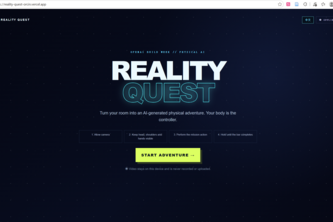
Reality Quest is a browser-based physical adventure game that adapts gameplay to the limitations of webcam-based pose detection. The author states it turns a room into an interactive space mission using only upper-body or full-body movement, depending on camera visibility. It uses MediaPipe for local pose detection and integrates with OpenAI's GPT-5.6 API for adaptive mission generation.
The project appears to be a hackathon submission (submitted to the OpenAI 2026 hackathon) with no evidence of revenue, customers or production deployment beyond a public demo. The author claims it works with ordinary laptop cameras and includes capability detection that switches between upper-body and full-body modes based on what is visible.
The single most important open question: Is there any evidence of commercial traction, user adoption or monetization strategy beyond the demo?
What The Product Actually Is
The description states Reality Quest is a "browser-based physical adventure game" that uses webcam pose detection to create an interactive space mission. It detects which parts of the player's body are visible and automatically selects one of two capability modes:
- Upper-body mode: works with only head, shoulders, elbows, and hands visible
- Full-body mode: unlocks additional movements such as squats
The game includes five physical missions with timers, progress indicators, scores, streaks, and story feedback. Actions include raising a hand, both hands, leaning, holding still, extending arms, or placing hands near head.
Pose detection runs entirely in the browser - camera frames are never uploaded to the server. The system only selects actions that the current camera framing can reliably evaluate.
The author states it uses MediaPipe Pose Landmarker, Next.js, React, TypeScript, Tailwind CSS, Zod, and OpenAI Responses API integration.
Positioning & Claim Evolution
The description states Reality Quest started with a simple question: "what if the game adapted to what the camera can actually see, instead of forcing the player to adapt to the camera?"
It positions itself as an adaptive physical game that works around camera limitations rather than requiring users to reposition themselves. The author claims it evolved from an initial assumption about camera visibility to a redesigned system around explicit pose capabilities.
The project appears to be self-positioned as a solution to webcam-based movement game limitations, particularly for small rooms and laptop cameras where only upper body visibility is reliable.
Target Customer & ICP
Not evidenced. The description does not state who the target customer or ideal customer profile (ICP) is beyond describing it as a physical adventure game for users with webcams in small rooms.
Business Model & Pricing Evidence
Not evidenced. The description does not contain any information about pricing, revenue model, monetization strategy or business model.
Technical & Delivery Signals
The author states Reality Quest is built as a full-stack Next.js application using TypeScript, React, Tailwind CSS, MediaPipe Pose Landmarker, Zod, and OpenAI Responses API integration.
Key technical signals:
- Pose detection runs entirely in the browser
- Camera frames are never uploaded to the server
- Uses MediaPipe for local pose landmark processing
- Capability-detection module evaluates landmark visibility over multiple frames with hysteresis
- Each movement implemented as normalized and testable pose predicate using body proportions rather than fixed pixels
- Mission system uses strict Zod schema and constrained list of supportedActions
- GPT-5.6 integration designed to act as adaptive game director
- Public demo runs in clearly labeled Offline Demo Mode when no production API key is configured
- Includes local-first MediaPipe assets with CDN fallback
- Has 23 automated tests, production build validation, and GitHub Actions CI
Traction & Maturity Signals
Not evidenced. The description states this is a hackathon submission (OpenAI 2026) and the public demo currently runs in Offline Demo Mode because no production OpenAI API key is configured.
The author mentions that the "public demo currently runs in clearly labeled Offline Demo Mode" and that "the GPT-5.6 runtime integration can be enabled through server-side environment configuration." No evidence of user adoption, revenue, or customer base is provided.
Competitive Context
Not evidenced. The description does not contain any information about competitors, market positioning, or competitive landscape.
Open Questions & Risks
- No commercial traction: This is a hackathon submission with no evidence of users, customers, or revenue
- Limited scope: Only five missions are described, and the system only works with webcam-based pose detection
- Demo-only deployment: The public demo runs in Offline Demo Mode because no production API key is configured
- Single-person team: The project has only one team member (as stated in the description)
- Unproven monetization: No evidence of business model, pricing or revenue streams beyond the demo
- AI integration dependency: Relies on OpenAI API which may not be available for production use
- Technical limitations: Only works with webcam-based pose detection and has limited physical interaction modes
Questions the description leaves open
- What is the actual user acquisition strategy beyond the demo?
- How does the team plan to monetize this product?
- Are there any plans for additional missions or features beyond the five described?
- What are the technical limitations of the current implementation that might prevent scaling?
- How does the team intend to handle the GPT-5.6 API integration in production?
- What is the roadmap for expanding beyond the current capabilities?
- Are there any partnerships or distribution channels planned?
- What is the team's experience with commercializing hackathon projects?
Overall Assessment
Not evidenced. The description provides no information about valuation, funding rounds, investment interest, or partnership opportunities. This appears to be a hackathon submission with no evidence of commercial traction, revenue, or established business relationships.
The project is described as a browser-based physical adventure game that adapts to webcam limitations, but there is no evidence of any commercial viability, user adoption, or monetization strategy beyond the demo. The author states it's a hackathon submission and the public demo runs in Offline Demo Mode with no production API key configured.
The single most important finding: This appears to be an unproven prototype with no evidence of commercial traction or business model.
User Stories BotA demo video on every pull request
Get a demo video on every new feature
GitHub App that watches your pull requests and records a narrated, captioned demo.
Save time on demo prep and make informed decisions faster with a video walkthrough of every new feature.
Source
Submitted to the OpenAI 2026 hackathon on Devpost. Project home on Devpost. Back to the full gallery on Devpost.
This competitive analysis was produced by top-founders.com (opens in a new tab)
Generated by a language model from this project's public Devpost page — its tagline, the author's own write-up and any built-with tags listed there — as captured in August 2026. Short quotations are the author's words. It is an opinion on the idea as a business, not on the people behind it, and it reflects the description as published then. If the project has moved on, request a correction below. The analysis is not independent research and contains no verified traction, revenue or customer data.
An independent guide by KFG International LLC — not affiliated with, endorsed by, or connected to Devpost or OpenAI.