

Archive position — measured, not model output
0 likes on Devpost
2,263 of the 7,850 archived projects have more likes, and 5,587 share exactly 0 — so this project's #6,730 place in the like-ranked listing is a tie-break inside that group, not a ranking.
Projects (log scale)
Likes on Devpost. ▲ marks this project's group.
Show the figures
| Likes | Projects | Share of archive |
|---|---|---|
| 0 | 5,587 | 71.2% |
| 1 | 1,758 | 22.4% |
| 2 | 284 | 3.6% |
| 3–4 | 132 | 1.7% |
| 5–9 | 75 | 1.0% |
| 10+ | 14 | 0.2% |
 User Stories BotA demo video on every pull request
Get a demo video on every new feature
GitHub App that watches your pull requests and records a narrated, captioned demo.
Save time on demo prep and make informed decisions faster with a video walkthrough of every new feature.
Executive Summary
What the company appears to be
Sınav Burada is an AI-powered exam preparation platform built for students. The author states it uses GPT-5.6 to interpret student performance data and generate personalized study actions, including daily missions and weekly plans. It supports timed tests, rich question formats (including geometry), and mobile/web delivery via React Native and Firebase.
What changed
The project was originally an exam prep platform; during a hackathon, the author integrated AI coaching using Codex to extend it into a personalized learning experience based on verified performance data.
Single most important open question
Does the platform have any real-world usage or user feedback yet? The description contains no evidence of actual students, test results, or adoption beyond the developer's own account.
What The Product Actually Is
The description states that Sınav Burada is an AI-powered exam preparation and personal coaching platform. It allows students to:
- Solve timed topic tests and full practice exams
- Work with rich-text, mathematical, map, chart, and geometry questions
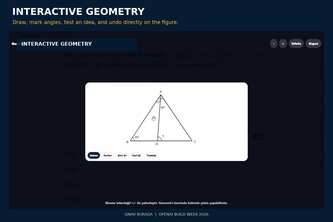
- Draw directly on geometry figures using built-in pen tools
- Review correct, incorrect, and unanswered questions
- Track lesson- and topic-level performance
- See net scores, success rates, time usage, and performance trends
After completing tests or exams, the platform creates a verified performance summary. GPT-5.6 interprets this summary to produce:
- A concise performance assessment
- A teacher-style guidance note
- A recommended study method
- A motivational message
- A focused daily mission
- A practical weekly plan
The system uses React Native and Expo for cross-platform delivery, with Firebase providing authentication, database services, and Cloud Functions. The OpenAI API key is stored server-side as a secret.
Inference The platform appears to be a prototype or early-stage product built for a hackathon, not yet validated in production use.
Positioning & Claim Evolution
The author claims that existing exam prep platforms only show scores and charts but do not guide students on what to study next. Sınav Burada aims to close this gap by turning verified performance into actionable coaching.
It positions itself as a tool that helps students understand their gaps and take the next step in studying — not just to tell them how they did, but to suggest how to improve.
Inference The positioning is centered on personalization and practicality. However, there is no evidence of whether this approach resonates with users or improves outcomes.
Target Customer & ICP
The description states that Sınav Burada targets students preparing for exams. It supports various question types including geometry, math, maps, charts, and rich text — suggesting a focus on STEM or academic subjects where such content is common.
Inference The target customer seems to be high school or college-level students who engage in structured practice exams. No specific demographic or geographic segmentation is mentioned.
Business Model & Pricing Evidence
There is no evidence of pricing, monetization strategy, or business model in the description. The author does not state whether the platform will be free, subscription-based, or sold to institutions.
Inference The business model remains undefined and unproven.
Technical & Delivery Signals
- Built with React Native and Expo for shared web/mobile experience
- Uses Firebase for authentication, database, and Cloud Functions
- Implements GPT-5.6 via OpenAI API (API key stored server-side)
- Includes local fallback if AI service is unavailable
- Supports drawing tools for geometry questions
- Uses Codex during development to accelerate implementation
Inference The technical stack suggests a lightweight, prototype-level solution built quickly using modern tools and frameworks. The presence of a fallback indicates some resilience planning.
Traction & Maturity Signals
There is no evidence of traction or user adoption beyond the developer’s own account. No customers, revenue, usage metrics, or performance data are provided.
Inference The product appears to be in early development and has not yet reached a stage where real-world impact can be measured.
Competitive Context
The description does not mention competitors or market positioning relative to other exam prep tools. It implies that current platforms lack personalized coaching features, but no comparison with existing solutions is made.
Inference No competitive analysis or differentiation strategy is evident in the self-reported description.
Open Questions & Risks
- The platform is described as a hackathon prototype with no real-world usage.
- No evidence of user feedback, testing, or validation.
- The AI model (GPT-5.6) is used only on verified performance data — but there’s no clarity on how well it generalizes or adapts to different student needs.
- The product relies heavily on a single developer and lacks team structure or external validation.
- No mention of scalability, privacy compliance, or institutional partnerships.
Inference The risk of failure is high due to lack of real-world testing, unclear business model, and absence of traction or feedback loops.
Questions the description leaves open
- Has the AI coaching been tested with actual students? What were the results?
- How does the platform handle edge cases in performance data (e.g., incomplete exams)?
- Are there plans to integrate with schools, teachers, or educational institutions?
- What are the long-term goals for the product beyond the hackathon prototype?
- Is there a plan to scale beyond one developer?
- How is student privacy and data handled, especially in relation to AI processing?
Overall Assessment
Not evidenced.
The description provides no information about revenue, customers, traction, or market validation. It describes a concept and a prototype built during a hackathon — not a product ready for investment or partnership.
Inference At this stage, there is insufficient evidence to support any commercial due-diligence conclusion. The project is in early conceptualization and lacks proof of concept or viability.
User Stories BotA demo video on every pull request
Get a demo video on every new feature
GitHub App that watches your pull requests and records a narrated, captioned demo.
Save time on demo prep and make informed decisions faster with a video walkthrough of every new feature.
Source
Submitted to the OpenAI 2026 hackathon on Devpost. Project home on Devpost. Back to the full gallery on Devpost.
This competitive analysis was produced by top-founders.com (opens in a new tab)
Generated by a language model from this project's public Devpost page — its tagline, the author's own write-up and any built-with tags listed there — as captured in August 2026. Short quotations are the author's words. It is an opinion on the idea as a business, not on the people behind it, and it reflects the description as published then. If the project has moved on, request a correction below. The analysis is not independent research and contains no verified traction, revenue or customer data.
An independent guide by KFG International LLC — not affiliated with, endorsed by, or connected to Devpost or OpenAI.