

Archive position — measured, not model output
0 likes on Devpost
2,263 of the 7,850 archived projects have more likes, and 5,587 share exactly 0 — so this project's #6,706 place in the like-ranked listing is a tie-break inside that group, not a ranking.
Projects (log scale)
Likes on Devpost. ▲ marks this project's group.
Show the figures
| Likes | Projects | Share of archive |
|---|---|---|
| 0 | 5,587 | 71.2% |
| 1 | 1,758 | 22.4% |
| 2 | 284 | 3.6% |
| 3–4 | 132 | 1.7% |
| 5–9 | 75 | 1.0% |
| 10+ | 14 | 0.2% |
 User Stories BotA demo video on every pull request
Get a demo video on every new feature
GitHub App that watches your pull requests and records a narrated, captioned demo.
Save time on demo prep and make informed decisions faster with a video walkthrough of every new feature.
Executive Summary
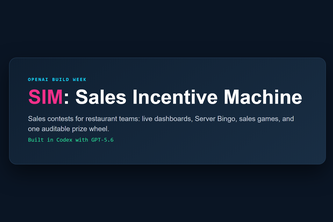
Project: SIM: Sales Incentive Machine
Source: Self-reported submission to the OpenAI 2026 hackathon on Devpost
Analysis basis: Author-supplied tagline and technology stack only; no additional description, traction, or commercial evidence provided
The description states that SIM is a tool that turns sales data into a contest, using AI for goal design and prize wheel mechanics. It appears to be a prototype or proof-of-concept built as part of a hackathon submission. The author claims the product uses AI to “design the goals, print the bingo cards, and spin the prize wheel,” but provides no evidence of actual implementation, user adoption, revenue, or business model.
Key open question: What is the intended commercial application of this tool, and how does it differ from existing sales incentive platforms?
What The Product Actually Is
The description states that SIM “turns your sales data into a contest your team actually plays.” It also claims that AI is used to “design the goals, print the bingo cards, and spin the prize wheel.”
Inference: Based on the author’s self-description, SIM appears to be an application that leverages AI to gamify sales performance by creating contests or challenges for teams. The tool seems to integrate with sales data and uses AI to dynamically generate incentives and reward mechanisms.
Evidence strength: The description is minimal. No screenshots, user flows, or functional details are provided. The author does not describe how the system works beyond its high-level claims.
Positioning & Claim Evolution
The tagline reads: “SIM turns your sales data into a contest your team actually plays, AI designs the goals, prints the bingo cards, and spins the prize wheel.”
Claim: SIM is positioned as an AI-powered gamification tool for sales teams that automates incentive design and execution.
Inference: The positioning suggests a shift from traditional sales incentive tools to a more dynamic, AI-driven approach. However, there’s no evidence of prior versions or evolution in product scope — this appears to be the first iteration.
Evidence strength: Only the tagline is provided; no historical claims or positioning evolution are evident.
Target Customer & ICP
The description does not state who the target customer is. It only mentions that SIM “turns your sales data into a contest your team actually plays.”
Inference: The tool likely targets sales teams or managers looking to increase engagement through gamification, but no explicit customer segment is defined.
Evidence strength: Not evidenced. No mention of industry verticals, company size, or specific use cases.
Business Model & Pricing Evidence
There is no evidence in the description of a business model or pricing structure.
Inference: If this tool were to be commercialized, it might follow a SaaS model, possibly with tiered pricing based on team size or features. However, no such details are provided.
Evidence strength: Not evidenced.
Technical & Delivery Signals
The author lists the following technologies used in development:
- better-sqlite3
- codex
- ffmpeg
- gpt-5.6
- model-context-protocol
- next.js
- node.js
- openai-api
- playwright
- react
- sqlite
- tailwindcss
- typescript
- vitest
Inference: The tool is built with a modern stack, including AI integration (via OpenAI API and GPT), frontend (React/Next.js), backend (Node.js), and testing (Vitest). It may be a web-based application.
Evidence strength: The technology stack is self-reported. No evidence of deployment, scalability, or production readiness.
Traction & Maturity Signals
The description states that this project was submitted to the OpenAI 2026 hackathon on Devpost.
Inference: This indicates that SIM is likely a prototype or proof-of-concept, not yet in production or commercial use. No evidence of user adoption, revenue, or customer engagement is provided.
Evidence strength: Not evidenced.
Competitive Context
The description does not mention any competitors or existing tools in the space.
Inference: The product may be positioned to compete with sales incentive platforms or gamification tools for teams. However, no competitive landscape is described.
Evidence strength: Not evidenced.
Open Questions & Risks
- No commercial traction: No evidence of revenue, customers, or adoption.
- Unproven business model: No pricing or monetization strategy is evident.
- Prototype nature: Submitted to a hackathon; no indication of maturity or production use.
- AI dependency: Relies heavily on AI tools (e.g., GPT), which may not be scalable or cost-effective in a commercial setting.
- Lack of clarity: The description does not explain how the tool works beyond high-level claims.
Evidence strength: These are inferred risks based on the lack of evidence, not direct facts.
Questions the description leaves open
- What is the intended use case for SIM? Who will actually use it?
- How does SIM integrate with existing sales data systems (e.g., Salesforce, HubSpot)?
- Is there a plan to monetize this tool? If so, what is the business model?
- What are the key features that differentiate SIM from existing gamification or incentive tools?
- What is the current development stage of SIM — prototype, MVP, or production-ready?
- How does the AI component work in practice? Is it fully automated or requires user input?
Overall Assessment
Assessment: Not evidenced.
The description provides no evidence of commercial traction, revenue, customer base, or business model. It is unclear whether this is a prototype, a proof-of-concept, or an early-stage product. The lack of any functional details, user feedback, or market positioning makes it impossible to assess the viability or potential for investment or partnership.
Confidence level: Low. This analysis is based entirely on self-reported claims and lacks any corroboration or evidence of actual product use, adoption, or commercialization.
User Stories BotA demo video on every pull request
Get a demo video on every new feature
GitHub App that watches your pull requests and records a narrated, captioned demo.
Save time on demo prep and make informed decisions faster with a video walkthrough of every new feature.
Source
Submitted to the OpenAI 2026 hackathon on Devpost. Project home on Devpost. Back to the full gallery on Devpost.
This competitive analysis was produced by top-founders.com (opens in a new tab)
Generated by a language model from this project's public Devpost page — its tagline and any built-with tags listed there, since the author published no write-up — as captured in August 2026. Short quotations are the author's words. It is an opinion on the idea as a business, not on the people behind it, and it reflects the description as published then. If the project has moved on, request a correction below. The analysis is not independent research and contains no verified traction, revenue or customer data.
An independent guide by KFG International LLC — not affiliated with, endorsed by, or connected to Devpost or OpenAI.