

Archive position — measured, not model output
0 likes on Devpost
2,263 of the 7,850 archived projects have more likes, and 5,587 share exactly 0 — so this project's #2,782 place in the like-ranked listing is a tie-break inside that group, not a ranking.
Projects (log scale)
Likes on Devpost. ▲ marks this project's group.
Show the figures
| Likes | Projects | Share of archive |
|---|---|---|
| 0 | 5,587 | 71.2% |
| 1 | 1,758 | 22.4% |
| 2 | 284 | 3.6% |
| 3–4 | 132 | 1.7% |
| 5–9 | 75 | 1.0% |
| 10+ | 14 | 0.2% |
 User Stories BotA demo video on every pull request
Get a demo video on every new feature
GitHub App that watches your pull requests and records a narrated, captioned demo.
Save time on demo prep and make informed decisions faster with a video walkthrough of every new feature.
Executive Summary
What the company appears to be
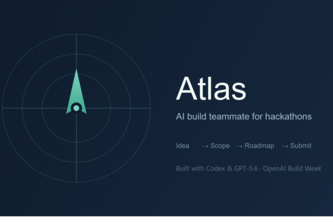
Atlas is an AI-powered planning tool designed for hackathon teams. The author states it takes a raw idea and generates a scoped plan, roadmap, and submission-ready documents — all in a linear flow. It uses Codex and GPT-5.6 as core technologies.
What changed
The project evolved from a simple AI project manager to a multi-agent "startup team" concept, then to an “autonomous AI build team” orchestrator. The authors chose to build the tool that would have prevented them from spiraling through multiple idea iterations, rather than building the most elaborate version.
Single most important open question
Is there evidence of traction or adoption beyond the hackathon context? The description does not indicate any revenue, customers, or usage outside of this single project submission.
Note: This analysis is based solely on the self-reported, unverified account provided by the author. No external verification, historical data, or third-party sources are available. All findings are drawn directly from the supplied project description.
What The Product Actually Is
- The description states that Atlas is an AI build teammate for hackathons.
- It takes a raw idea and turns it into:
- A scoped plan
- A time-boxed roadmap
- Submission-ready documents (README draft, demo script)
- The process includes:
- Idea input in plain language
- Scope generation with tech stack suggestion
- Roadmap creation based on available time
- README and demo script generation
- Live submission checklist aligned with hackathon rules
- It can also analyze existing project ideas outside of the specific hackathon context.
- The tool is built using:
- Codex CLI
- GPT-5.6 as the underlying model
- Express.js backend
- Node.js and JavaScript frontend
Inference: The product appears to be a prototype or proof-of-concept, not a commercial offering. It was built for one hackathon event.
Positioning & Claim Evolution
- The author claims Atlas solves the problem of teams spending too much time deciding what to build instead of building.
- The positioning shifts from:
- Initial idea: AI project manager
- Evolved idea: Multi-agent "startup team"
- Final idea: Autonomous AI build team (orchestrator coordinating agents)
- The authors chose to build the simplest, most functional version that avoids over-engineering — resisting a multi-agent system in favor of a linear pipeline.
- They emphasize:
- Demo-first scoping
- Time-boxed roadmap generation
- Submission checklist built from actual hackathon requirements
Claim: Atlas is positioned as a tool to reduce decision fatigue and accelerate hackathon planning.
Inference: The evolution shows a shift toward simplicity and practicality over complexity.
Target Customer & ICP
- The primary target customer is:
- Hackathon teams
- Specifically, those participating in hackathons like OpenAI Build Week
- The description does not identify any secondary or broader customer segments.
- No mention of:
- Individual developers
- Startups or enterprises
- Non-hackathon users
Claim: Atlas targets hackathon participants who struggle with idea scoping and planning.
Not evidenced: No indication of other personas, use cases, or market expansion plans.
Business Model & Pricing Evidence
- The description does not mention:
- Revenue model
- Pricing structure
- Monetization strategy
- Subscription tiers or one-time fees
- It is unclear whether Atlas will be offered as a free tool, paid service, or integrated into another platform.
- No evidence of:
- Customer acquisition costs
- Unit economics
- Sales channels
Claim: No explicit business model or pricing information is provided.
Inference: The tool appears to be a prototype for a hackathon submission with no commercialization plan stated.
Technical & Delivery Signals
- Built entirely within Codex CLI using GPT-5.6.
- Uses Express.js, Node.js, HTML, CSS, JavaScript.
- API endpoints are scaffolded via Codex and wired manually.
- GPT-5.6 powers reasoning behind pipeline steps, returning structured JSON for rendering.
- The tool supports:
- Idea analysis
- Roadmap generation
- Document drafting (README, demo script)
- Submission checklist tracking
- Challenges included:
- Environment setup issues (PowerShell execution policy, clipboard paste behavior)
- API billing confusion — resolved with MOCK_MODE toggle for zero-cost development
Claim: Atlas uses Codex and GPT-5.6 to automate planning workflows.
Inference: The tool is built on AI-as-a-service but has limited production-grade infrastructure.
Traction & Maturity Signals
- Not evidenced.
- No mention of:
- Users or customers
- Revenue or monetization
- Adoption metrics
- Product usage data
- Iteration history beyond this hackathon submission
- The project is described as a single, end-to-end prototype built in one hackathon cycle.
Claim: No traction or maturity indicators are present.
Inference: This is a one-off hackathon project with no evidence of ongoing development or user engagement.
Competitive Context
- Not evidenced.
- No mention of:
- Competitors
- Market landscape
- Differentiation from existing tools
- Prior art in AI-powered planning or hackathon support tools
- The description does not reference similar products or platforms that might offer comparable functionality.
Claim: No competitive positioning or market context is provided.
Inference: There is no indication of how Atlas fits into the broader ecosystem of planning or ideation tools.
Open Questions & Risks
- Unproven commercial viability: The tool exists only as a hackathon prototype with no evidence of real-world adoption.
- Limited scope: Designed for hackathons, not general-purpose planning or development workflows.
- Dependency on AI APIs: Relies heavily on Codex and OpenAI API access — subject to cost, availability, and rate limits.
- Lack of scalability: Built for one-time use in a single hackathon environment; unclear if it can be extended beyond that.
- No monetization strategy: No indication of how the tool would generate revenue or sustain itself post-hackathon.
Inference: The project lacks commercial traction and may not scale beyond its initial use case.
Questions the description leaves open
- What is the intended path from this hackathon prototype to a product that could be used by teams outside of hackathons?
- How would you monetize Atlas if it were extended beyond hackathon planning?
- Are there any plans to support other types of projects or workflows beyond hackathons?
- What are the technical limitations or bottlenecks in scaling this tool for broader use?
- Have you considered how to handle API costs and billing when moving from demo mode to live usage?
Overall Assessment
- Not evidenced: No financials, traction, or customer data are available.
- The project is described as a hackathon submission with no indication of commercial intent or viability beyond the event.
- It is unclear whether Atlas will evolve into a product or remain a prototype.
Assessment: Based on the self-reported description alone, there is insufficient evidence to support an investment or partnership decision. This appears to be a proof-of-concept rather than a scalable business opportunity.
User Stories BotA demo video on every pull request
Get a demo video on every new feature
GitHub App that watches your pull requests and records a narrated, captioned demo.
Save time on demo prep and make informed decisions faster with a video walkthrough of every new feature.
Source
Submitted to the OpenAI 2026 hackathon on Devpost. Project home on Devpost. Back to the full gallery on Devpost.
This competitive analysis was produced by top-founders.com (opens in a new tab)
Generated by a language model from this project's public Devpost page — its tagline, the author's own write-up and any built-with tags listed there — as captured in August 2026. Short quotations are the author's words. It is an opinion on the idea as a business, not on the people behind it, and it reflects the description as published then. If the project has moved on, request a correction below. The analysis is not independent research and contains no verified traction, revenue or customer data.
An independent guide by KFG International LLC — not affiliated with, endorsed by, or connected to Devpost or OpenAI.