

Archive position — measured, not model output
1 like on Devpost
505 of the 7,850 archived projects have more likes, and 1,758 share exactly 1 — so this project's #1,923 place in the like-ranked listing is a tie-break inside that group, not a ranking.
Projects (log scale)
Likes on Devpost. ▲ marks this project's group.
Show the figures
| Likes | Projects | Share of archive |
|---|---|---|
| 0 | 5,587 | 71.2% |
| 1 | 1,758 | 22.4% |
| 2 | 284 | 3.6% |
| 3–4 | 132 | 1.7% |
| 5–9 | 75 | 1.0% |
| 10+ | 14 | 0.2% |
 User Stories BotA demo video on every pull request
Get a demo video on every new feature
GitHub App that watches your pull requests and records a narrated, captioned demo.
Save time on demo prep and make informed decisions faster with a video walkthrough of every new feature.
Executive Summary
What the company appears to be
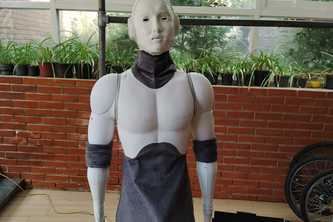
Silex is a self-reported physical social robot designed to interact with users through voice, text, and gesture. The author describes it as an embodied AI assistant that moves beyond screen-based interfaces by integrating conversational intelligence (via GPT-5.6), expressive motion (via inverse-kinematics), local perception (MediaPipe, EfficientDet, YAMNet), and deterministic motor control.
What changed
The project evolved during OpenAI Build Week to incorporate a measured inverse-kinematics (IK) architecture that replaces manual servo pose estimation with mathematically grounded physical movement planning. This change was implemented using Codex for code generation and simulation, while the author handled physical validation and safety enforcement.
Single most important open question
Is there any evidence of real-world deployment or user testing beyond the developer's own use? The description states no revenue, customers, or traction data exist; all claims are self-reported and unverified.
What The Product Actually Is
The description states that Silex is a physical social robot controlled through voice, browser, and mobile interfaces. It uses GPT-5.6 to interpret user instructions and generate structured responses containing:
- text for speech;
- detected intent;
- emotion;
- intensity;
- movement sequence.
It speaks using Azure neural TTS and coordinates facial and body movements via servos. The system includes local perception (MediaPipe, EfficientDet, YAMNet), memory (SQLite), WhatsApp integration, Jitsi meetings, and remote access via Tailscale.
The robot has a measured inverse-kinematics foundation built with Codex assistance, enabling Cartesian-space movement planning instead of fixed servo angles.
Evidence
- Author's own write-up.
- Technology stack includes: Node.js, ESP32, Azure TTS, OpenAI Responses API, MediaPipe, SQLite, FFmpeg, WhatsApp Web, Jitsi, browser-based control.
Inference The robot is described as a prototype or proof-of-concept rather than a commercial product. No evidence of production, distribution, or sales channels exists.
Positioning & Claim Evolution
The author positions Silex as an embodied AI assistant that transforms generative AI from screen-based to physical interaction. The tagline emphasizes awareness of body, surroundings, and device interaction, aiming to make personal generative AI "safe and expressive."
Before Build Week, Silex already supported voice interaction, expressive choreographies, local perception, WhatsApp communication, memory, camera streaming, and remote control.
During Build Week, the focus shifted toward replacing manual servo pose estimation with a measured inverse-kinematics system. This was intended to improve safety, expressiveness, and scalability of motion planning.
Evidence
- Self-reported evolution in development.
- Claim that prior version lacked measured IK; new version uses analytical solvers and simulation tools.
Inference The positioning suggests Silex aims to be a platform for exploring embodied AI in daily life. No evidence indicates market positioning beyond personal experimentation or hackathon submission.
Target Customer & ICP
Not evidenced.
The description does not identify specific customer segments, personas, or use cases beyond the developer’s own interaction with the robot. There is no mention of target industries, end-users, or adoption scenarios outside of the author's testing environment.
Evidence
- No stated target audience.
- No evidence of market research, user interviews, or persona development.
Business Model & Pricing Evidence
Not evidenced.
There is no indication of pricing models, monetization strategies, or business structure. The project appears to be a personal or hackathon endeavor without any commercial framework described.
Evidence
- No mention of revenue streams, subscriptions, licensing, or sales.
- No evidence of B2B or consumer-facing offerings.
Technical & Delivery Signals
Silex integrates several technologies including:
- AI/ML: GPT-5.6, MediaPipe, EfficientDet, YAMNet, TensorFlow Lite
- Hardware: ESP32 motor controllers, servos, RGB-D camera (planned)
- Software: Node.js, Express.js, JavaScript, SQLite, Tailscale, WhatsApp Web API
- Perception & Control: Inverse kinematics, local memory, motion scheduling, safety clamps
The system runs on a Windows PC with integrated graphics and monitors performance to reduce perception frequency under overload.
It supports:
- Wake-word voice control;
- Multilingual neural speech;
- Facial expressions and gesture coordination;
- Local perception without external AI services;
- Deterministic motor control with emergency stopping;
- Simulated movement preview before physical execution;
- Automated testing (216 tests, zero failures).
Evidence
- Author's own write-up.
- Technology tags list all components used.
Inference The architecture shows a strong emphasis on local processing and deterministic control to ensure safety. However, no evidence of scalability or production readiness is provided.
Traction & Maturity Signals
Not evidenced.
There is no mention of users, customers, installations, or adoption metrics. The project is described as a prototype developed over time, but no data on usage, retention, or impact is included.
Evidence
- No revenue, ARR, headcount, or customer base mentioned.
- No evidence of product-market fit or traction beyond the developer's own use.
Competitive Context
Not evidenced.
The description does not reference competitors, market size, or competitive positioning. It lacks any comparison to existing robots or AI assistants in the space.
Evidence
- No mention of competing products or markets.
- No evidence of competitive analysis or differentiation strategy.
Open Questions & Risks
- Unverified Claims: All information is self-reported and unverified.
- No Traction: No evidence of users, customers, or revenue.
- Prototype Status: The project appears to be a personal development effort, not a commercial product.
- Safety Limitations: Some hardware components are marked as provisional (e.g., B20 motor).
- Limited Scope: No indication of broader platform features or ecosystem development.
- Single Developer: Team size is listed as one person, suggesting limited resources for scaling.
Evidence
- Author’s own write-up.
- No external validation or third-party sources.
Questions the description leaves open
- What specific problems are you trying to solve with Silex? How do you plan to validate those needs?
- Are there any real-world tests or feedback from users beyond your own experience?
- What is the timeline for moving from prototype to a deployable product?
- Do you have plans for hardware manufacturing, supply chain, or distribution?
- How do you intend to scale the inverse-kinematics system beyond current capabilities?
- Have you considered regulatory compliance or safety standards for physical robots in consumer environments?
- What are your long-term goals for Silex beyond the current prototype?
Overall Assessment
Not evidenced.
There is no evidence of funding rounds, valuations, or investment interest. The project is described as a personal development effort submitted to a hackathon, with no indication of commercial viability or strategic value.
Evidence
- No financial data, funding history, or investor involvement.
- No evidence of market demand or competitive positioning.
Inference At this stage, Silex appears to be an experimental platform for exploring embodied AI. It lacks the traction, business model, or scalability needed for investment or partnership consideration.
User Stories BotA demo video on every pull request
Get a demo video on every new feature
GitHub App that watches your pull requests and records a narrated, captioned demo.
Save time on demo prep and make informed decisions faster with a video walkthrough of every new feature.
Source
Submitted to the OpenAI 2026 hackathon on Devpost. Project home on Devpost. Back to the full gallery on Devpost.
This competitive analysis was produced by top-founders.com (opens in a new tab)
Generated by a language model from this project's public Devpost page — its tagline, the author's own write-up and any built-with tags listed there — as captured in August 2026. Short quotations are the author's words. It is an opinion on the idea as a business, not on the people behind it, and it reflects the description as published then. If the project has moved on, request a correction below. The analysis is not independent research and contains no verified traction, revenue or customer data.
An independent guide by KFG International LLC — not affiliated with, endorsed by, or connected to Devpost or OpenAI.