

Archive position — measured, not model output
1 like on Devpost
505 of the 7,850 archived projects have more likes, and 1,758 share exactly 1 — so this project's #1,925 place in the like-ranked listing is a tie-break inside that group, not a ranking.
Projects (log scale)
Likes on Devpost. ▲ marks this project's group.
Show the figures
| Likes | Projects | Share of archive |
|---|---|---|
| 0 | 5,587 | 71.2% |
| 1 | 1,758 | 22.4% |
| 2 | 284 | 3.6% |
| 3–4 | 132 | 1.7% |
| 5–9 | 75 | 1.0% |
| 10+ | 14 | 0.2% |
 User Stories BotA demo video on every pull request
Get a demo video on every new feature
GitHub App that watches your pull requests and records a narrated, captioned demo.
Save time on demo prep and make informed decisions faster with a video walkthrough of every new feature.
Executive Summary
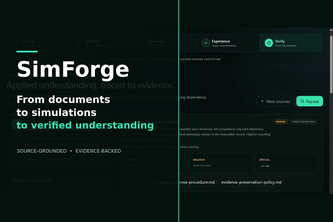
What the company appears to be: SimForge, as described by its author, is a self-reported AI-powered system that transforms documents and media into source-grounded interactive simulations for learning and assessment. It uses generative AI (GPT-5.6) to interpret uploaded materials and generate structured knowledge models, which are then compiled deterministically into executable simulation scenarios. The system records learner actions and evaluates understanding through a mix of AI interpretation and deterministic scoring.
What changed: The author states that SimForge evolved from an individual project called Provexar, initially built for personal use in preparing for a private pilot checkride. It was then generalized to apply across domains such as cybersecurity, workplace conflicts, chemical spills, and software deployment failures.
The single most important open question: Is there evidence of traction or adoption beyond the author's own development work? The description contains no data on users, revenue, customers, or market validation — only claims about functionality and architecture.
What The Product Actually Is
The description states that SimForge is a system that:
- Transforms documents and media into source-grounded interactive simulations.
- Uses GPT-5.6 to interpret uploaded materials and produce structured knowledge models (competencies, rules, procedures, evidence requirements).
- Requires human approval of the knowledge model before simulation generation begins.
- Generates semantic scenario blueprints using GPT-5.6, which are then compiled deterministically into executable simulations.
- Records learner actions and evaluates understanding through a deterministic process.
- Separates assessment from narrative explanation to avoid unsupported claims by AI.
It is built with technologies including Next.js, TypeScript, Zod, OpenAI APIs (Responses API, Files, Structured Outputs), vector stores, file search, real-time transcription, text-to-speech, and edge middleware.
Inference: The system appears designed for training and assessment in professional or educational domains where structured knowledge and safety-critical decision-making are important. It is not a general-purpose chatbot but an AI-augmented simulation engine with deterministic safeguards.
Positioning & Claim Evolution
The author states that SimForge evolved from Provexar, which was originally built for personal use in preparing for a private pilot checkride. The idea was generalized to apply across domains such as cybersecurity, workplace conflicts, chemical spills, and software deployment failures.
Claim: SimForge can be applied to “almost any domain” and supports simulations across unrelated fields.
Inference: This suggests the system is positioned as a cross-domain training platform, not limited to one industry or use case. However, no evidence of actual deployment or customer feedback is provided.
Target Customer & ICP
The description does not identify specific target customers or personas. It implies that users are individuals or organizations with reference materials they want to convert into simulations for learning and assessment.
Claim: SimForge supports simulations across domains like cybersecurity incident response, workplace conflicts of interest, chemical-spill response, and software deployment failure.
Inference: The system may appeal to training providers, educational institutions, or corporate learning teams looking to create domain-specific simulations from internal documentation. No explicit ICP is defined.
Business Model & Pricing Evidence
There is no evidence in the description of a business model or pricing structure. The author describes the system as a prototype built for a hackathon and does not mention monetization, licensing, subscriptions, or any commercial offering.
Claim: The next step includes adding team analytics, simulation libraries, and collaborative workflows — suggesting a potential move toward enterprise or subscription-based offerings.
Inference: If this is the direction taken, it may imply a SaaS model with tiered access or usage-based pricing. However, no such details are provided.
Technical & Delivery Signals
The system uses:
- GPT-5.6 for interpretation and blueprint generation
- Deterministic compilation to convert blueprints into executable simulations
- Structured outputs via OpenAI Responses API
- Real-time transcription and text-to-speech capabilities
- Vector stores and file search for source material handling
- Resumable checkpoints for long-running ingestion tasks
- Protection against prompt injection by treating uploads as reference, not instructions
Claim: SimForge separates evidence collection from narrative explanation to avoid unsupported AI claims.
Inference: This suggests a hybrid architecture combining generative AI with deterministic validation and auditability features. The system is designed to be safe and accountable in high-stakes environments.
Traction & Maturity Signals
The description states that the author successfully ran an unseen source package through the complete pipeline, including ingestion, interpretation, human approval, blueprint generation, compilation, simulation, evidence collection, assessment, and tutoring.
It also mentions testing source-change sensitivity — when a threshold in the source changed from 8% to 11%, that change propagated correctly through all stages.
Claim: SimForge retains unsafe attempts instead of erasing them after learner recovery, showing what happened, how the learner responded, and which source supports each conclusion.
Inference: This indicates a mature system with built-in auditing and feedback mechanisms. However, there is no evidence of external users or real-world deployment beyond the author’s own testing.
Competitive Context
The description does not provide any information about competitors or market positioning. It does not name similar tools or platforms in the space of AI-powered simulations, training systems, or educational technology.
Claim: The system supports simulations across unrelated domains, implying it is not tied to one industry or scenario type.
Inference: This could place SimForge in a niche between traditional e-learning platforms and AI-augmented simulation engines. No competitive landscape is described.
Open Questions & Risks
- No traction or adoption evidence: The system appears to be a prototype built for a hackathon with no known users, customers, or revenue.
- Unverified claims about generality: The author claims SimForge works across unrelated domains, but there is no demonstration of this in practice beyond one test case.
- Single-person team: The project is described as being built by one person (Mikhail Kozyrev), raising questions about scalability and long-term development capacity.
- No commercialization path: No mention of monetization, pricing, or go-to-market strategy.
- Self-reported architecture: All technical claims are self-reported without independent verification.
Questions the description leaves open
- What specific domains have you tested SimForge in beyond the examples given?
- How do you plan to scale beyond a single developer?
- Have you validated the effectiveness of the simulations with real learners or subject-matter experts?
- What is your roadmap for monetization and customer acquisition?
- Can you demonstrate how the deterministic components ensure safety and accountability in practice?
- Are there any known limitations or edge cases where the system fails to perform as described?
Overall Assessment
Not evidenced: There is no evidence of revenue, customers, traction, or market validation beyond the author’s own account. The system is described as a prototype built for a hackathon with no commercial activity.
Confidence level: Low — based entirely on self-reported claims and no external data.
Assessment: This is an early-stage idea with strong technical architecture and clear intent to build a cross-domain simulation platform. However, without evidence of traction, adoption, or a viable business model, it does not yet meet the criteria for investment or partnership consideration at this stage.
User Stories BotA demo video on every pull request
Get a demo video on every new feature
GitHub App that watches your pull requests and records a narrated, captioned demo.
Save time on demo prep and make informed decisions faster with a video walkthrough of every new feature.
Source
Submitted to the OpenAI 2026 hackathon on Devpost. Project home on Devpost. Back to the full gallery on Devpost.
This competitive analysis was produced by top-founders.com (opens in a new tab)
Generated by a language model from this project's public Devpost page — its tagline, the author's own write-up and any built-with tags listed there — as captured in August 2026. Short quotations are the author's words. It is an opinion on the idea as a business, not on the people behind it, and it reflects the description as published then. If the project has moved on, request a correction below. The analysis is not independent research and contains no verified traction, revenue or customer data.
An independent guide by KFG International LLC — not affiliated with, endorsed by, or connected to Devpost or OpenAI.