

Archive position — measured, not model output
0 likes on Devpost
2,263 of the 7,850 archived projects have more likes, and 5,587 share exactly 0 — so this project's #5,851 place in the like-ranked listing is a tie-break inside that group, not a ranking.
Projects (log scale)
Likes on Devpost. ▲ marks this project's group.
Show the figures
| Likes | Projects | Share of archive |
|---|---|---|
| 0 | 5,587 | 71.2% |
| 1 | 1,758 | 22.4% |
| 2 | 284 | 3.6% |
| 3–4 | 132 | 1.7% |
| 5–9 | 75 | 1.0% |
| 10+ | 14 | 0.2% |
 User Stories BotA demo video on every pull request
Get a demo video on every new feature
GitHub App that watches your pull requests and records a narrated, captioned demo.
Save time on demo prep and make informed decisions faster with a video walkthrough of every new feature.
Executive Summary
What the company appears to be
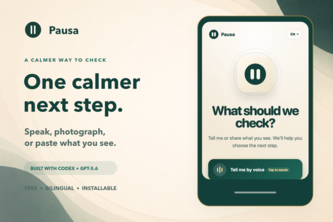
Pausa is a self-reported open-source, bilingual web app designed to help people in moments of digital uncertainty — especially those who are not digitally native — by offering a calm, non-judgmental space to analyze suspicious messages or interactions. It uses AI models (primarily OpenAI GPT-5.6 and others) to assess risk signals such as urgency, fear, impersonation, and pressure, and recommends safer next steps.
What changed
The author, Dex Aguilar, built Pausa after a family member was scammed via SMS. The project evolved from an idea into a functional prototype using AI tools like Codex, GPT-4o-mini-tts, and OpenAI Responses API. It is described as a mobile-first Progressive Web App (PWA) that supports voice input, screenshots, text paste, and image uploads.
Single most important open question
Is there evidence of real-world usage or testing with target users beyond the author’s own synthetic scenarios?
Note: This analysis is based entirely on the self-reported description provided by the author. No external verification, traction data, revenue figures, or customer feedback are available.
What The Product Actually Is
- The description states that Pausa is a free, bilingual web app.
- It supports multiple input methods: voice, photo of screen, screenshot, and pasted text.
- It uses AI models (e.g., GPT-5.6, gpt-4o-transcribe) to analyze suspicious content.
- It provides risk levels, plain-language explanations, and safer next steps.
- The app is designed for people who are not digitally native.
- It works on phones, tablets, and web, and can be installed as a PWA without an app store.
- There is no account, no analytics, no background monitoring, and no database of submissions.
- It includes a guided example so users understand the experience without sharing private data.
Inference: The product appears to be built for low-trust, high-anxiety digital moments, especially around scams or fraud. It is not described as a full-fledged security platform but rather a helpful pause button in uncertain situations.
Positioning & Claim Evolution
- The author states that Pausa was built to fill a gap in family support during scam attempts.
- It aims to replicate the experience of talking to someone trusted who understands tech and security.
- The app is positioned as a calm alternative to alarmist tools, focusing on understanding rather than judgment.
- It does not claim to definitively identify fraud; instead, it encourages users to verify through trusted channels.
Claim: Pausa is described as an open-source tool that helps people pause before acting on suspicious messages.
Inference: The positioning reflects a shift from reactive tools (e.g., antivirus) to proactive, empathetic support in digital moments of uncertainty.
Target Customer & ICP
- The description states Pausa is designed for people who are not digitally native.
- It is intended for older adults, especially those vulnerable to scams.
- It targets individuals who may feel uncertain or afraid when encountering suspicious messages.
- The app is described as useful for family members or caregivers who want to help others navigate digital threats.
Inference: The ICP likely includes older users, low-tech users, and people in high-risk situations (e.g., elderly relatives).
Not evidenced: No specific demographics, usage data, or customer segments are provided.
Business Model & Pricing Evidence
- The app is described as free.
- It is built as an open-source project.
- There is no mention of monetization, subscriptions, or paid features.
- The author does not describe any revenue model or pricing strategy.
Not evidenced: No evidence of a business model beyond the free, open-source nature of the tool.
Technical & Delivery Signals
- Built with: Cloudflare, Codex, GPT-4o-mini-tts, gpt-4o-transcribe, Next.js, OpenAI Responses API, React, TypeScript, Vite.
- Uses mobile-first PWA architecture.
- Voice input is transcribed using gpt-4o-transcribe and read aloud via gpt-4o-mini-tts.
- AI models are used to analyze risk signals, with results constrained to a structured output format (risk level, explanation, signals, next steps).
- The system is designed to not store or monitor user data.
- Voice recordings begin only after an explicit tap.
Inference: The technical stack suggests a privacy-first, AI-assisted tool, built with modern web and AI technologies.
Not evidenced: No details on scalability, infrastructure, or long-term maintenance plans.
Traction & Maturity Signals
- The author tested 12 synthetic scenarios covering various scam types.
- All 12 passed against the public production endpoint.
- Testing revealed real product issues (e.g., image analysis performance).
- A demo must not pretend to be live analysis; it falls back to a clearly labeled synthetic walkthrough if API access fails.
Not evidenced: No evidence of real-world usage, user feedback, or adoption beyond author’s own testing.
Inference: The product is in an early prototype phase, with limited external validation.
Competitive Context
- The description does not mention direct competitors.
- It is positioned as a tool for digital uncertainty, not general cybersecurity.
- It is described as a personal help button rather than a platform or service.
- It focuses on empathy and clarity, which may differentiate it from traditional scam detection tools.
Not evidenced: No competitive landscape, market analysis, or comparison to existing tools.
Inference: Pausa could be seen as a niche tool in the broader anti-scam or digital literacy space.
Open Questions & Risks
- The app is described as self-built by one person (team size: 1).
- It is not verified to have real-world usage or user feedback.
- It relies heavily on AI models, which may introduce accuracy or bias risks in scam detection.
- There is no evidence of a go-to-market strategy, user acquisition plan, or long-term roadmap.
- The app is described as open-source, but the author does not clarify how this impacts scalability or monetization.
Inference: Risk of limited adoption due to lack of traction, user testing, and commercial viability.
Not evidenced: No evidence of scaling, funding, or long-term sustainability.
Questions the description leaves open
- What real-world feedback have you received from users beyond your own synthetic tests?
- How do you plan to validate the accuracy of AI-generated risk assessments in live scenarios?
- Are there any plans for monetization or commercialization beyond open-source?
- How will you ensure privacy and safety if the tool is adopted at scale?
- What are the key challenges in expanding beyond the current bilingual (Spanish/English) support?
Overall Assessment
- The project is described as a self-built prototype with no evidence of traction, revenue, or user adoption.
- It is positioned as a personal tool for family support, not a scalable business.
- There is no indication of a commercial model, funding, or growth strategy.
- It is built with AI and web technologies but lacks any demonstration of real-world impact.
Assessment: Not ready for investment or partnership.
Confidence: Low — based on self-reported evidence only, with no external validation or traction data.
Next step: If the author has begun user testing or feedback loops, that would be a key signal to explore further.
User Stories BotA demo video on every pull request
Get a demo video on every new feature
GitHub App that watches your pull requests and records a narrated, captioned demo.
Save time on demo prep and make informed decisions faster with a video walkthrough of every new feature.
Source
Submitted to the OpenAI 2026 hackathon on Devpost. Project home on Devpost. Back to the full gallery on Devpost.
This competitive analysis was produced by top-founders.com (opens in a new tab)
Generated by a language model from this project's public Devpost page — its tagline, the author's own write-up and any built-with tags listed there — as captured in August 2026. Short quotations are the author's words. It is an opinion on the idea as a business, not on the people behind it, and it reflects the description as published then. If the project has moved on, request a correction below. The analysis is not independent research and contains no verified traction, revenue or customer data.
An independent guide by KFG International LLC — not affiliated with, endorsed by, or connected to Devpost or OpenAI.