

Archive position — measured, not model output
0 likes on Devpost
2,263 of the 7,850 archived projects have more likes, and 5,587 share exactly 0 — so this project's #5,853 place in the like-ranked listing is a tie-break inside that group, not a ranking.
Projects (log scale)
Likes on Devpost. ▲ marks this project's group.
Show the figures
| Likes | Projects | Share of archive |
|---|---|---|
| 0 | 5,587 | 71.2% |
| 1 | 1,758 | 22.4% |
| 2 | 284 | 3.6% |
| 3–4 | 132 | 1.7% |
| 5–9 | 75 | 1.0% |
| 10+ | 14 | 0.2% |
 User Stories BotA demo video on every pull request
Get a demo video on every new feature
GitHub App that watches your pull requests and records a narrated, captioned demo.
Save time on demo prep and make informed decisions faster with a video walkthrough of every new feature.
Executive Summary
What the company appears to be
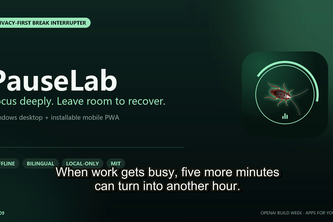
PauseLab is a self-reported desktop and mobile application designed to interrupt long periods of focused work or screen use with attention-grabbing creature animations. It is described as a privacy-first, local-only tool that does not collect user data or rely on backend systems.
What changed
The project was submitted as part of the OpenAI 2026 hackathon and is presented as a clean-room rewrite of an earlier concept. The author states it was built using AI tools like Codex and GPT-5.6, with a focus on reproducible local workflows for animation and user experience.
Single most important open question
Is there evidence that PauseLab has gained any traction or user adoption beyond its initial development phase?
What The Product Actually Is
The description states that PauseLab is:
- A bilingual Windows desktop app and installable mobile PWA
- Designed to interrupt long periods of focused work or screen use
- Uses transparent creature animations (cockroach, scorpion, ant, beetle, cricket, centipede) across one or more monitors on Windows
- Includes local-only check-ins for resting heart rate, sleep, physical activity, and perceived stress
- Provides concise general recovery guidance and a simple meal idea
- Has no account system, backend, telemetry, or health-data upload endpoint
It is described as a clean-room rewrite of an earlier project, not copying its source code or structure.
Evidence
- The author describes the app’s features in detail.
- It includes technical implementation details like Electron, PWA, and AI-assisted workflows.
- No mention of revenue, customers, or usage metrics.
Inference The product is a local-first, privacy-focused wellbeing tool, built for personal use rather than enterprise or commercial adoption.
Positioning & Claim Evolution
The author states that PauseLab was inspired by the "memorable on-screen cockroach reminder" from another project. It evolved into a broader opt-in wellbeing tool for desktop and mobile.
Key claims:
- It makes it harder to ignore what your body is asking for.
- It is a privacy-first tool with no backend or telemetry.
- It provides local-only wellbeing data collection and recovery guidance.
- It avoids medical diagnosis or treatment claims.
The positioning appears to be:
- A personal productivity and wellness aid
- Focused on interrupting focus without tracking or data collection
- Positioned as a lightweight, opt-in intervention
Evidence
- The tagline and self-description reflect these claims.
- No evidence of branding, marketing, or customer-facing positioning beyond the author’s own words.
Target Customer & ICP
The description does not name specific customers or personas. It implies:
- Users who engage in long periods of screen use or focused work
- People interested in wellbeing interventions that do not require data sharing
- Individuals seeking opt-in break reminders with attention-grabbing visuals
It is described as a personal tool, not a commercial product for businesses.
Evidence
- No explicit customer segments, personas, or buyer profiles.
- The app is framed as a self-contained, local-first experience.
Inference The ICP likely includes remote workers, students, developers, and others who spend long hours on screens and seek non-intrusive, privacy-preserving break reminders.
Business Model & Pricing Evidence
There is no evidence of:
- Revenue streams
- Pricing models
- Monetization strategy
- Paid features or tiers
The app is described as:
- Local-only
- No account system
- No backend or telemetry
- No health-data upload endpoint
Evidence
- The author explicitly states that the app has no account, backend, telemetry, or health-data upload.
- No mention of subscriptions, in-app purchases, or paid features.
Inference The business model is not commercial, and likely non-revenue-generating. It may be a personal project or prototype.
Technical & Delivery Signals
The app was built using:
- Electron for desktop
- PWA for mobile
- AI tools: Codex, GPT-5.6
- OpenCV, FFmpeg, Python, Node.js, JavaScript, HTML5, CSS3, Pillow
Key technical features:
- Transparent, click-through overlays
- Multi-display support
- Offline focus timing and notifications
- Screen wake lock
- Local-only wellbeing logging
- Creature animation pipeline using AI-assisted video processing
Evidence
- The author describes the tech stack and implementation process.
- Mention of reproducible local workflows, automated checks, and packaging.
Inference The technical approach is self-contained, AI-enhanced, and local-first, with no reliance on external services or cloud infrastructure.
Traction & Maturity Signals
There is no evidence of:
- User adoption
- Customer base
- Revenue or monetization
- Product usage metrics
- Market traction beyond the hackathon submission
The project is described as a hackathon submission, and no data on downloads, retention, or user feedback is provided.
Evidence
- The app was submitted to the OpenAI 2026 hackathon.
- No mention of users, reviews, or market performance.
Inference PauseLab appears to be in an early-stage prototype or proof-of-concept phase, not a mature product with traction.
Competitive Context
The description does not reference:
- Competitors
- Market analysis
- Prior art or similar tools
It is implied that PauseLab is a novel approach to break reminders, using creature animations and local-first design.
Evidence
- The author references an earlier project (cockroach reminder) as inspiration.
- No mention of existing apps or platforms in the space.
Inference
The competitive landscape is not clearly defined, but it likely includes:
- Focus timers (e.g., Pomodoro)
- Wellness apps
- Break-interruption tools
Open Questions & Risks
Key risks and open questions based on the description:
- No revenue or monetization strategy — raises questions about sustainability.
- No user data or feedback — indicates no real-world testing or adoption.
- Self-reported only — no independent verification of claims or performance.
- Hackathon project — likely not a commercial product in production.
- Local-only architecture — limits scalability and potential for growth.
Evidence
- No mention of users, customers, or monetization.
- The app is described as a hackathon submission.
Questions the description leaves open
- What is the intended user base beyond the initial prototype?
- Are there any plans to monetize the product or generate revenue?
- Has the app been tested with real users, and what feedback has been received?
- How does the team plan to scale beyond a single developer?
- Is there any intention to expand beyond the current feature set (e.g., health data integration)?
- What are the long-term goals for PauseLab beyond the hackathon?
Overall Assessment
PauseLab is presented as a self-contained, local-first productivity tool built for personal use or early-stage experimentation. It is described as a hackathon submission, with no evidence of traction, revenue, or commercial adoption.
It appears to be:
- A prototype or proof-of-concept
- Not a product ready for investment or partnership
- Built by one developer using AI tools and local workflows
Confidence Low
Reasoning
The description is entirely self-reported, with no external validation, user data, or commercial evidence.
Assessment PauseLab does not currently meet the criteria for investment or partnership. It may be a useful prototype or personal project but lacks commercial viability or traction.
User Stories BotA demo video on every pull request
Get a demo video on every new feature
GitHub App that watches your pull requests and records a narrated, captioned demo.
Save time on demo prep and make informed decisions faster with a video walkthrough of every new feature.
Source
Submitted to the OpenAI 2026 hackathon on Devpost. Project home on Devpost. Back to the full gallery on Devpost.
This competitive analysis was produced by top-founders.com (opens in a new tab)
Generated by a language model from this project's public Devpost page — its tagline, the author's own write-up and any built-with tags listed there — as captured in August 2026. Short quotations are the author's words. It is an opinion on the idea as a business, not on the people behind it, and it reflects the description as published then. If the project has moved on, request a correction below. The analysis is not independent research and contains no verified traction, revenue or customer data.
An independent guide by KFG International LLC — not affiliated with, endorsed by, or connected to Devpost or OpenAI.