

Archive position — measured, not model output
1 like on Devpost
505 of the 7,850 archived projects have more likes, and 1,758 share exactly 1 — so this project's #1,929 place in the like-ranked listing is a tie-break inside that group, not a ranking.
Projects (log scale)
Likes on Devpost. ▲ marks this project's group.
Show the figures
| Likes | Projects | Share of archive |
|---|---|---|
| 0 | 5,587 | 71.2% |
| 1 | 1,758 | 22.4% |
| 2 | 284 | 3.6% |
| 3–4 | 132 | 1.7% |
| 5–9 | 75 | 1.0% |
| 10+ | 14 | 0.2% |
 User Stories BotA demo video on every pull request
Get a demo video on every new feature
GitHub App that watches your pull requests and records a narrated, captioned demo.
Save time on demo prep and make informed decisions faster with a video walkthrough of every new feature.
Executive Summary
What the company appears to be
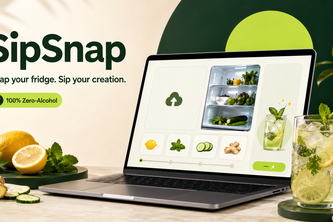
SipSnap is a self-reported browser-based web application that allows users to upload or capture a photo of their fridge or pantry and receive a structured, non-alcoholic drink recipe based on detected ingredients. The app claims to run entirely on-device using open-source AI models, without requiring an account, API keys, or server-side processing.
What changed
The project was submitted as part of the OpenAI 2026 hackathon. It is described as a prototype built in a short timeframe with no evidence of revenue, customers, or product-market fit beyond its own self-reporting.
Single most important open question
Is there any evidence that SipSnap has achieved meaningful user adoption or traction, or whether it has moved beyond the prototype stage?
What The Product Actually Is
The description states that SipSnap is a browser-based web application designed to generate non-alcoholic drink recipes from fridge or pantry photos. It uses:
- On-device vision model (Xenova/clip-vit-base-patch32)
- Transformers.js
- React, Next.js, TypeScript, Tailwind CSS
Users can:
- Upload or capture a photo of their fridge
- Review detected ingredients before generating a recipe
- Download the recipe as structured JSON or print a recipe card
The app is described as running entirely in the browser with no server-side processing.
Inference The product appears to be a proof-of-concept or early-stage prototype, not a commercial offering. No evidence of monetization or customer usage exists.
Positioning & Claim Evolution
The description positions SipSnap as:
- A privacy-first, family-friendly alternative to existing drink recipe tools
- Designed specifically for people who prefer non-alcoholic beverages
- Free, accessible, and zero-proof (no alcohol in recipes)
- Built without paid APIs or subscriptions
It claims to be:
- Zero-alcohol by design
- On-device AI processing
- No account required
- No personal data collected
Inference The positioning is focused on privacy, accessibility, and family-friendliness. It does not appear to have evolved from a broader product vision into a scalable business model.
Target Customer & ICP
The description states that SipSnap targets:
- People who have fruits, herbs, juices, and mixers in their fridge but don’t know how to combine them
- Families, students, health-conscious users, and privacy-conscious users
It is described as a family-friendly tool, with no mention of enterprise or B2B use cases.
Inference The ICP seems to be casual home users, not commercial or institutional customers. No evidence of segmentation beyond general user types.
Business Model & Pricing Evidence
The description states that SipSnap is:
- Free
- Does not require an account
- Does not use paid APIs or subscriptions
There is no mention of monetization strategies, pricing tiers, or revenue models.
Inference No evidence of a business model beyond a free prototype. The product does not appear to be monetized or sold.
Technical & Delivery Signals
The app is built with:
- Next.js
- React
- TypeScript
- Tailwind CSS
- Transformers.js
- CLIP vision model (Xenova/clip-vit-base-patch32)
- On-device processing
It uses:
- Browser-based AI for ingredient recognition
- No server-side image processing or API usage
- Structured JSON output
- Print-friendly recipe cards
Inference The technical stack is modern and aligned with a lightweight, privacy-focused web app. However, no evidence of production deployment, scalability, or performance data.
Traction & Maturity Signals
The description states:
- SipSnap was built for the OpenAI 2026 hackathon
- It includes a demo mode that works without uploading a photo
- The team size is one person (Qamar Qamar)
- No mention of users, customers, or usage metrics
Inference There is no evidence of traction, adoption, or product maturity beyond the prototype stage.
Competitive Context
The description notes:
- Most drink-recipe tools focus on alcoholic cocktails
- SipSnap aims to be a family-friendly alternative
No specific competitors are named. The app does not appear to be part of an existing marketplace or platform ecosystem.
Inference There is no evidence of competitive analysis or positioning against other players in the space.
Open Questions & Risks
- Prototype-only: No evidence of product-market fit, users, or monetization
- Limited team size: Only one developer, which may limit scalability and iteration speed
- On-device AI limitations: Performance and accuracy may vary across devices
- No data on user behavior or feedback
- No commercial traction or revenue
Inference The project is a hackathon submission with no indication of commercial viability or long-term strategy.
Questions the description leaves open
- What is the current usage or adoption rate of SipSnap?
- Has the prototype been tested with real users, and what feedback was received?
- Are there plans to monetize or scale the product beyond its current prototype form?
- How does the app handle edge cases in ingredient detection (e.g., blurry images, similar-looking items)?
- What are the technical limitations of running AI models on-device, and how do they affect performance?
Overall Assessment
Not evidenced
There is no evidence of revenue, customers, or product-market fit. The project is described as a hackathon submission with no indication of commercial traction or strategic direction.
The description states that SipSnap is a prototype, not a commercial product. No evidence supports the idea that it has moved beyond the experimental stage.
Confidence Low. This analysis is based entirely on self-reported information, and there is no independent verification or data to support any claims of traction, adoption, or scalability.
User Stories BotA demo video on every pull request
Get a demo video on every new feature
GitHub App that watches your pull requests and records a narrated, captioned demo.
Save time on demo prep and make informed decisions faster with a video walkthrough of every new feature.
Source
Submitted to the OpenAI 2026 hackathon on Devpost. Project home on Devpost. Back to the full gallery on Devpost.
This competitive analysis was produced by top-founders.com (opens in a new tab)
Generated by a language model from this project's public Devpost page — its tagline, the author's own write-up and any built-with tags listed there — as captured in August 2026. Short quotations are the author's words. It is an opinion on the idea as a business, not on the people behind it, and it reflects the description as published then. If the project has moved on, request a correction below. The analysis is not independent research and contains no verified traction, revenue or customer data.
An independent guide by KFG International LLC — not affiliated with, endorsed by, or connected to Devpost or OpenAI.