

Archive position — measured, not model output
1 like on Devpost
505 of the 7,850 archived projects have more likes, and 1,758 share exactly 1 — so this project's #1,926 place in the like-ranked listing is a tie-break inside that group, not a ranking.
Projects (log scale)
Likes on Devpost. ▲ marks this project's group.
Show the figures
| Likes | Projects | Share of archive |
|---|---|---|
| 0 | 5,587 | 71.2% |
| 1 | 1,758 | 22.4% |
| 2 | 284 | 3.6% |
| 3–4 | 132 | 1.7% |
| 5–9 | 75 | 1.0% |
| 10+ | 14 | 0.2% |
 User Stories BotA demo video on every pull request
Get a demo video on every new feature
GitHub App that watches your pull requests and records a narrated, captioned demo.
Save time on demo prep and make informed decisions faster with a video walkthrough of every new feature.
Executive Summary
What the company appears to be
Simple Trade Copilot IA is a self-reported human-in-the-loop decision-support platform for Brazilian B3 day trading. It does not execute trades autonomously but provides real-time market context, risk controls, replay-driven learning, and AI-assisted planning. The author describes it as a "quantitative decision copilot" that helps traders understand when opportunities form, evaluate timing, and manage risk before capital deployment.
What changed
The project was built by a solo engineer (Uilson Nardocci) over a short development period, using AI tools like GPT and Codex to overcome time constraints and technical complexity. It is presented as a prototype or demo version for a hackathon, with no evidence of revenue, customers, or production use.
Single most important open question
Is there any evidence that the platform has been tested in live trading conditions beyond mock mode, and how does it intend to scale beyond a single developer’s vision?
What The Product Actually Is
The description states that Simple Trade Copilot IA is:
- A human-in-the-loop decision-support platform for B3 day trading.
- Not an auto-trader; it does not execute trades.
- Designed to help the operator understand market opportunities, timing validity, and risk before capital deployment.
- Built with a modern TypeScript stack including React, Next.js, Node.js, and SQLite.
It includes features such as:
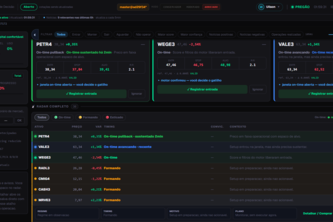
- ON_TIME Radar: monitors asset states (FORMING, ON_TIME, STRETCHED, ENGINE_ACTIONABLE).
- Contextual Decision Engine: combines price action, volatility, volume, trend location, market regime, and microstructure.
- Risk-Aware Trade Planning: calculates entry, stop, target, and position sizing based on fixed monetary risk unit.
- Portfolio and Operation Tracking: shows active positions, daily capital context, executed operations, and current decision status.
- AI Conversation Layer: allows users to ask questions about market context without losing workflow.
The system is described as a protective cockpit, where the AI supports decisions, the platform exposes risk, and humans remain responsible for final action.
Evidence Self-reported by the author. No third-party validation or demonstration of actual functionality beyond mock mode.
Positioning & Claim Evolution
The author positions Simple Trade Copilot IA as:
- A quantitative decision copilot, not an auto-trader.
- Focused on real-time radar, risk-first planning, audit trails, replay-driven learning, and AI-assisted engineering discipline.
- A tool to make complex retail trading safer by providing objective market context, risk controls, and explainable decision support.
It is also framed as:
- A personal statement: the author built it under constraints of limited time and leadership responsibilities, using AI to bridge a gap between idea and execution.
- A demonstration of how AI can reopen the door to hands-on creation for people with discipline but not unlimited time.
The claim evolution shows a shift from:
- Initial inspiration (complexity of retail trading in Brazil)
- Product definition (human-in-the-loop, AI-assisted support)
- Technical realization (stack, architecture, replay logic)
- Future vision (security hardening, broker-side guardrails, live microstructure shadowing)
Evidence All claims are self-reported and unverified.
Target Customer & ICP
The description states:
- The platform targets B3 day traders in Brazil, who face challenges due to oversimplified chart patterns, unrealistic promises, emotional decision-making, and market complexity.
- It is intended for individual retail traders navigating fast, complex markets shaped by liquidity, spreads, slippage, institutional flow, and high-frequency behavior.
The platform is described as:
- Not for replacing the human trader but protecting them with objective context and risk controls.
- Designed to help operators evaluate timing, understand risk, and make disciplined decisions.
There is no mention of institutional users or other financial sectors beyond B3 day trading.
Evidence Self-reported. No evidence of customer segmentation, personas, or adoption data.
Business Model & Pricing Evidence
The description does not contain any information about:
- Revenue streams
- Pricing models
- Monetization strategy
- Customer acquisition plans
- Subscription tiers or usage-based pricing
It is unclear whether the platform will be offered as a SaaS product, a one-time tool, or part of a larger ecosystem.
Evidence Not evidenced.
Technical & Delivery Signals
The author reports:
- Built with Next.js 16, React 19, TypeScript, and SQLite.
- Market data layer uses Cedro Crystal integration for B3 data ingestion.
- Includes replay and oracle layers to evaluate strategies without risking real capital.
- AI-assisted development using Codex and GPT throughout the build process.
- Platform runs in a controlled mock mode for demos, with no live market dependency.
The architecture emphasizes:
- Traceability, replayability, and operational safety.
- Canonical radar frames, freshness checks, and stale-state handling.
- Throttling persistence and aggressive pruning to avoid database issues (e.g., 14GB WAL incident).
- Separation of signal quality from frequency.
Evidence Self-reported. No evidence of production deployment or scalability testing.
Traction & Maturity Signals
The description does not provide any evidence of:
- Revenue
- Customers or user base
- Product usage metrics
- Market traction or adoption
- Beta testing or pilot programs
- Product maturity beyond prototype/demo stage
It is clear that this is a hackathon submission, and the author explicitly states it is a “Build Week version” designed as a protective cockpit.
Evidence Not evidenced.
Competitive Context
The description does not mention:
- Direct competitors
- Market size or share
- Competitive advantages or differentiation
- Existing tools in the Brazilian B3 trading space
It is implied that the platform addresses a gap in retail trading support, but no comparison to existing platforms or services is made.
Evidence Not evidenced.
Open Questions & Risks
Inferences based on self-reported information:
- Solo Development Risk: The entire product was built by one person (Uilson Nardocci), which raises questions about scalability, long-term maintenance, and feature depth.
- Lack of Live Testing: The platform is described as running in mock mode for demos; no evidence of live trading or real-world validation.
- AI Dependency Risk: Heavy reliance on AI tools (GPT, Codex) may create dependency risks if those services change or become unavailable.
- Limited Scope: The focus is on B3 day trading only, with no indication of expansion plans or broader applicability.
- Unproven Commercial Viability: No evidence of monetization strategy, pricing model, or customer demand.
Evidence Self-reported. These are inferences drawn from lack of evidence and project constraints.
Questions the description leaves open
- Has the platform been tested in any live trading conditions beyond mock mode?
- What is the plan for securing real market data access and integrating with brokers?
- How does the team intend to scale beyond a solo developer?
- Are there plans to monetize or commercialize this product?
- What are the key assumptions behind the replay-driven learning approach, and how were they validated?
- Is there any intention to expand beyond B3 day trading into other markets or asset classes?
- How will the platform handle regulatory compliance in financial services?
Overall Assessment
Not evidenced.
There is no evidence of:
- Revenue
- Customers
- Product-market fit
- Traction or growth metrics
- Financials or funding history
- Strategic partnerships or use cases beyond a hackathon submission
The project is presented as a proof-of-concept prototype, built by one developer in a short timeframe, using AI to overcome time and technical constraints. It has no demonstrated commercial viability or scalability potential.
Confidence Level Low — based entirely on self-reported claims with no external validation or data points.
User Stories BotA demo video on every pull request
Get a demo video on every new feature
GitHub App that watches your pull requests and records a narrated, captioned demo.
Save time on demo prep and make informed decisions faster with a video walkthrough of every new feature.
Source
Submitted to the OpenAI 2026 hackathon on Devpost. Project home on Devpost. Back to the full gallery on Devpost.
This competitive analysis was produced by top-founders.com (opens in a new tab)
Generated by a language model from this project's public Devpost page — its tagline, the author's own write-up and any built-with tags listed there — as captured in August 2026. Short quotations are the author's words. It is an opinion on the idea as a business, not on the people behind it, and it reflects the description as published then. If the project has moved on, request a correction below. The analysis is not independent research and contains no verified traction, revenue or customer data.
An independent guide by KFG International LLC — not affiliated with, endorsed by, or connected to Devpost or OpenAI.