

Archive position — measured, not model output
0 likes on Devpost
2,263 of the 7,850 archived projects have more likes, and 5,587 share exactly 0 — so this project's #5,849 place in the like-ranked listing is a tie-break inside that group, not a ranking.
Projects (log scale)
Likes on Devpost. ▲ marks this project's group.
Show the figures
| Likes | Projects | Share of archive |
|---|---|---|
| 0 | 5,587 | 71.2% |
| 1 | 1,758 | 22.4% |
| 2 | 284 | 3.6% |
| 3–4 | 132 | 1.7% |
| 5–9 | 75 | 1.0% |
| 10+ | 14 | 0.2% |
 User Stories BotA demo video on every pull request
Get a demo video on every new feature
GitHub App that watches your pull requests and records a narrated, captioned demo.
Save time on demo prep and make informed decisions faster with a video walkthrough of every new feature.
Executive Summary
What the company appears to be
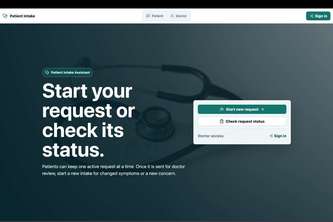
The project described by the caller is a self-reported AI-powered patient intake assistant for healthcare providers. The author states that it interviews patients before their visit and provides doctors with a structured, verifiable summary of the conversation.
What changed
This is a solo-built prototype submitted to the OpenAI 2026 hackathon. It includes a backend built with FastAPI, a frontend in React, and uses GPT-5.6 mini for conversational logic. The author claims to have deployed it end-to-end with features like authentication, safety checks, and PDF report generation.
The single most important open question
Is there evidence of real-world usage or traction beyond the hackathon prototype? The description contains no data on revenue, customers, or adoption — only self-reported claims about functionality and design decisions.
Note: This analysis is based entirely on the self-reported project description provided by the caller. No external verification or historical data is available. All statements are labeled as "the author states" unless otherwise noted.
What The Product Actually Is
The author states that the product is an AI intake assistant that interviews patients before their visit and gives doctors a structured, verifiable summary.
- The system uses GPT-5.6 mini for conversation logic.
- It includes a FastAPI backend, React frontend, Supabase for auth/database/storage.
- The chat loop is designed to ensure all nine intake topics are covered before closing the interview.
- Emergency open questions are handled via pre-model rules, not the language model.
- The system supports returning patients by referencing past intake summaries.
- It generates PDF reports for doctors.
Inference: Based on the author's own description, this is a prototype built in a short timeframe (likely a hackathon project) with no evidence of commercial deployment or production use beyond the author’s own testing.
Positioning & Claim Evolution
The author states that the idea came from a conversation at a tech event where a doctor expressed frustration over time spent gathering patient information during appointments.
- The product is positioned as a way to move intake questions before the visit, so doctors walk in with a summary.
- It claims to reduce time wasted on basic information-gathering and improve efficiency for physicians.
- The author emphasizes safety by keeping critical logic outside of the LLM.
Claim vs Fact: These are self-reported claims about intent and positioning. There is no evidence that this has been validated in practice or adopted by real users.
Target Customer & ICP
The author states that the primary user is a doctor who sees patients and wants to save time during visits.
- The system targets physicians who perform frequent patient intake, especially those switching between surgeries and appointments.
- It also implies a secondary audience: patients who will interact with the assistant via chat before their visit.
Inference: The ICP appears to be healthcare providers (doctors) using an AI tool to streamline pre-appointment information gathering. No evidence of segmentation or targeting beyond this general group.
Business Model & Pricing Evidence
Not evidenced.
The description does not contain any information about pricing, monetization strategy, or business model.
Absence of evidence: There is no mention of how the product would be sold, who pays for it, or what revenue streams are envisioned.
Technical & Delivery Signals
The author states that they built the system in phases:
- Chat loop first
- Then persistence
- Then authentication
- Then doctor-side dashboard
Key technical decisions include:
- Use of GPT-5.6 mini due to latency concerns.
- Codex used for debugging and test case generation.
- Server controls when the interview ends, not the model.
- Emergency open questions enforced by code, not LLM.
- State management issues fixed with database constraints and row-level security.
Inference: The author shows engineering discipline in handling state, access control, and safety logic. However, this is a solo-built prototype, not a scalable product.
Traction & Maturity Signals
Not evidenced.
There is no mention of:
- Customers
- Revenue
- Usage metrics
- Product adoption
- User feedback or testing
Absence of evidence: No traction data exists in the description. The project is described as a hackathon submission with no indication of real-world use.
Competitive Context
Not evidenced.
The description does not reference any competitors, market size, or competitive landscape.
Absence of evidence: No information on existing solutions or how this compares to other tools in healthcare intake or AI assistant platforms.
Open Questions & Risks
- Solo-built prototype: The system was built by two individuals (as stated), likely without a dedicated team or product development process.
- No commercialization plan: There is no indication of a go-to-market strategy, pricing model, or customer acquisition approach.
- Unverified safety claims: While the author emphasizes safety logic being outside the LLM, there’s no evidence that these safeguards have been tested in real-world conditions.
- Limited scalability assumptions: The architecture seems tailored for a small-scale prototype, not enterprise-level deployment.
Inference: This is a proof-of-concept with no clear path to commercial viability or long-term sustainability.
Questions the description leaves open
- What specific feedback did you get from the doctor who inspired this idea?
- Have you tested the system with actual patients and doctors in a live setting?
- How do you plan to scale beyond the current prototype?
- Are there any regulatory or compliance considerations for healthcare data that you’ve addressed?
- What is your roadmap for monetization and customer acquisition?
- How do you intend to handle integration with existing EMR systems?
Overall Assessment
Not evidenced.
There is no evidence of:
- Revenue
- Customers
- Product-market fit
- Financials
- Team traction or prior experience
Confidence Level: Low. This is a self-reported hackathon project with no verified commercial activity or market validation. Any investment or partnership decision would require additional due diligence beyond this description.
User Stories BotA demo video on every pull request
Get a demo video on every new feature
GitHub App that watches your pull requests and records a narrated, captioned demo.
Save time on demo prep and make informed decisions faster with a video walkthrough of every new feature.
Source
Submitted to the OpenAI 2026 hackathon on Devpost. Project home on Devpost. Back to the full gallery on Devpost.
This competitive analysis was produced by top-founders.com (opens in a new tab)
Generated by a language model from this project's public Devpost page — its tagline, the author's own write-up and any built-with tags listed there — as captured in August 2026. Short quotations are the author's words. It is an opinion on the idea as a business, not on the people behind it, and it reflects the description as published then. If the project has moved on, request a correction below. The analysis is not independent research and contains no verified traction, revenue or customer data.
An independent guide by KFG International LLC — not affiliated with, endorsed by, or connected to Devpost or OpenAI.