

Archive position — measured, not model output
1 like on Devpost
505 of the 7,850 archived projects have more likes, and 1,758 share exactly 1 — so this project's #1,919 place in the like-ranked listing is a tie-break inside that group, not a ranking.
Projects (log scale)
Likes on Devpost. ▲ marks this project's group.
Show the figures
| Likes | Projects | Share of archive |
|---|---|---|
| 0 | 5,587 | 71.2% |
| 1 | 1,758 | 22.4% |
| 2 | 284 | 3.6% |
| 3–4 | 132 | 1.7% |
| 5–9 | 75 | 1.0% |
| 10+ | 14 | 0.2% |
 User Stories BotA demo video on every pull request
Get a demo video on every new feature
GitHub App that watches your pull requests and records a narrated, captioned demo.
Save time on demo prep and make informed decisions faster with a video walkthrough of every new feature.
Executive Summary
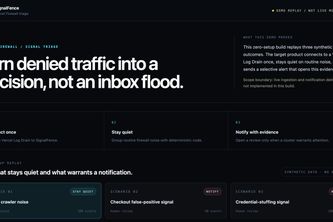
SignalFence is a self-reported prototype for a firewall alert triage system that claims to reduce noise by clustering routine events and presenting only high-priority alerts with GPT-5.6-generated explanations. The project is built as a browser-based demo using Next.js, TypeScript, and OpenAI Codex, and does not currently support real-world integration or production use.
The author states the system groups firewall events into clusters, flags suspicious activity for review, and uses deterministic logic to avoid automatic rule changes. It leverages GPT-5.6 through Codex CLI to generate human-readable explanations of clustered events, but does not make decisions about blocking traffic or modifying infrastructure.
Key commercial due-diligence read
The project is a prototype with no evidence of traction, revenue, customers, or production deployment. It has no demonstrated business model or pricing structure. The author's claims about the system’s functionality and trustworthiness are self-reported and unverified.
What The Product Actually Is
The description states that SignalFence is a firewall alert triage tool designed to reduce alert fatigue by clustering routine events and presenting only those requiring human review. It uses deterministic logic for event grouping and GPT-5.6 through Codex CLI to generate explanations of clustered events.
It is built as a browser-based demo, with no real-world integration or API support currently implemented. The system does not change firewall rules or make blocking decisions, according to the author.
Evidence
- “SignalFence makes a simpler promise. Routine firewall noise stays quiet. Patterns that deserve attention open a short evidence view for a human.”
- “The parser accepts JSON or NDJSON and hashes client IPs before events reach the interface.”
- “GPT-5.6 Sol was used through Codex CLI to turn sanitized cluster summaries into readable explanations.”
- “SignalFence never changes or deploys firewall rules.”
Inference
- The system is a prototype, not a production-ready tool.
Positioning & Claim Evolution
The author positions SignalFence as a solution to alert fatigue in firewall systems, where routine events clutter the alert inbox and obscure real threats. It claims to offer deterministic triage with cited GPT explanations, distinguishing itself from traditional rule-based systems that may block legitimate traffic.
Evidence
- “A firewall can stop an attack. It can also stop a paying customer at checkout.”
- “SignalFence makes a simpler promise. Routine firewall noise stays quiet.”
- “Deterministic triage, cited GPT-5.6 explanations, and no automatic rule changes.”
Inference
- The positioning implies a shift from reactive to proactive alert handling with human-in-the-loop decision-making.
Target Customer & ICP
The description does not explicitly identify the target customer or Ideal Customer Profile (ICP). It is unclear whether SignalFence targets IT security teams, DevOps engineers, or system administrators who manage firewall configurations.
Evidence
- No mention of specific roles, industries, or use cases beyond firewall alerting.
Inference
- Likely aimed at organizations with firewall monitoring and security operations centers (SOCs), but this is not stated.
Business Model & Pricing Evidence
There is no evidence in the description of a business model or pricing structure. The project is presented as a prototype with no indication of monetization, licensing, or customer acquisition plans.
Evidence
- “Nothing needs to be uploaded.”
- “The finished demo runs without an API key or account.”
- No mention of subscriptions, usage fees, or enterprise licensing.
Inference
- The project is not yet commercialized and lacks a defined monetization path.
Technical & Delivery Signals
SignalFence is built using Next.js, TypeScript, Tailwind CSS, Vercel, and integrates with OpenAI Codex CLI. It uses deterministic clustering logic and GPT-5.6 for explanations, but does not implement real-world firewall integrations or automated actions.
Evidence
- “Built with (author-declared): gpt-5.6, next.js, openai-codex, tailwind-css, typescript, vercel, vitest, zod”
- “The parser accepts JSON or NDJSON and hashes client IPs before events reach the interface.”
- “GPT-5.6 Sol was used through Codex CLI to turn sanitized cluster summaries into readable explanations.”
Inference
- The system is a browser-based prototype with no backend infrastructure or real-world data ingestion.
Traction & Maturity Signals
There is no evidence of traction, revenue, customers, or adoption. The project is described as a prototype submitted to a hackathon and not yet deployed in production.
Evidence
- “This project was submitted to the OpenAI 2026 hackathon on Devpost.”
- “The finished demo runs without an API key or account.”
- “Automatic Log Drain ingestion and email or Slack delivery are the next integration layer. They are not presented as implemented in this prototype.”
Inference
- The project is early-stage, with no real-world usage or product-market fit demonstrated.
Competitive Context
The description does not provide information on competitors, nor does it describe how SignalFence compares to existing solutions for firewall alert triage or security orchestration.
Evidence
- No mention of competitors or market positioning relative to other tools in the space.
Inference
- The competitive landscape is unknown, and no differentiation from existing tools is stated.
Open Questions & Risks
- Prototype only: No production deployment or real-world integration.
- Unverified claims: The author’s description of GPT usage and deterministic logic is self-reported.
- No monetization path: No evidence of a business model, pricing, or customer acquisition strategy.
- Limited scope: The demo does not support real data ingestion or delivery channels (e.g., email, Slack).
- Unproven trustworthiness: Claims about hashing IPs and deterministic logic are unverified.
Inference
- The project is not ready for commercial use and lacks any evidence of viability or traction.
Questions the description leaves open
- What specific firewall systems or log formats does SignalFence support in production?
- How does the system handle false positives in real-world scenarios?
- Is there a plan to integrate with actual security tools or platforms (e.g., SIEMs)?
- What is the roadmap for moving from prototype to a commercial product?
- How does SignalFence ensure that GPT-5.6 explanations are accurate and actionable?
- Are there any plans to support enterprise features like role-based access or audit logs?
Overall Assessment
Not evidenced — The project is described as a prototype submitted to a hackathon, with no evidence of traction, revenue, customers, or commercial viability. It lacks a defined business model, pricing structure, or integration capabilities.
The author states that the system uses deterministic logic and GPT-5.6 for explanations but does not implement automated actions or real-world integrations. The project is not yet ready for investment or partnership consideration.
Inference
- This is an early-stage idea with no demonstrated product-market fit or commercial potential.
User Stories BotA demo video on every pull request
Get a demo video on every new feature
GitHub App that watches your pull requests and records a narrated, captioned demo.
Save time on demo prep and make informed decisions faster with a video walkthrough of every new feature.
Source
Submitted to the OpenAI 2026 hackathon on Devpost. Project home on Devpost. Back to the full gallery on Devpost.
This competitive analysis was produced by top-founders.com (opens in a new tab)
Generated by a language model from this project's public Devpost page — its tagline, the author's own write-up and any built-with tags listed there — as captured in August 2026. Short quotations are the author's words. It is an opinion on the idea as a business, not on the people behind it, and it reflects the description as published then. If the project has moved on, request a correction below. The analysis is not independent research and contains no verified traction, revenue or customer data.
An independent guide by KFG International LLC — not affiliated with, endorsed by, or connected to Devpost or OpenAI.