

Archive position — measured, not model output
0 likes on Devpost
2,263 of the 7,850 archived projects have more likes, and 5,587 share exactly 0 — so this project's #5,845 place in the like-ranked listing is a tie-break inside that group, not a ranking.
Projects (log scale)
Likes on Devpost. ▲ marks this project's group.
Show the figures
| Likes | Projects | Share of archive |
|---|---|---|
| 0 | 5,587 | 71.2% |
| 1 | 1,758 | 22.4% |
| 2 | 284 | 3.6% |
| 3–4 | 132 | 1.7% |
| 5–9 | 75 | 1.0% |
| 10+ | 14 | 0.2% |
 User Stories BotA demo video on every pull request
Get a demo video on every new feature
GitHub App that watches your pull requests and records a narrated, captioned demo.
Save time on demo prep and make informed decisions faster with a video walkthrough of every new feature.
Executive Summary
Project
PathoTrack
Author's Self-Description
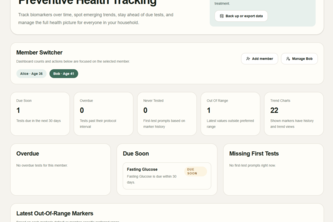
A focused, private app to help users track pathology markers, spot trends early, and be proactive about preventive health. Built as a local-only desktop application using Next.js, TypeScript, SQLite, and Drizzle ORM. The author states they built it for personal use, with no intention of commercializing it, but are now considering open-sourcing the code.
What Changed
The project description indicates a shift from personal tool to potential public product, with an intent to open-source and make it available for others to use or contribute to.
Single Most Important Open Question
Is there any evidence that PathoTrack has moved beyond the prototype stage, or whether it is being used by anyone other than its creator?
What The Product Actually Is
The description states that PathoTrack is a local-only desktop application designed for tracking pathology markers and health trends. It is built with:
- Next.js
- TypeScript
- SQLite
- Drizzle ORM
It is described as intentionally focused, simple to use, and private — running entirely on the user's device without cloud dependencies or network tracking.
The author states: “This app is built to be strictly local-only for now: it runs entirely on your machine and keeps 100% of your data safely on your own device, with no network tracking or cloud dependencies.”
Inference The product appears to be a personal health tracker, not a commercial SaaS offering.
Positioning & Claim Evolution
The author positions PathoTrack as a solution for preventive health management, aiming to help users spot trends early and be proactive about their health. The app is framed as a response to the problem of scattered, overwhelming health data.
The author states: “I built it to simplify things, which is why PathoTrack is intentionally focused and easy to use.”
The claim evolution shows:
- Initial intent: Personal tool for self-tracking.
- Evolving intent: A tool others can use or contribute to via open-sourcing.
- No commercial claims or market positioning beyond personal utility.
Inference The app is not positioned as a commercial product, but rather as a personal utility with potential community adoption.
Target Customer & ICP
The description does not state any specific customer segments or personas. It only indicates that the author built it for themselves and others who may want to track health markers.
The author states: “This is the app that I have wanted for years to track pathology tests and keep ahead of my health.”
Inference The target customer is likely health-conscious individuals who are self-tracking their biomarkers, but there is no evidence of segmentation or targeting beyond personal use.
Business Model & Pricing Evidence
There is no evidence of a business model or pricing structure. The author states that the app is built for personal use and is not intended to be commercialized.
The author states: “I knew I needed to take action, but I wasn't sure how. Well not until recently did I realize that, empowered by coding agents, I could develop an app for this myself!”
There is no mention of monetization, subscriptions, or any revenue-generating mechanism.
Inference No business model is evidenced; the project appears to be non-commercial in nature.
Technical & Delivery Signals
The author reports building PathoTrack using:
- Next.js
- TypeScript
- SQLite
- Drizzle ORM
They also mention using Codex with GPT-5.6 Sol for development assistance, indicating a reliance on AI tools for coding.
The author states: “I have only been using Codex for a week, but it has been an absolute game-changer.”
The app is described as a standalone desktop application, built to be local-only and private.
Inference The technical stack suggests a lightweight, personal-use application, likely not scalable or enterprise-ready. The use of AI tools for development indicates a rapid prototyping approach.
Traction & Maturity Signals
There is no evidence of traction, adoption, or user engagement beyond the author’s own use. The project was submitted to a hackathon and is described as a personal tool with no commercial intent.
The author states: “I built it for myself, and I am now considering open-sourcing the code.”
No data on users, usage frequency, or retention is provided.
Inference No traction or maturity signals are evident. The project appears to be in early prototype stage, possibly a personal experiment.
Competitive Context
The description does not provide any information about competitors or market positioning. It does not reference existing tools for health tracking or pathology monitoring.
The author states: “I built it because I couldn’t find anything that worked the way I wanted.”
Inference No competitive analysis is evidenced, but the app appears to be unique in its focus on local-only tracking, which may differentiate it from cloud-based health apps.
Open Questions & Risks
- No commercialization intent: The project is described as personal and not intended for sale or monetization.
- No traction or user data: There is no evidence of adoption, usage, or feedback.
- Prototype stage: The app appears to be a personal prototype, not a product ready for market.
- AI dependency: Heavy reliance on AI tools (Codex) for development may indicate lack of deep technical expertise or scalability concerns.
Inference The project is not a commercial product, and its potential for growth or adoption is unclear.
Questions the description leaves open
- Is the app currently being used by anyone other than the creator?
- What are the plans for open-sourcing, if any?
- Are there any future plans to monetize or scale the product?
- How does the app handle data import/export, and what formats are supported?
- Has the author considered privacy or regulatory compliance (e.g., HIPAA)?
- What is the long-term roadmap for the project?
Overall Assessment
Not evidenced.
The description indicates that PathoTrack is a personal prototype, not a commercial product, and there is no evidence of traction, revenue, or business model.
The author states: “I built it for myself, and I am now considering open-sourcing the code.”
Inference This project does not appear to be a viable investment or partnership opportunity at this stage. It is a personal tool with no commercial intent, and no evidence of market demand or scalability.
User Stories BotA demo video on every pull request
Get a demo video on every new feature
GitHub App that watches your pull requests and records a narrated, captioned demo.
Save time on demo prep and make informed decisions faster with a video walkthrough of every new feature.
Source
Submitted to the OpenAI 2026 hackathon on Devpost. Project home on Devpost. Back to the full gallery on Devpost.
This competitive analysis was produced by top-founders.com (opens in a new tab)
Generated by a language model from this project's public Devpost page — its tagline, the author's own write-up and any built-with tags listed there — as captured in August 2026. Short quotations are the author's words. It is an opinion on the idea as a business, not on the people behind it, and it reflects the description as published then. If the project has moved on, request a correction below. The analysis is not independent research and contains no verified traction, revenue or customer data.
An independent guide by KFG International LLC — not affiliated with, endorsed by, or connected to Devpost or OpenAI.