

Archive position — measured, not model output
0 likes on Devpost
2,263 of the 7,850 archived projects have more likes, and 5,587 share exactly 0 — so this project's #5,847 place in the like-ranked listing is a tie-break inside that group, not a ranking.
Projects (log scale)
Likes on Devpost. ▲ marks this project's group.
Show the figures
| Likes | Projects | Share of archive |
|---|---|---|
| 0 | 5,587 | 71.2% |
| 1 | 1,758 | 22.4% |
| 2 | 284 | 3.6% |
| 3–4 | 132 | 1.7% |
| 5–9 | 75 | 1.0% |
| 10+ | 14 | 0.2% |
 User Stories BotA demo video on every pull request
Get a demo video on every new feature
GitHub App that watches your pull requests and records a narrated, captioned demo.
Save time on demo prep and make informed decisions faster with a video walkthrough of every new feature.
Executive Summary
Company: PathPilot AI
Self-reported basis: The analysis is based entirely on the project description provided by the caller — including the name, tagline, author's own write-up, and technology stack. No external verification or historical data is available.
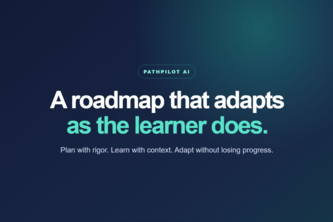
Commercial due-diligence read: PathPilot AI is a self-reported AI-powered learning coach that claims to generate adaptive, evolving learning roadmaps using multi-agent workflows powered by GPT-5.6. It is presented as a tool for career-oriented learners who want personalized and dynamic learning journeys. The project is in early development, with no evidence of revenue, customers or traction. The most important open question is whether the author’s claims about adaptability, personalization, and multi-agent workflow are substantiated by the technical implementation or if they are aspirational.
What The Product Actually Is
The description states that PathPilot AI:
- Turns career goals into personalized learning roadmaps.
- Uses a multi-agent workflow:
- Planner creates an initial roadmap.
- Critic reviews it for quality and feasibility.
- Revision improves the roadmap based on feedback.
- Adapts the roadmap as learners make progress or update their goals.
- Includes features such as:
- Explain Why
- Adaptive Replanning
- Strategy Comparison
- Journey Dashboard
- Trusted Resources
- PDF Export
- Shareable Roadmaps
Inference: The product is described as an AI-powered learning companion that evolves with the user’s progress and goals. It is not a static course recommendation tool but one that claims to maintain continuity in learning plans.
Positioning & Claim Evolution
The description states:
- The inspiration behind PathPilot AI was the lack of adaptive learning tools — most existing tools offer one-time recommendations, not evolving plans.
- The team wanted to build an AI coach that "stays with the learner throughout the journey" rather than generating a static roadmap.
- It is positioned as a tool for career-oriented learners who want to turn goals into personalized, evolving journeys.
Inference: The positioning evolved from a generic learning assistant to a long-term companion that adapts to user progress and changing goals. This evolution is implied in the “What’s next” section, where the team plans to add features like long-term learner memory and calendar integration.
Target Customer & ICP
The description states:
- The tool is for learners who want to turn career goals into personalized learning journeys.
- It is designed for users who are looking for adaptive, evolving learning plans rather than one-time recommendations.
Not evidenced: No explicit customer segments, personas or use cases beyond “career-oriented learners” are provided. No evidence of target industries, job roles, or learner types.
Business Model & Pricing Evidence
The description states:
- The project is presented as a prototype for a hackathon.
- There is no mention of pricing, monetization strategy, or business model.
Not evidenced: No information on how the product would be sold, who would pay, or what revenue model is envisioned. The author does not describe any commercial intent beyond the hackathon submission.
Technical & Delivery Signals
The description states:
- Built with:
- OpenAI Responses API
- GPT-5.6
- React + Vite
- ASP.NET Core (.NET 8)
- Azure
- Vercel
- Remotion
- Codex was used for implementation and debugging.
- The multi-agent workflow is powered by GPT-5.6.
Inference: The technical stack suggests a modern, cloud-native SaaS architecture with AI integration. However, no evidence of production deployment, scalability, or robustness is provided. The use of GPT-5.6 implies reliance on a proprietary model, but no details on prompt engineering, data handling, or API usage are shared.
Traction & Maturity Signals
The description states:
- This was submitted to the OpenAI 2026 hackathon.
- It is described as a prototype.
- The team size is one (Quoc Bao An Nguyen).
- No evidence of users, customers, or revenue is provided.
Not evidenced: There is no evidence of traction, adoption, or product-market fit. The project is presented as a hackathon submission with no indication of real-world usage or feedback.
Competitive Context
The description states:
- Most AI tools and online courses can answer questions or recommend content but rarely provide evolving learning plans.
- PathPilot AI aims to be different by offering adaptive, personalized roadmaps that evolve with the learner.
Inference: The product is positioned as a competitor to static course recommendation platforms and generic AI learning tools. However, no specific competitors are named or analyzed.
Open Questions & Risks
The description states:
- The team size is one.
- It is a hackathon project.
- No evidence of real-world usage or feedback.
- The multi-agent workflow is powered by GPT-5.6 — a proprietary model with unclear behavior and control.
Open questions:
- Lack of team, traction, or commercialization signals.
- Reliance on a single, unverified AI model (GPT-5.6) for core functionality.
- No evidence of user testing, feedback loops, or product iteration beyond the hackathon.
- The “adaptive replanning” and “multi-agent workflow” are claimed but not demonstrated.
Questions the description leaves open
- What is the exact mechanism by which the multi-agent workflow adapts to learner progress?
- How does the system ensure consistency in learning plans when goals or time availability change?
- What data is used to personalize recommendations, and how is it collected or stored?
- Is there any user testing or feedback from real learners?
- What are the technical limitations of using GPT-5.6 for this application, and how are they being addressed?
- How does the system explain its reasoning in a way that builds trust with users?
Overall Assessment
The description states:
- This is a hackathon project.
- The team size is one.
- No evidence of revenue, customers or traction.
Assessment: Not evidenced. There is no commercial readiness, product-market fit, or financial viability to support an investment or partnership decision at this stage. The project is in early development and lacks any signal of traction or scalability. It is presented as a proof-of-concept with aspirational goals but no demonstrated execution.
User Stories BotA demo video on every pull request
Get a demo video on every new feature
GitHub App that watches your pull requests and records a narrated, captioned demo.
Save time on demo prep and make informed decisions faster with a video walkthrough of every new feature.
Source
Submitted to the OpenAI 2026 hackathon on Devpost. Project home on Devpost. Back to the full gallery on Devpost.
This competitive analysis was produced by top-founders.com (opens in a new tab)
Generated by a language model from this project's public Devpost page — its tagline, the author's own write-up and any built-with tags listed there — as captured in August 2026. Short quotations are the author's words. It is an opinion on the idea as a business, not on the people behind it, and it reflects the description as published then. If the project has moved on, request a correction below. The analysis is not independent research and contains no verified traction, revenue or customer data.
An independent guide by KFG International LLC — not affiliated with, endorsed by, or connected to Devpost or OpenAI.