

Archive position — measured, not model output
0 likes on Devpost
2,263 of the 7,850 archived projects have more likes, and 5,587 share exactly 0 — so this project's #3,882 place in the like-ranked listing is a tie-break inside that group, not a ranking.
Projects (log scale)
Likes on Devpost. ▲ marks this project's group.
Show the figures
| Likes | Projects | Share of archive |
|---|---|---|
| 0 | 5,587 | 71.2% |
| 1 | 1,758 | 22.4% |
| 2 | 284 | 3.6% |
| 3–4 | 132 | 1.7% |
| 5–9 | 75 | 1.0% |
| 10+ | 14 | 0.2% |
 User Stories BotA demo video on every pull request
Get a demo video on every new feature
GitHub App that watches your pull requests and records a narrated, captioned demo.
Save time on demo prep and make informed decisions faster with a video walkthrough of every new feature.
Executive Summary
What the company appears to be
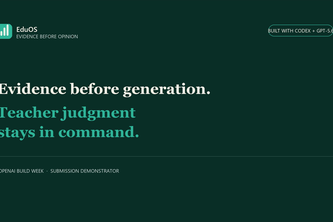
EduOS is a self-reported prototype product designed to support teacher decision-making in secondary school education using AI. The author states that it is not a lesson generator but a governed decision-support system that presents evidence-based recommendations while preserving human authority.
What changed
The project description indicates a shift from general AI content generation toward structured, evidence-driven decision-making with bounded options and deterministic validation. It introduces a new workflow where AI supports the choice before content is generated, rather than generating content directly.
Single most important open question
Is there sufficient evidence that teachers would find this system useful in practice, or does it remain an unvalidated product hypothesis?
What The Product Actually Is
The description states that EduOS is a decision-support prototype for secondary school teachers. It uses a fixed synthetic class dossier and two bounded options to guide decisions about instructional strategies.
- The system employs GPT-5.6 Terra via Codex.
- It processes heterogeneous sources (e.g., records, observations, guidance) into a structured JSON brief.
- A deterministic validator checks the output against strict criteria before it is presented.
- The final artifact is cryptographically bound to its source using SHA-256 hashes.
- The browser companion displays only validated artifacts and ensures no model call occurs during presentation.
Inference This is not a general-purpose AI tool but a narrow vertical focused on one teacher decision, with strong emphasis on traceability, validation, and human control.
Positioning & Claim Evolution
The author claims that EduOS repositions AI from content generator to decision enabler, emphasizing:
- Decision before generation
- Evidence before fluency
- Validation before presentation
- Human authority after recommendation
These are positioned as innovations in how AI can be used in education — not to replace teachers, but to reduce cognitive friction and preserve professional judgment.
Inference The positioning reflects a shift from “AI for efficiency” to “AI for accountability.” However, the description does not indicate whether this approach has been tested or validated beyond the prototype stage.
Target Customer & ICP
The target customer is secondary school teachers, specifically those who must make instructional decisions based on complex, distributed information.
- The system uses a synthetic class dossier to simulate real-world context.
- It assumes the user will be a teacher making professional choices about learning objectives and strategies.
- No mention of institutional buyers or administrators.
Inference The ICP appears to be individual educators working within secondary education settings who are burdened by information fragmentation and seek clarity in decision-making.
Business Model & Pricing Evidence
Not evidenced.
The description does not contain any information about pricing, monetization, or business model. There is no indication of whether this will be offered as a SaaS product, a free tool, or something else entirely.
Technical & Delivery Signals
- Built with Codex, GPT-5.6 Terra, Python, JavaScript, HTML, CSS, JSON Schema.
- Uses repository-local skills and deterministic validation logic.
- Validator rejects outputs that do not conform to schema or contain invalid citations, language, or structure.
- Artifact integrity is ensured via SHA-256 hashing.
- Browser companion displays only validated reports without further model interaction.
Inference The technical architecture shows a deliberate focus on trustworthiness and control, rather than scalability or broad functionality. The use of deterministic validation suggests an emphasis on auditability over generality.
Traction & Maturity Signals
Not evidenced.
There is no mention of:
- Revenue
- Customers
- Users
- Adoption metrics
- Product usage data
- Market traction
The description explicitly notes that this is a prototype, and the author states that the next step is co-design with teachers, not feature expansion.
Competitive Context
Not evidenced.
There is no discussion of:
- Competitors
- Alternative tools in education
- Market positioning relative to other AI or decision-support systems
The description does not reference existing platforms or products in the edtech space.
Open Questions & Risks
- Unvalidated Product Hypothesis: The system is described as a prototype with no evidence of real-world testing or user feedback.
- Limited Scope: Only one decision, one class, and two options are supported — not scalable to broader use cases.
- No Real Data Handling: No mention of how the system would handle real learner data, privacy, or compliance.
- Founder-Only Development: One-person team implies limited capacity for rapid iteration or scaling.
- Unclear Path to Market: No indication of how this would transition from prototype to product or service.
Questions the description leaves open
- What specific feedback have you received from teachers during the co-design phase?
- How do you plan to handle real-world data privacy, security, and legal compliance?
- Are there any plans for expanding beyond one decision type or one class scenario?
- What are your thoughts on integrating this into existing school systems or platforms?
- Do you have a roadmap for moving from prototype to product, including monetization?
Overall Assessment
Not evidenced.
There is no information provided about:
- Funding status
- Valuation
- Investor interest
- Partnership opportunities
The description makes clear that this is an early-stage prototype submitted to a hackathon. It does not suggest readiness for investment or partnership at this time.
User Stories BotA demo video on every pull request
Get a demo video on every new feature
GitHub App that watches your pull requests and records a narrated, captioned demo.
Save time on demo prep and make informed decisions faster with a video walkthrough of every new feature.
Source
Submitted to the OpenAI 2026 hackathon on Devpost. Project home on Devpost. Back to the full gallery on Devpost.
This competitive analysis was produced by top-founders.com (opens in a new tab)
Generated by a language model from this project's public Devpost page — its tagline, the author's own write-up and any built-with tags listed there — as captured in August 2026. Short quotations are the author's words. It is an opinion on the idea as a business, not on the people behind it, and it reflects the description as published then. If the project has moved on, request a correction below. The analysis is not independent research and contains no verified traction, revenue or customer data.
An independent guide by KFG International LLC — not affiliated with, endorsed by, or connected to Devpost or OpenAI.