

Archive position — measured, not model output
0 likes on Devpost
2,263 of the 7,850 archived projects have more likes, and 5,587 share exactly 0 — so this project's #6,691 place in the like-ranked listing is a tie-break inside that group, not a ranking.
Projects (log scale)
Likes on Devpost. ▲ marks this project's group.
Show the figures
| Likes | Projects | Share of archive |
|---|---|---|
| 0 | 5,587 | 71.2% |
| 1 | 1,758 | 22.4% |
| 2 | 284 | 3.6% |
| 3–4 | 132 | 1.7% |
| 5–9 | 75 | 1.0% |
| 10+ | 14 | 0.2% |
 User Stories BotA demo video on every pull request
Get a demo video on every new feature
GitHub App that watches your pull requests and records a narrated, captioned demo.
Save time on demo prep and make informed decisions faster with a video walkthrough of every new feature.
Executive Summary
The company appears to be a solo project named SignalCut, submitted by Maggy A as part of the OpenAI 2026 hackathon. The author states that SignalCut is a tool for claim review in product demos, designed to ensure that each release claim has supporting evidence before publication. It operates as an overlay on existing demo workflows, using AI to help identify and flag claims without evidence.
What changed: The project was built during OpenAI Build Week, integrating with existing demo processes through a "deterministic claim-and-evidence layer". It uses Codex and GPT-5.6 for development, including building the review engine and adversarial testing.
The single most important open question: Is there any evidence of traction, revenue, or real-world adoption beyond this hackathon submission? The description does not indicate whether SignalCut has moved beyond prototype or been used by anyone other than its creator.
Note: This analysis is based entirely on the self-reported and unverified project description provided. No third-party verification, funding data, customer list, or performance metrics are available.
What The Product Actually Is
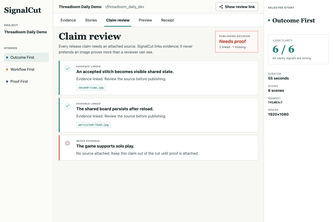
The description states that SignalCut is a tool for claim review in product demos. It allows users to declare each release claim and link the exact evidence behind it. The system then displays the claim alongside its sources. If a link is missing, the system flags it as “Needs proof” rather than silently allowing publication.
It was built as an overlay over SignalCut’s existing demo workflow during OpenAI Build Week. It uses AI (specifically Codex and GPT-5.6) to assist in building the review engine, adversarial tests, and verification of deployment.
Inference: The product is described as a tool for validating claims in demos, not a general-purpose fact-checking or content validation platform.
Positioning & Claim Evolution
The author states that SignalCut addresses a gap in demo quality: “A demo can look polished and still make claims its evidence does not support.” This positions the tool as a quality control mechanism for product storytelling, ensuring that claims made during demos are substantiated.
It is positioned to be used by builders (e.g., developers, product teams) who want to avoid making unsubstantiated claims in their product releases or presentations. It is not described as a general-purpose fact-checking tool or an enterprise SaaS offering.
Claim: The project aims to improve trust and transparency in product demos.
Evidence: From the author's own write-up.
Target Customer & ICP
The description does not explicitly name target customers. However, it implies that SignalCut is aimed at product builders, including developers or teams who create product demos for users, judges, or internal stakeholders.
It is described as a tool for those who “share a product story with users, teammates, or judges,” suggesting the ICP includes:
- Product managers
- Developers or engineers
- Designers or product teams
Inference: The target customer is likely early-stage product creators or demo-focused teams.
Evidence: Not directly stated; inferred from context.
Business Model & Pricing Evidence
There is no evidence of a business model, pricing structure, or monetization strategy in the description. The project is described as a hackathon submission and does not mention any revenue streams, subscriptions, or paid features.
Claim: No pricing or business model information provided.
Evidence: Not evidenced.
Technical & Delivery Signals
The project was built using:
- AI tools: Codex and GPT-5.6
- OpenAI Build Week as the development context
- A deterministic claim-and-evidence layer over an existing demo workflow
- Adversarial testing included in development
- Public deployment verified by the team
It is described as a live Threadloom example, suggesting it has some interactive or visual component.
Inference: The tool uses AI to automate parts of the claim review process, but leaves final judgment to humans.
Evidence: From the author's own write-up.
Traction & Maturity Signals
There is no evidence of traction, customers, or adoption beyond the hackathon submission. The project is described as a solo effort by one person (Maggy A) and has not been deployed in production outside of this context.
Claim: No traction or user data.
Evidence: Not evidenced.
Competitive Context
The description does not mention any competitors or similar tools. It is unclear whether there are existing solutions for claim validation or demo quality control in the market.
Claim: No competitive landscape described.
Evidence: Not evidenced.
Open Questions & Risks
- The project is a hackathon submission, with no evidence of real-world usage or product-market fit.
- It is built by a single person (team size: 1), raising questions about scalability and long-term maintenance.
- No pricing, monetization, or business model are described.
- The use of GPT-5.6 implies reliance on AI that may not be stable or scalable in production.
- The project has no evidence of customer feedback, user testing, or iteration beyond the hackathon.
Inference: The tool is unproven and lacks commercial viability indicators.
Evidence: Not evidenced.
Questions the description leaves open
- What was the actual problem you were solving, and how did you validate that it existed?
- Have you tested SignalCut with any real users or teams beyond yourself?
- How do you plan to scale this from a hackathon prototype to a product that others would pay for?
- What is your long-term vision for monetization or business model?
- Are there any existing tools in the market that solve similar problems, and how does SignalCut differ?
Overall Assessment
Not evidenced.
There is no evidence of revenue, traction, customers, or a clear path to commercialization. The project is described as a solo hackathon effort with no indication of product-market fit or business viability beyond its initial concept.
Inference: This is an early-stage idea with no demonstrated commercial potential.
Evidence: Not evidenced.
User Stories BotA demo video on every pull request
Get a demo video on every new feature
GitHub App that watches your pull requests and records a narrated, captioned demo.
Save time on demo prep and make informed decisions faster with a video walkthrough of every new feature.
Source
Submitted to the OpenAI 2026 hackathon on Devpost. Project home on Devpost. Back to the full gallery on Devpost.
This competitive analysis was produced by top-founders.com (opens in a new tab)
Generated by a language model from this project's public Devpost page — its tagline, the author's own write-up and any built-with tags listed there — as captured in August 2026. Short quotations are the author's words. It is an opinion on the idea as a business, not on the people behind it, and it reflects the description as published then. If the project has moved on, request a correction below. The analysis is not independent research and contains no verified traction, revenue or customer data.
An independent guide by KFG International LLC — not affiliated with, endorsed by, or connected to Devpost or OpenAI.