

Archive position — measured, not model output
0 likes on Devpost
2,263 of the 7,850 archived projects have more likes, and 5,587 share exactly 0 — so this project's #6,689 place in the like-ranked listing is a tie-break inside that group, not a ranking.
Projects (log scale)
Likes on Devpost. ▲ marks this project's group.
Show the figures
| Likes | Projects | Share of archive |
|---|---|---|
| 0 | 5,587 | 71.2% |
| 1 | 1,758 | 22.4% |
| 2 | 284 | 3.6% |
| 3–4 | 132 | 1.7% |
| 5–9 | 75 | 1.0% |
| 10+ | 14 | 0.2% |
 User Stories BotA demo video on every pull request
Get a demo video on every new feature
GitHub App that watches your pull requests and records a narrated, captioned demo.
Save time on demo prep and make informed decisions faster with a video walkthrough of every new feature.
Executive Summary
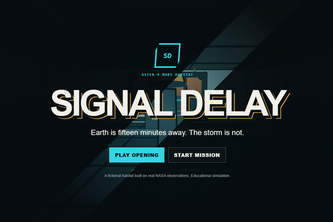
What the company appears to be: Signal Delay is a first-person decision game set in a fictional Mars habitat, built using real NASA MEDA weather station data from the 2022 Jezero dust storm. The project is self-described as an immersive educational experience for general audiences, high school and college students, and science enthusiasts. It simulates emergency response planning under communication delays (15-minute signal delay) between Mars and Earth, with a live AI assistant named ASTER evaluating player plans against logged evidence.
What changed: The author states that this is a self-contained MVP focused on one event — a dust storm cutting habitat power — with three attempts to submit an emergency plan. It includes a cinematic opening, data inspection tools, evidence logging, and AI-based plan evaluation using real NASA sources.
The single most important open question: Is there any evidence of traction, revenue, or customer adoption beyond the author's own development? The description does not provide any information about users, monetization, or market engagement.
What The Product Actually Is
The description states that Signal Delay is a first-person decision game set in a cel-shaded Mars habitat, based on real MEDA observations from sols 305 and 313. Players act as systems engineers during an emergency — specifically, a dust storm cutting the habitat's power — with a 15-minute communication delay between Mars and Earth.
Players inspect data from four station systems, log their observations, and submit an emergency response plan. The AI assistant ASTER evaluates the player’s plan live against the evidence they logged. If API connection fails, it falls back to pre-scripted contingency guidance.
The game uses real NASA PDS MEDA archive data, with every scientific claim linked to its source file. It is built using Next.js + React Three Fiber + Rapier, and all visuals are 100% code-generated (no external assets). The AI evaluation system is powered by GPT-5.6, and the voice of ASTER is generated via OpenAI TTS.
Inference: The product appears to be a single-player educational simulation game with an emphasis on data literacy, systems engineering, and space mission realism.
Positioning & Claim Evolution
The author positions Signal Delay as an evidence-based Mars crisis game, aimed at making space exploration more accessible to the general public, students, and science enthusiasts. It is described as a way to bridge the gap between popular portrayals of space missions (often fictional) and the actual complexity involved in real missions.
Key claims:
- The project uses real NASA MEDA data from the 2022 Jezero dust storm.
- The game simulates a systems engineering role during an emergency.
- It is designed for curious members of the general public, including students and educators.
- Players can verify scientific claims by clicking through to actual NASA source files.
The author also notes that the project was submitted to the OpenAI 2026 hackathon, suggesting it may be a prototype or proof-of-concept rather than a commercial product.
Inference: The positioning is educational and experiential, focusing on accessibility and scientific accuracy. It does not claim to be a commercial game or platform with monetization.
Target Customer & ICP
The description states that Signal Delay is designed for:
- Curious members of the general public
- High school and college students
- Science enthusiasts
It also mentions that it targets people who are interested in space exploration but lack access to detailed technical information, especially those who have limited exposure to real-world aerospace work.
Inference: The ICP appears to be educational users, particularly younger learners and amateur science fans. No mention of enterprise customers or institutional buyers.
Business Model & Pricing Evidence
There is no evidence in the description of a business model or pricing structure. The author describes it as an educational prototype, not a commercial product.
Inference: No business model or pricing data is provided. The project seems to be a non-commercial prototype, possibly intended for educational use or hackathon submission.
Technical & Delivery Signals
The project was built by one person (Huiying Chung) with three collaborators using:
- OpenAI Codex as the primary development tool
- Claude Code for prompt drafting and review
- Next.js + React Three Fiber + Rapier for frontend/backend
- GPT-5.6 for AI evaluation logic
- OpenAI TTS for ASTER’s voice
- Playwright for E2E testing
- Vitest for unit tests
All visuals are 100% code-generated, and the build is auditable with:
- Eleven Codex threads
- Hash-verified session records
- Commit history with SHA-256 hashes
- Green CI on exact merged commit
The author also mentions that the AI evaluation system is security-hardened, with server-side origin allowlist, forgery-safe client identity, rate-limiting, and zero-leak errors.
Inference: The technical stack is modern and well-documented. The build process is highly traceable and auditable, suggesting strong engineering discipline.
Traction & Maturity Signals
There is no evidence of traction, customers, or revenue. The project was submitted to a hackathon and described as an MVP focused on one event (dust storm). No mention of user engagement, adoption, or monetization.
The author states that the game includes:
- A cinematic opening
- Data inspection tools
- Evidence logging
- AI-based plan evaluation
But no data is provided about how many people have played it, how long they stayed, or whether it has been used in classrooms or by educators.
Inference: The project is at a very early stage, likely a prototype or proof-of-concept. No signs of user traction or commercial maturity.
Competitive Context
The description does not provide any information about competitors or similar products. It is unclear if there are existing educational games or simulations focused on Mars missions or systems engineering under communication delays.
Inference: No competitive landscape is described, and no evidence suggests this project has a defined market or competition.
Open Questions & Risks
- No traction or revenue: The project appears to be a prototype with no evidence of user adoption or monetization.
- Single-person development: While technically impressive, the lack of team size raises questions about scalability and long-term maintenance.
- Educational focus only: No indication that it is intended for broader commercial use or institutional deployment.
- Hackathon submission: The project was submitted to a hackathon, suggesting it may be a short-term experiment rather than a long-term venture.
Inference: The main risk is that this is a non-commercial prototype, not a scalable or monetizable product. It lacks any evidence of real-world usage or commercial viability.
Questions the description leaves open
- What are the plans for expanding beyond the current MVP (single event)?
- Has the project been tested with actual students or educators?
- Are there any intentions to monetize or scale this beyond a prototype?
- How is the AI evaluation system validated for accuracy and fairness?
- Is there any interest from educational institutions or NASA in using this tool?
- What are the long-term goals for the project — is it intended to evolve into a commercial product?
Overall Assessment
There is no evidence of revenue, customers, or traction beyond the author's own development and hackathon submission.
The project is described as a self-contained educational prototype, built by one person using AI tools. It does not appear to be a commercial venture or product with a defined market.
Inference: This is likely a non-commercial prototype or proof-of-concept, not a viable investment or partnership opportunity at this stage. The author has not demonstrated any traction, monetization strategy, or customer base.
User Stories BotA demo video on every pull request
Get a demo video on every new feature
GitHub App that watches your pull requests and records a narrated, captioned demo.
Save time on demo prep and make informed decisions faster with a video walkthrough of every new feature.
Source
Submitted to the OpenAI 2026 hackathon on Devpost. Project home on Devpost. Back to the full gallery on Devpost.
This competitive analysis was produced by top-founders.com (opens in a new tab)
Generated by a language model from this project's public Devpost page — its tagline, the author's own write-up and any built-with tags listed there — as captured in August 2026. Short quotations are the author's words. It is an opinion on the idea as a business, not on the people behind it, and it reflects the description as published then. If the project has moved on, request a correction below. The analysis is not independent research and contains no verified traction, revenue or customer data.
An independent guide by KFG International LLC — not affiliated with, endorsed by, or connected to Devpost or OpenAI.