

Archive position — measured, not model output
0 likes on Devpost
2,263 of the 7,850 archived projects have more likes, and 5,587 share exactly 0 — so this project's #2,765 place in the like-ranked listing is a tie-break inside that group, not a ranking.
Projects (log scale)
Likes on Devpost. ▲ marks this project's group.
Show the figures
| Likes | Projects | Share of archive |
|---|---|---|
| 0 | 5,587 | 71.2% |
| 1 | 1,758 | 22.4% |
| 2 | 284 | 3.6% |
| 3–4 | 132 | 1.7% |
| 5–9 | 75 | 1.0% |
| 10+ | 14 | 0.2% |
 User Stories BotA demo video on every pull request
Get a demo video on every new feature
GitHub App that watches your pull requests and records a narrated, captioned demo.
Save time on demo prep and make informed decisions faster with a video walkthrough of every new feature.
Executive Summary
What the company appears to be
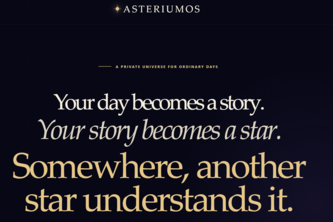
Asteriumos is described as a private digital constellation for personal journaling and storytelling, where users record daily moments that become stars in an interactive 3D visualization. These moments can be transformed into AI-generated Day Cards using GPT-5.6, and optionally released anonymously into a shared "Universe" as Echoes. The system is built with privacy controls and user agency at its core.
What changed
The author states this project was developed during the OpenAI 2026 hackathon. It represents a self-contained product concept with an integrated AI, visual, and privacy architecture. No prior version or evolution beyond this single submission is described.
Single most important open question
Is there evidence of user adoption, feedback loops, or traction that would indicate real-world utility or demand for this type of emotional storytelling platform?
Note: All claims in this report are based on the self-reported description provided by the author. No external verification or historical data is available.
What The Product Actually Is
The description states that Asteriumos is a journaling and storytelling tool with the following features:
- Users record short moments, emotions, or details as “stars” in an interactive 3D constellation.
- These stars can be rotated, panned, zoomed, recoloured, and surrounded by a custom nebula.
- At day’s end, users choose creative voice (Gentle, Playful, Honest, Wild), story world, and ending to generate a Day Card using GPT-5.6.
- The Day Card includes title, narrative, closing line, thread, motif, grounded star roles, and a procedural constellation badge.
- Users can keep or export the Day Card, reforge its badge from a 3D viewpoint, or delete it.
- Encrypted Memory Capsules store accepted Day Cards across time.
- A moment may be released into a shared Universe as an anonymous Echo after moderation.
- Echoes are matched semantically to similar ones and displayed as nebulae in the public Universe.
- The system uses a Constellation Key for account-free cross-device continuity.
Inference: The product is described as a hybrid of personal journaling, creative AI storytelling, and privacy-preserving social connection. It is not a traditional SaaS or marketplace but rather an emotionally expressive digital experience.
Positioning & Claim Evolution
The author positions Asteriumos as:
- A place where users can keep tiny moments without judgment, discover stories only when they choose, and feel less alone.
- An alternative to both traditional journaling (which asks for reflection after the fact) and social media (which demands performance).
- A tool that allows private noticing, creative reflection, and optional anonymous release into a shared universe.
The claim evolution appears to be:
- From inspiration: wanting a place for private, unjudged moments.
- To execution: building a system where those moments become stars in a 3D constellation.
- To functionality: using AI to generate Day Cards and Echoes while maintaining strong privacy boundaries.
- To future vision: enabling long-term memory, mythology control, and human connection without identity exposure.
Claim vs Fact: The author claims this is a “private constellation for ordinary days,” but there’s no evidence of actual users or usage patterns. This is a self-described product concept.
Target Customer & ICP
The description states:
- The target user is someone who wants to journal without judgment, discover stories only when they choose, and feel less alone.
- Users are likely people interested in personal reflection, creative expression, and emotional storytelling.
- The system supports account-free access, suggesting a broad, non-commercial audience.
- It appeals to individuals who value privacy, agency, and non-invasive AI interaction.
Inference: The ICP seems to be emotionally expressive, privacy-conscious individuals who want to explore their inner lives through creative tools. There is no evidence of segmentation beyond this general profile.
Business Model & Pricing Evidence
The description does not mention:
- Any pricing structure.
- Monetization plans.
- Revenue streams.
- Customer acquisition or retention strategies.
- Paid features or tiers.
Not evidenced: No business model or pricing information is provided. The system appears to be a personal tool built for a hackathon, with no indication of commercial intent.
Technical & Delivery Signals
The author states:
- Built using Next.js 16, React 19, TypeScript, Three.js, and Tailwind CSS.
- Uses GPT-5.6 via Responses API, with strict JSON schemas and
store: false. - Implements encrypted storage, browser-held data, and protected server routes.
- Utilizes Supabase/Postgres for encrypted vaults and public Echoes.
- Hosted on Netlify.
- Includes 81 automated tests, linting, type checking, and runtime/cost guards.
- Uses Codex as an implementation partner during development.
Inference: The technical stack suggests a modern, privacy-aware web application with strong AI integration. However, there is no evidence of production deployment beyond the hackathon submission.
Traction & Maturity Signals
The description does not provide:
- Any user base or adoption metrics.
- Customer feedback or usage data.
- Product iteration history beyond the hackathon.
- Evidence of product-market fit.
- Any form of monetization or revenue.
Not evidenced: No traction or maturity indicators are present. The project is described as a single submission to a hackathon, with no evidence of ongoing development or user engagement.
Competitive Context
The description does not mention:
- Direct competitors.
- Similar products in the market.
- Market positioning relative to other journaling or AI storytelling tools.
Not evidenced: No competitive landscape is described. The author does not reference existing platforms or their differentiation strategy.
Open Questions & Risks
Key risks and open questions based on the description:
- No commercial traction or user feedback — this is a single hackathon project with no evidence of real-world adoption.
- Unproven privacy model — while described as secure, there’s no independent validation or audit.
- Highly specialized AI use case — relies heavily on GPT-5.6 for creative generation, which may not scale or be reproducible outside the hackathon context.
- Limited scalability assumptions — no mention of infrastructure, performance, or user load handling.
- Single-person team — raises questions about long-term maintenance and growth potential.
Inference: The lack of any commercial or user data makes it difficult to assess viability beyond a prototype. The product is not yet proven in real-world use.
Questions the description leaves open
- What specific user needs does Asteriumos address that existing tools don’t?
- Have you conducted any user research or testing beyond the hackathon?
- How do you plan to ensure long-term privacy and security as the system scales?
- Is there a roadmap for monetization or product evolution beyond this prototype?
- What are the technical limitations of GPT-5.6 in generating consistent, grounded Day Cards?
- How do you intend to handle potential misuse or abuse of the Echo feature?
- Are there any plans to expand beyond the current 3D visual and AI storytelling model?
Overall Assessment
Not evidenced: There is no evidence of revenue, customers, traction, or a clear path to monetization. The project is described as a hackathon submission with no indication of commercial viability or scalability.
Assessment: This is a conceptually rich and technically ambitious prototype. However, without any evidence of user adoption, product-market fit, or business model, it cannot be evaluated for investment or partnership potential at this stage. It remains a speculative idea rather than a developed product.
User Stories BotA demo video on every pull request
Get a demo video on every new feature
GitHub App that watches your pull requests and records a narrated, captioned demo.
Save time on demo prep and make informed decisions faster with a video walkthrough of every new feature.
Source
Submitted to the OpenAI 2026 hackathon on Devpost. Project home on Devpost. Back to the full gallery on Devpost.
This competitive analysis was produced by top-founders.com (opens in a new tab)
Generated by a language model from this project's public Devpost page — its tagline, the author's own write-up and any built-with tags listed there — as captured in August 2026. Short quotations are the author's words. It is an opinion on the idea as a business, not on the people behind it, and it reflects the description as published then. If the project has moved on, request a correction below. The analysis is not independent research and contains no verified traction, revenue or customer data.
An independent guide by KFG International LLC — not affiliated with, endorsed by, or connected to Devpost or OpenAI.