

Archive position — measured, not model output
0 likes on Devpost
2,263 of the 7,850 archived projects have more likes, and 5,587 share exactly 0 — so this project's #6,684 place in the like-ranked listing is a tie-break inside that group, not a ranking.
Projects (log scale)
Likes on Devpost. ▲ marks this project's group.
Show the figures
| Likes | Projects | Share of archive |
|---|---|---|
| 0 | 5,587 | 71.2% |
| 1 | 1,758 | 22.4% |
| 2 | 284 | 3.6% |
| 3–4 | 132 | 1.7% |
| 5–9 | 75 | 1.0% |
| 10+ | 14 | 0.2% |
 User Stories BotA demo video on every pull request
Get a demo video on every new feature
GitHub App that watches your pull requests and records a narrated, captioned demo.
Save time on demo prep and make informed decisions faster with a video walkthrough of every new feature.
Executive Summary
Company: SightLine
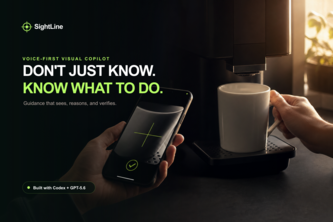
Self-reported purpose: A voice-first visual copilot for blind and low-vision people that guides users through real-world tasks using AI-powered perception, reasoning, and verification.
Key commercial signal: The project is an MVP submitted to the OpenAI 2026 hackathon; no revenue, customers or traction are evidenced.
What changed: The author describes a shift from image-description tools to a task-oriented, safety-aware copilot with structured AI interaction.
Single most important open question: Is there evidence of user testing or real-world validation beyond the hackathon submission?
What The Product Actually Is
The description states that SightLine is a voice-first visual copilot for blind and low-vision users. It operates through a mobile-first PWA, built with Next.js, React, TypeScript, and integrates with GPT-5.6 via OpenAI Responses API.
It uses the device’s camera to capture frames on-demand, processes them through AI to generate spoken instructions, and verifies each step visually before advancing. It includes a background safety watcher that scans for hazards without interrupting the task unless necessary.
The MVP supports four modes:
- Guide me
- Orient me
- Read this
- What is this?
It also supports voice commands like “done,” “repeat,” “pause,” “resume,” and “end.”
Inference: The product appears to be a task-oriented AI assistant, not a general-purpose image description tool.
Positioning & Claim Evolution
The author states that SightLine was built with the question:
“What if an AI could stay with the user through the task, give one clear instruction, verify that it worked, and interrupt when the scene became unsafe?”
This represents a positioning shift from tools that answer single questions (e.g., “what is in front of me?”) to ones that guide users through tasks while maintaining safety.
The product claims to implement a perceive → reason → guide → verify loop, which is described as the core of its functionality.
Inference: The positioning reflects an intent to move beyond passive image recognition into active, task-oriented AI assistance with safety awareness.
Target Customer & ICP
The description states that SightLine is designed for blind and low-vision people. It is built to help them perform real-world tasks such as:
- Making coffee
- Finding a door
- Reading labels
- Identifying objects
It also notes that the product is not intended for:
- Street crossing
- Driving
- Emergencies
- Other safety-critical navigation
Inference: The target customer is visually impaired individuals, with a focus on task completion and safety in controlled environments.
Business Model & Pricing Evidence
The description does not include any information about pricing, monetization or business model. It also does not state whether the product will be offered as a paid service, freemium, or open-source.
Not evidenced: No commercial structure is described.
Technical & Delivery Signals
SightLine is built as a mobile-first PWA, using:
- Next.js
- React
- TypeScript
- Codex
- GPT-5.6 via OpenAI Responses API
It uses the device's camera to capture frames on-demand, resizes them to reduce latency and cost, and sends them to GPT-5.6 with structured inputs including:
- User’s goal
- Current task step
- Rolling memory of recent observations
- Whether the request is a task turn or safety-only scan
The system returns structured outputs including:
- Observation
- Spoken instruction
- Confidence
- Task state
- Next physical action
- Hazard status
It also includes visual and haptic feedback, and does not persist frames or sessions.
Inference: The technical stack suggests a lightweight, mobile-first AI assistant with structured outputs and safety monitoring. It is built for low-latency, task-oriented interaction.
Traction & Maturity Signals
The project was submitted to the OpenAI 2026 hackathon, and the author states that it is an MVP.
There is no evidence of:
- Revenue
- Customers
- User adoption
- Product usage metrics
- Post-hackathon development or deployment
It includes a deterministic 45-second showcase with no camera or account required, but this is not indicative of traction.
Not evidenced: No signs of product maturity or user engagement beyond the hackathon submission.
Competitive Context
The description does not mention any competitors. It does state that most visual-assistance apps answer a single image question, and that SightLine aims to go beyond that.
It also notes that it was built with Codex, which is described as a product-design collaborator.
Not evidenced: No competitive analysis or market positioning against existing tools.
Open Questions & Risks
- No user testing or real-world validation beyond the hackathon submission.
- No evidence of revenue, customers, or commercial traction.
- The project is described as an MVP and a hackathon submission — not a product in development or deployed.
- The use of GPT-5.6 may raise concerns about cost, scalability, and dependency on external APIs.
- The system’s reliance on on-demand camera frames and structured outputs suggests it may be limited in complexity or robustness without further development.
Questions the description leaves open
- Has the product been tested with blind or low-vision users outside of the hackathon?
- What is the current status of the MVP — has it moved beyond prototype or hackathon submission?
- Are there any plans for monetization or commercial deployment?
- How does the system handle uncertainty or ambiguous inputs in real-world use cases?
- What are the technical limitations of using GPT-5.6 for real-time task guidance and safety monitoring?
Overall Assessment
Not evidenced: No data on traction, revenue, or commercial viability is provided.
The project appears to be a proof-of-concept MVP submitted to a hackathon. It shows an understanding of the problem space and some technical execution, but lacks evidence of:
- Product-market fit
- User testing
- Commercial viability
- Revenue or customer data
Confidence level: Low — based entirely on self-reported description.
The author states that SightLine is assistive guidance, not a replacement for a cane or guide dog. It is not intended for safety-critical navigation.
This is a self-reported, unverified product concept, not a validated commercial offering.
User Stories BotA demo video on every pull request
Get a demo video on every new feature
GitHub App that watches your pull requests and records a narrated, captioned demo.
Save time on demo prep and make informed decisions faster with a video walkthrough of every new feature.
Source
Submitted to the OpenAI 2026 hackathon on Devpost. Project home on Devpost. Back to the full gallery on Devpost.
This competitive analysis was produced by top-founders.com (opens in a new tab)
Generated by a language model from this project's public Devpost page — its tagline, the author's own write-up and any built-with tags listed there — as captured in August 2026. Short quotations are the author's words. It is an opinion on the idea as a business, not on the people behind it, and it reflects the description as published then. If the project has moved on, request a correction below. The analysis is not independent research and contains no verified traction, revenue or customer data.
An independent guide by KFG International LLC — not affiliated with, endorsed by, or connected to Devpost or OpenAI.