

Archive position — measured, not model output
0 likes on Devpost
2,263 of the 7,850 archived projects have more likes, and 5,587 share exactly 0 — so this project's #6,685 place in the like-ranked listing is a tie-break inside that group, not a ranking.
Projects (log scale)
Likes on Devpost. ▲ marks this project's group.
Show the figures
| Likes | Projects | Share of archive |
|---|---|---|
| 0 | 5,587 | 71.2% |
| 1 | 1,758 | 22.4% |
| 2 | 284 | 3.6% |
| 3–4 | 132 | 1.7% |
| 5–9 | 75 | 1.0% |
| 10+ | 14 | 0.2% |
 User Stories BotA demo video on every pull request
Get a demo video on every new feature
GitHub App that watches your pull requests and records a narrated, captioned demo.
Save time on demo prep and make informed decisions faster with a video walkthrough of every new feature.
Executive Summary
What the company appears to be
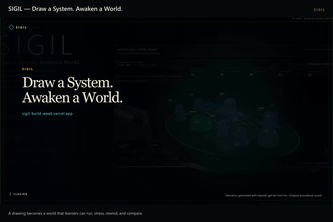
SIGIL is a browser-based application that interprets hand-drawn or digitally illustrated systems using AI (specifically GPT5.6 Sol), compiles them into structured simulations, and allows users to interact with those simulations through interventions, rewinding, and comparing alternate futures.
What changed
The author describes SIGIL as an evolution from static drawings to interactive, executable systems — where the "ink lifts off the page" and becomes a living simulation. This transformation is enabled by AI interpretation of visual elements and deterministic TypeScript-based execution of system logic.
Single most important open question
Does SIGIL have any commercial traction or revenue-generating potential beyond its hackathon demo? The description contains no evidence of customers, users, monetization, or market adoption.
What The Product Actually Is
The description states that SIGIL is a browser-based TypeScript application built with Next.js, React, Three.js, and OpenAI APIs. It interprets uploaded drawings using GPT5.6 Sol to generate structured representations (WorldSpecs), which are then executed by a deterministic simulation engine written in TypeScript.
Key components include:
- A particle rendering system that lifts visual marks from the source image into 3D space.
- A simulation engine handling production, consumption, storage, dependencies, events, metrics, snapshots, replay fingerprints, rewind, and branch comparison.
- Natural language processing for interpreting user interventions via GPT5.6 Sol.
- An architecture supporting multiple world types (Mars Colony, Living Cell, Watershed Ecosystem, Arcane Realm).
The product is described as a "browser-based" tool with no account required to use the public demo.
Evidence Self-reported by author; not independently verified.
Positioning & Claim Evolution
The author positions SIGIL as a system for turning drawings into executable simulations — specifically stating that “a drawing was not just a picture of a system, but the first layer of programming it.”
Key claims:
- The ink lifts off the page and becomes a world.
- Drawing is transformed into a living simulation with resources, dependencies, failures, decisions, and consequences.
- Users can trigger crises, intervene, rewind, and compare alternate futures.
- Natural language interventions are converted into bounded actions.
- Rewind and Echo features allow for fair comparison of different paths.
The positioning evolves from a conceptual idea ("What if a drawing was not just a picture...") to a functional prototype with working demos (e.g., Mars Colony).
Evidence Self-reported; no external validation or market positioning data provided.
Target Customer & ICP
The description does not clearly define target customers or ideal customer profiles. However, the author implies use cases involving:
- Educational contexts (students sketching systems like colonies, cells, watersheds).
- System design and simulation environments.
- Researchers or educators interested in exploring system behavior through visual means.
There is no mention of specific personas, buyer roles, or institutional adoption.
Evidence Not evidenced; inferred from context of educational and research use cases.
Business Model & Pricing Evidence
No evidence of a business model or pricing structure is provided. The author mentions:
- Public demo works without an account.
- Potential future features include teacher-created lessons, assignments, shareable capsules, SDKs, etc.
- No indication of monetization strategy, subscription tiers, or paid access.
Evidence Not evidenced; no commercial information available.
Technical & Delivery Signals
SIGIL is built using:
- Frontend: Next.js, React, Three.js, WebGL2, Zustand, Zod
- Backend/Processing: TypeScript, OpenAI Responses API, Codex, GPT5.6 Sol
- Rendering: GPU-driven particle system with custom logic for visual continuity
- Simulation: Deterministic runtime engine managing state, resources, events, replay, and branching
Key technical elements:
- Source ink Awakening uses custom GPU particle rendering.
- Simulation engine handles fixed-step execution, snapshots, replay fingerprints, rewind, and branch comparison.
- GPT5.6 Sol interprets drawings and natural language interventions but does not execute code directly.
- Model outputs are validated before entering the simulation.
The author notes hundreds of passing unit tests, end-to-end browser coverage, public Vercel deployment, and bundled demonstration functionality.
Evidence Self-reported; no independent verification or performance metrics.
Traction & Maturity Signals
There is no evidence of traction or maturity beyond the hackathon submission. The description states:
- It's a demo built during a 4-day hackathon.
- Public demo exists but requires no account.
- No mention of users, customers, revenue, or usage data.
- No indication of product-market fit or user feedback loops.
Evidence Not evidenced; no signs of traction or adoption beyond the author’s own work.
Competitive Context
No competitive landscape is described. The author does not reference existing tools or platforms that perform similar functions (e.g., system modeling, simulation software, educational tools). There is no mention of competitors or substitutes in the market.
Evidence Not evidenced; no competitive analysis provided.
Open Questions & Risks
- Unproven commercial viability: No evidence of revenue, customers, or monetization.
- AI dependency without control: Reliance on GPT5.6 Sol for interpretation and intervention, which may introduce inconsistency or failure points if not fully validated.
- Limited scalability: The project is described as a single-person effort built in 4 days, suggesting limited scalability or robustness.
- Technical complexity risks: Complex integration of AI with deterministic simulation raises potential issues around accuracy, consistency, and maintainability.
- No clear path to market: No evidence of product-market fit, user feedback, or go-to-market strategy.
Evidence Inferred from lack of commercial data, technical dependencies, and project scope.
Questions the description leaves open
- What specific use cases are you targeting beyond the hackathon demo?
- Have you tested SIGIL with real users or educators? If so, what feedback did you receive?
- How do you plan to validate AI interpretations in production environments?
- Is there any roadmap for monetization or commercial partnerships?
- What is your strategy for scaling beyond a single-person development effort?
- Are there any known limitations or edge cases in how the system handles ambiguous or complex drawings?
- How does SIGIL handle model hallucinations or incorrect interpretations that could lead to invalid simulations?
Evidence Inferred from gaps in self-reported information.
Overall Assessment
SIGIL is a technically ambitious hackathon project that demonstrates a compelling vision of turning drawings into executable systems. However, there is no evidence of traction, revenue, customer base, or commercial viability beyond the author’s own implementation.
The product shows strong technical execution and conceptual clarity but lacks any indication of market readiness or sustainable business model.
Confidence Level Low — based entirely on self-reported description with no external validation or data points.
Assessment Not ready for investment or partnership at this stage. Further due diligence would require evidence of early traction, user feedback, or a clear path to monetization.
User Stories BotA demo video on every pull request
Get a demo video on every new feature
GitHub App that watches your pull requests and records a narrated, captioned demo.
Save time on demo prep and make informed decisions faster with a video walkthrough of every new feature.
Source
Submitted to the OpenAI 2026 hackathon on Devpost. Project home on Devpost. Back to the full gallery on Devpost.
This competitive analysis was produced by top-founders.com (opens in a new tab)
Generated by a language model from this project's public Devpost page — its tagline, the author's own write-up and any built-with tags listed there — as captured in August 2026. Short quotations are the author's words. It is an opinion on the idea as a business, not on the people behind it, and it reflects the description as published then. If the project has moved on, request a correction below. The analysis is not independent research and contains no verified traction, revenue or customer data.
An independent guide by KFG International LLC — not affiliated with, endorsed by, or connected to Devpost or OpenAI.