

Archive position — measured, not model output
0 likes on Devpost
2,263 of the 7,850 archived projects have more likes, and 5,587 share exactly 0 — so this project's #6,687 place in the like-ranked listing is a tie-break inside that group, not a ranking.
Projects (log scale)
Likes on Devpost. ▲ marks this project's group.
Show the figures
| Likes | Projects | Share of archive |
|---|---|---|
| 0 | 5,587 | 71.2% |
| 1 | 1,758 | 22.4% |
| 2 | 284 | 3.6% |
| 3–4 | 132 | 1.7% |
| 5–9 | 75 | 1.0% |
| 10+ | 14 | 0.2% |
 User Stories BotA demo video on every pull request
Get a demo video on every new feature
GitHub App that watches your pull requests and records a narrated, captioned demo.
Save time on demo prep and make informed decisions faster with a video walkthrough of every new feature.
Executive Summary
What the company appears to be
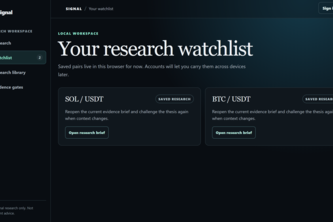
Signal is a self-reported crypto market data interpretation tool that claims to present clear facts and competing evidence without pressuring users to act. It integrates with Binance API and uses OpenAI’s GPT models, among other technologies.
What changed
The project was submitted to the OpenAI 2026 hackathon, indicating it is in an early-stage development or prototype phase. No commercial traction, revenue or customer evidence is provided.
Single most important open question
Is Signal intended as a consumer-facing product or a B2B tool for traders, and what is its actual commercial intent?
What The Product Actually Is
The description states that Signal “turns crypto market data into interpretations you can challenge.” It uses the Binance API and integrates with OpenAI’s GPT models (specifically referenced as “gpt-5.6”), Next.js, React, FastAPI, Docker, TypeScript, and Python.
Evidence
- The product is described as a tool that interprets crypto market data.
- It uses Binance API for data input.
- It integrates with OpenAI’s GPT models.
- Technologies listed include: Docker, FastAPI, Next.js, React, TypeScript, Python, and responses-api.
Inference
- Based on the tech stack, Signal likely has a web-based UI and backend services.
- The use of GPT suggests it may offer AI-generated insights or summaries.
Not evidenced
- No details on how the interpretation is generated or what specific outputs are produced.
- No mention of whether Signal is a dashboard, API, or standalone app.
Positioning & Claim Evolution
The tagline states: “Signal turns crypto market data into interpretations you can challenge. It provides clear market facts and competing evidence while putting zero pressure on the user to buy or sell.”
Evidence
- The product positions itself as non-prescriptive.
- It emphasizes clarity, competition of evidence, and neutrality.
Inference
- The positioning suggests Signal is intended for traders or analysts who want objective data interpretation without sales pressure.
- The claim implies a contrast with traditional trading platforms that push buy/sell decisions.
Not evidenced
- No indication of how “competing evidence” is presented or what the source of such evidence is.
- No mention of whether this is a consumer-facing product or an internal tool for professionals.
Target Customer & ICP
The description does not state who the target customer is.
Evidence
- No explicit customer segment identified.
- The use of GPT and Binance API suggests it may be aimed at traders or crypto analysts.
Inference
- If the product is intended for traders, it might appeal to those seeking neutral, data-driven insights.
- It could also be a tool for financial professionals or developers building crypto tools.
Not evidenced
- No customer personas, use cases, or buyer profiles are provided.
- No indication of whether Signal targets retail users, institutional clients, or developers.
Business Model & Pricing Evidence
There is no evidence in the description about pricing, monetization, or business model.
Evidence
- No mention of how Signal will generate revenue.
- No pricing structure, subscriptions, or payment methods are described.
Inference
- If it’s a SaaS tool, it may be priced per user or per data feed.
- It could also be freemium or monetized through API access or premium features.
Not evidenced
- No business model, pricing tiers, or monetization strategy is stated.
Technical & Delivery Signals
The project uses several technologies that suggest a modern, scalable stack:
Evidence
- Built with: Docker, FastAPI, Next.js, React, TypeScript, Python, OpenAI API, Binance API.
- Uses GPT-5.6 (a self-declared model version).
- The use of APIs and frameworks suggests Signal is built for integration or scalability.
Inference
- The stack implies a web-based product with backend processing and AI-driven insights.
- It may be designed to be modular, allowing for future expansion or API access.
Not evidenced
- No details on architecture, deployment, or data pipeline.
- No mention of performance, latency, or scalability features.
Traction & Maturity Signals
The project is described as a hackathon submission and has no evidence of traction or maturity.
Evidence
- Submitted to the OpenAI 2026 hackathon.
- Team size is listed as 3 members.
- No revenue, customers, or usage data are mentioned.
Inference
- The project is likely in early development or prototype stage.
- It may be a proof-of-concept or MVP.
Not evidenced
- No user base, customer feedback, or product adoption metrics.
- No evidence of product-market fit or commercial viability.
Competitive Context
No information is provided about competitors or market positioning.
Evidence
- No mention of existing tools in the crypto data interpretation space.
- No competitive analysis or differentiation strategy described.
Inference
- Signal may compete with existing crypto dashboards, trading platforms, or AI-driven financial tools.
- It could be positioned as a neutral alternative to traditional trading advice.
Not evidenced
- No information on direct or indirect competitors.
- No evidence of market size or competitive landscape.
Open Questions & Risks
Several risks and open questions emerge from the lack of detail:
Evidence
- The project is a hackathon submission with no commercial traction.
- No clear business model, pricing, or target customer.
Inference
- Risk of misalignment between stated goals and actual product direction.
- Lack of clarity on monetization may indicate a high-risk investment or partnership opportunity.
- The use of GPT-5.6 (a non-existent model) raises questions about technical accuracy or marketing claims.
Not evidenced
- No evidence of IP, regulatory compliance, or data handling practices.
- No indication of how Signal will scale or differentiate in the market.
Questions the description leaves open
- What is the intended use case for Signal — is it for retail traders, institutional clients, or developers?
- How does Signal generate interpretations from crypto data? Is it purely AI-driven or does it include human curation?
- What is the business model and monetization strategy?
- How will Signal differentiate itself in a crowded crypto data space?
- What are the technical limitations or scalability concerns with the current stack?
Overall Assessment
Not evidenced
The project description provides no evidence of commercial traction, revenue, customer adoption, or clear business model. It is presented as a hackathon submission and lacks any indication of product-market fit or maturity.
Inference
- Signal may be an early-stage idea with potential but requires further validation.
- If the founders are looking to pivot toward a commercial product, this would be a high-risk opportunity unless more evidence emerges.
Confidence Level Low. The analysis is based entirely on self-reported, unverified information and lacks any data on performance, adoption, or financials.
User Stories BotA demo video on every pull request
Get a demo video on every new feature
GitHub App that watches your pull requests and records a narrated, captioned demo.
Save time on demo prep and make informed decisions faster with a video walkthrough of every new feature.
Source
Submitted to the OpenAI 2026 hackathon on Devpost. Project home on Devpost. Back to the full gallery on Devpost.
This competitive analysis was produced by top-founders.com (opens in a new tab)
Generated by a language model from this project's public Devpost page — its tagline and any built-with tags listed there, since the author published no write-up — as captured in August 2026. Short quotations are the author's words. It is an opinion on the idea as a business, not on the people behind it, and it reflects the description as published then. If the project has moved on, request a correction below. The analysis is not independent research and contains no verified traction, revenue or customer data.
An independent guide by KFG International LLC — not affiliated with, endorsed by, or connected to Devpost or OpenAI.