

Archive position — measured, not model output
1 like on Devpost
505 of the 7,850 archived projects have more likes, and 1,758 share exactly 1 — so this project's #797 place in the like-ranked listing is a tie-break inside that group, not a ranking.
Projects (log scale)
Likes on Devpost. ▲ marks this project's group.
Show the figures
| Likes | Projects | Share of archive |
|---|---|---|
| 0 | 5,587 | 71.2% |
| 1 | 1,758 | 22.4% |
| 2 | 284 | 3.6% |
| 3–4 | 132 | 1.7% |
| 5–9 | 75 | 1.0% |
| 10+ | 14 | 0.2% |
 User Stories BotA demo video on every pull request
Get a demo video on every new feature
GitHub App that watches your pull requests and records a narrated, captioned demo.
Save time on demo prep and make informed decisions faster with a video walkthrough of every new feature.
Executive Summary
What the company appears to be
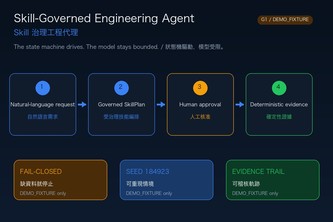
CircuitRescue is a self-reported engineering automation platform designed to help teams evaluate component substitutions in electronic designs through a controlled, traceable workflow. It uses an AI agent architecture that enforces governance over engineering tasks by restricting access to pre-approved tools, references, and procedures.
What changed
The project description shows development of a prototype system with working components including a runtime engine, multi-step workflows, skill definitions, and a web interface. It is presented as a solution to supply chain disruption challenges in electronics engineering.
Single most important open question
Does CircuitRescue have any real-world usage or adoption by engineering teams, or is it purely a proof-of-concept?
What The Product Actually Is
The description states that CircuitRescue is an "engineering agent" that helps teams evaluate component substitutions. It operates through:
- A "Single Agent + Multi-Skill architecture"
- An "Agent Runtime" that manages policy, routing, session state, workflow execution, approvals, and failure handling
- "Skills" which define when they are applicable, what inputs are required, which references are allowed, which tools may be called, and how results are evaluated
- A "SkillPlan" that combines multiple Skills into complex workflows
- Tool Adapters for deterministic engineering tools like ERC or SPICE
- A "Model Gateway" that can be replaced
- A browser-based interaction interface using Server-Sent Events
The system is described as not replacing engineers but helping them reuse approved knowledge, reduce repetitive work, and generate auditable evidence.
Evidence The author states this is how the product works. No independent verification or demonstration of actual functionality beyond prototype level is provided.
Positioning & Claim Evolution
The description states that CircuitRescue was created to address supply-chain disruptions in electronic products where components become unavailable due to discontinuation, lead times, or sourcing restrictions.
It positions itself as a "skill-governed engineering agent" that:
- Does not allow AI to freely invent repair solutions
- Only selects and executes human-approved procedures, trusted references, and controlled validation tools
- Helps teams safely reuse approved knowledge
- Reduces repetitive work
- Generates traceable, reproducible evidence
The author notes they are proud of moving beyond conceptual design to a working software foundation.
Evidence The author claims this positioning. No external validation or market feedback is provided.
Target Customer & ICP
The description states that CircuitRescue targets "engineering teams" who work with electronic designs and need to evaluate component substitutions due to supply chain disruptions.
It focuses on industrial 24 V sensor input interfaces with isolation and 3.3 V microcontroller outputs as its first domain profile.
Evidence The author describes the target customer and use case. No data about actual customers or market segmentation is provided.
Business Model & Pricing Evidence
Not evidenced.
The description does not contain any information about pricing, revenue streams, monetization strategy, or business model.
Technical & Delivery Signals
The system architecture includes:
- Single Agent + Multi-Skill design
- Agent Runtime managing policy and workflow
- Skills defined with JSON Schema contracts
- Tool Adapters for deterministic engineering tools (ERC, SPICE)
- Event-based session storage
- Server-Sent Events for live progress updates
- Versioned Skill lifecycle and routing layer
- Browser-based interface
- Automated unit and contract validation tests
The first domain profile focuses on industrial 24 V sensor input interfaces.
Evidence The author describes the technical architecture. No evidence of production deployment or delivery to customers is provided.
Traction & Maturity Signals
Not evidenced.
There is no mention of revenue, customers, users, adoption metrics, or any traction indicators beyond the prototype development stage described in the write-up.
Competitive Context
Not evidenced.
The description does not reference competitors, market size, or competitive positioning beyond stating that general-purpose AI models are insufficient for this domain.
Open Questions & Risks
- Unproven commercial viability: The system is described as a prototype with no evidence of real-world usage.
- Limited scope: The first domain profile is narrow (industrial 24 V sensor input interface), suggesting limited applicability.
- No revenue or customer data: No information about monetization, users, or market traction.
- Self-reported maturity: The project is described as a "working software foundation" but lacks evidence of operational deployment.
- High technical complexity without demonstrated execution: The architecture involves many moving parts (skills, tool adapters, references) that may be difficult to implement correctly.
Inference If the system has not been deployed in real engineering environments, it may face significant challenges in scaling or proving its utility beyond a hackathon prototype.
Questions the description leaves open
- What is the current status of the prototype? Is it being used internally by any engineering teams?
- How many actual engineering workflows have been completed using CircuitRescue?
- What are the specific use cases where customers have requested this type of solution?
- Are there any existing partnerships or pilot programs with engineering teams or companies?
- What is the roadmap for integrating real EDA tools like KiCad, and what challenges have been encountered?
- How do you plan to scale beyond the current narrow domain profile?
- What are the key assumptions about user behavior and adoption that underlie your product design?
Overall Assessment
Not evidenced.
There is no information provided about funding rounds, valuations, or investment interest. The description does not indicate whether this project has attracted investors or partners beyond its hackathon submission.
The author states that the system is a prototype with working components but provides no evidence of traction, revenue, or customer adoption. The project appears to be in early development and lacks commercial due-diligence signals such as users, customers, or market validation.
Inference Without evidence of real-world usage or business traction, this project is likely at a very early stage and not ready for investment or partnership consideration based on the provided information alone.
User Stories BotA demo video on every pull request
Get a demo video on every new feature
GitHub App that watches your pull requests and records a narrated, captioned demo.
Save time on demo prep and make informed decisions faster with a video walkthrough of every new feature.
Source
Submitted to the OpenAI 2026 hackathon on Devpost. Project home on Devpost. Back to the full gallery on Devpost.
This competitive analysis was produced by top-founders.com (opens in a new tab)
Generated by a language model from this project's public Devpost page — its tagline, the author's own write-up and any built-with tags listed there — as captured in August 2026. Short quotations are the author's words. It is an opinion on the idea as a business, not on the people behind it, and it reflects the description as published then. If the project has moved on, request a correction below. The analysis is not independent research and contains no verified traction, revenue or customer data.
An independent guide by KFG International LLC — not affiliated with, endorsed by, or connected to Devpost or OpenAI.