

Archive position — measured, not model output
0 likes on Devpost
2,263 of the 7,850 archived projects have more likes, and 5,587 share exactly 0 — so this project's #4,723 place in the like-ranked listing is a tie-break inside that group, not a ranking.
Projects (log scale)
Likes on Devpost. ▲ marks this project's group.
Show the figures
| Likes | Projects | Share of archive |
|---|---|---|
| 0 | 5,587 | 71.2% |
| 1 | 1,758 | 22.4% |
| 2 | 284 | 3.6% |
| 3–4 | 132 | 1.7% |
| 5–9 | 75 | 1.0% |
| 10+ | 14 | 0.2% |
 User Stories BotA demo video on every pull request
Get a demo video on every new feature
GitHub App that watches your pull requests and records a narrated, captioned demo.
Save time on demo prep and make informed decisions faster with a video walkthrough of every new feature.
Executive Summary
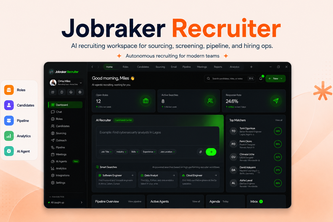
What the company appears to be: Jobraker Recruiter is a self-reported AI-powered recruiting workspace built for lean hiring teams. The author states it uses OpenAI Codex and GPT-5.6 to help with sourcing, evaluating fit, managing pipelines, and creating personalized outreach — all within one interface.
What changed: During the OpenAI Build Week hackathon, the product was extended to move from a local CLI-based Codex workflow into a browser-compatible “Codex App Server” architecture. This allowed recruiters to interact with AI-assisted tools through the web application rather than running commands locally.
Single most important open question: Is there any evidence of actual user adoption or revenue generation beyond the author’s own development and submission?
Note: All claims are self-reported and unverified. No third-party data, traction metrics, customer names, or financials are provided in this description.
What The Product Actually Is
The description states that Jobraker Recruiter is a web-based AI recruiting workspace for lean hiring teams. It supports:
- Sourcing candidates
- Evaluating candidate fit
- Managing hiring pipelines
- Creating personalized outreach messages
It integrates with Supabase for authentication and data persistence, AWS DynamoDB for operational workflow state, and uses an OpenAI Codex-powered assistant architecture to execute recruiter requests inside the application.
The author describes it as not just a chatbot but a working recruiting system that produces inspectable artifacts like candidate records, role briefs, fit assessments, outreach drafts, pipeline stages, sourcing notes, and analytics.
Inference: The product appears to be a custom-built SaaS tool using modern web technologies (React, TypeScript, Vercel, Supabase) with AI integration via Codex and GPT-5.6.
Positioning & Claim Evolution
The author positions Jobraker Recruiter as an alternative to fragmented or expensive enterprise recruiting tools — particularly targeting lean teams such as startups, community organizations, or individuals who lack time or resources for multi-tool workflows.
Key claims include:
- It solves setup friction in hiring.
- It helps users avoid manual copy-paste between disconnected tabs (LinkedIn, Gmail, etc.).
- It provides a shared memory across candidate searches.
- It avoids AI products that hide context instead of helping inspect, refine, and own work.
The product evolved during OpenAI Build Week to support browser-based interaction with Codex, moving away from a local CLI assumption.
Claim: The product was built for “lean teams” who need an integrated, inspectable, and AI-enhanced recruiting experience.
Inference: It is positioned as a lightweight, accessible solution for small-scale hiring operations, not large enterprises.
Target Customer & ICP
The description states that Jobraker Recruiter targets:
- Founders who are also hiring managers
- Lean startups with one recruiter
- Community organizations running fair searches without full recruiting stacks
- Hiring managers with strong intuition but little time to operate multiple tools
Claim: The target is “lean teams” — those who do not have access to or need full enterprise-level ATS systems.
Inference: Likely small-scale, early-stage companies or individuals managing recruitment themselves.
Business Model & Pricing Evidence
No information is provided about the business model or pricing structure. The description does not mention:
- Revenue streams
- Subscription tiers
- Freemium offerings
- Licensing models
- Monetization strategy
Not evidenced
Technical & Delivery Signals
The product is built using:
- Frontend: React 19, TypeScript, Vite, Tailwind CSS
- Backend: Supabase (auth + data), AWS DynamoDB, Supabase Edge Functions, Codex App Server
- AI stack: OpenAI Codex, GPT-5.6
Key technical decisions include:
- Separation of concerns between Supabase (data), DynamoDB (operational state), and Codex (AI reasoning)
- Use of Supabase Edge Functions to securely connect to AWS without exposing credentials
- Browser-to-server communication via a hosted Codex App Server instead of local CLI
Claim: The architecture is designed to be secure, scalable, and user-friendly for non-developers.
Inference: The system uses modern cloud-native patterns with clear separation between frontend, backend, and AI execution layers.
Traction & Maturity Signals
There is no evidence of:
- Users or customers
- Revenue or monetization
- Product usage metrics
- Customer feedback or testimonials
- Market traction beyond the author’s own development
Not evidenced
Competitive Context
The description does not mention competitors or market positioning relative to existing recruiting tools. It only contrasts Jobraker Recruiter with “fragmented tools” and “expensive enterprise software.”
Not evidenced
Open Questions & Risks
- No traction: No evidence of users, revenue, or adoption.
- Unproven AI integration: While the product claims to use Codex and GPT-5.6, there is no demonstration or validation of real-world performance.
- Self-reported only: All descriptions are author-generated and unverified.
- Limited scope: The project appears to be a prototype or hackathon submission, not a production-ready product.
- Dependency on proprietary AI models: Reliance on Codex and GPT-5.6 may pose long-term sustainability risks if access changes.
Inference: Without external validation or usage data, the commercial viability of this product remains unproven.
Questions the description leaves open
- What is your actual experience with hiring teams? Have you tested Jobraker Recruiter with real users?
- How do you plan to monetize the platform once it moves beyond a hackathon prototype?
- Can you demonstrate how the AI integration actually improves recruiting outcomes compared to existing tools?
- Are there any known limitations or edge cases in how Codex interacts with Supabase or DynamoDB?
- What are your plans for scaling beyond a single developer’s effort?
Overall Assessment
There is no evidence of traction, revenue, customers, or validated product-market fit.
The description indicates that Jobraker Recruiter was developed as part of a hackathon submission and has not yet been deployed in production or tested with real users.
Assessment: Not ready for investment or partnership at this stage. The project lacks commercial evidence and is heavily dependent on unverified claims about AI functionality and user adoption.
User Stories BotA demo video on every pull request
Get a demo video on every new feature
GitHub App that watches your pull requests and records a narrated, captioned demo.
Save time on demo prep and make informed decisions faster with a video walkthrough of every new feature.
Source
Submitted to the OpenAI 2026 hackathon on Devpost. Project home on Devpost. Back to the full gallery on Devpost.
This competitive analysis was produced by top-founders.com (opens in a new tab)
Generated by a language model from this project's public Devpost page — its tagline, the author's own write-up and any built-with tags listed there — as captured in August 2026. Short quotations are the author's words. It is an opinion on the idea as a business, not on the people behind it, and it reflects the description as published then. If the project has moved on, request a correction below. The analysis is not independent research and contains no verified traction, revenue or customer data.
An independent guide by KFG International LLC — not affiliated with, endorsed by, or connected to Devpost or OpenAI.