

Archive position — measured, not model output
0 likes on Devpost
2,263 of the 7,850 archived projects have more likes, and 5,587 share exactly 0 — so this project's #4,725 place in the like-ranked listing is a tie-break inside that group, not a ranking.
Projects (log scale)
Likes on Devpost. ▲ marks this project's group.
Show the figures
| Likes | Projects | Share of archive |
|---|---|---|
| 0 | 5,587 | 71.2% |
| 1 | 1,758 | 22.4% |
| 2 | 284 | 3.6% |
| 3–4 | 132 | 1.7% |
| 5–9 | 75 | 1.0% |
| 10+ | 14 | 0.2% |
 User Stories BotA demo video on every pull request
Get a demo video on every new feature
GitHub App that watches your pull requests and records a narrated, captioned demo.
Save time on demo prep and make informed decisions faster with a video walkthrough of every new feature.
Executive Summary
What the company appears to be
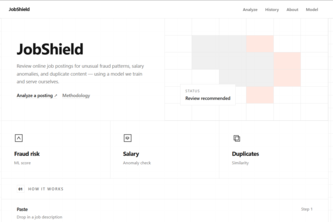
JobShield is a self-reported machine-learning platform designed to help job seekers evaluate job postings for potentially suspicious patterns using explainable AI. It is built as an end-to-end system including a web dashboard, Chrome extension, and backend API.
What changed
The author states that JobShield was developed during a hackathon (OpenAI 2026) with the goal of exploring whether machine learning could help job seekers recognize unusual patterns in job postings while communicating uncertainty responsibly. It is presented as an explainable ML product rather than one that sends data to an LLM.
Single most important open question
Is there evidence of traction, revenue, or user adoption beyond the author's own development and testing? The description contains no information about users, customers, or monetization — only a self-reported technical implementation.
What The Product Actually Is
The description states that JobShield is an explainable machine-learning platform that analyzes job postings for potentially suspicious patterns. It offers:
- A web application where users can paste job postings.
- A Chrome extension (Manifest V3) that extracts and analyzes job listings directly from the browser.
- A backend API built with FastAPI, supporting individual and batch analysis.
- A frontend dashboard built with Next.js, TypeScript, and Tailwind CSS.
- A machine-learning pipeline trained using TF-IDF with Logistic Regression or XGBoost models.
- Features include fraud-related language detection, salary anomaly detection, duplicate listing identification, and explainable outputs.
The system evaluates signals such as:
- Missing company profile
- Vague job requirements
- Unusual salary formatting
- Suspicious contact or payment language
- Similarity to previously observed postings
It does not claim that a company is fraudulent but instead provides cautious labels like “Low model risk,” “Some unusual signals,” “Review recommended,” and “Insufficient information.”
Evidence
- Author's own write-up.
- Technology stack includes FastAPI, Next.js, React, Python, scikit-learn, XGBoost, TF-IDF, etc.
Inference This is a self-contained ML product built for personal use or demonstration purposes. No evidence of deployment at scale or integration with external services beyond its own architecture.
Positioning & Claim Evolution
The author claims that JobShield helps job seekers make safer decisions by identifying potentially suspicious patterns in job postings without declaring them fake or real. The platform emphasizes:
- Explainability: users are shown which signals influenced the model’s output.
- Caution: it avoids definitive labels and encourages independent verification.
- Responsibility: it does not pretend to determine an employer's intentions with certainty.
It positions itself as a tool for pre-application decision-making, not replacement of human judgment.
Evidence
- The author explicitly states that the system "does not claim that a company or recruiter is fraudulent."
- It focuses on “cautious labels” and “explainable signals.”
- The goal is to help users recognize when they should verify an opportunity before sharing personal information.
Inference The positioning reflects a niche, ethical approach to fraud detection in job markets. However, the lack of any mention of market traction or adoption suggests this remains a prototype or proof-of-concept.
Target Customer & ICP
The description states that JobShield targets job seekers, particularly students and new graduates who are already struggling with job searches and may be vulnerable to scams.
It is designed for users who want to evaluate opportunities before applying, especially when:
- Suspicious postings are not obvious.
- Listings contain unrealistic salaries or vague company descriptions.
- There are repeated or copied job requirements.
Evidence
- The inspiration section mentions that the author noticed suspicious postings during their own job search.
- It is aimed at people who "spend hours tailoring resumes, completing assessments, and preparing for interviews."
Inference The intended user base appears to be individuals in early career stages or those unfamiliar with open questions in job listings. No evidence of segmentation beyond this general audience.
Business Model & Pricing Evidence
There is no evidence of a business model or pricing strategy in the description. The author does not mention any monetization, subscription plans, or commercial partnerships.
Evidence
- No mention of revenue streams.
- No indication of paid features or tiered access.
- The project is described as a hackathon submission and personal development effort.
Inference The system appears to be non-commercial in nature. It may have been built for demonstration or educational purposes, not for sale or use in a business context.
Technical & Delivery Signals
JobShield includes:
- A monorepo structure with:
- Python ML pipeline
- FastAPI backend
- Next.js web dashboard
- Chrome Manifest V3 extension
- Uses TF-IDF with Logistic Regression and XGBoost models.
- Implements explainability using SHAP or similar techniques.
- Parses salary formats and normalizes values.
- Detects duplicates via cosine similarity of sentence embeddings.
- Supports JSON-LD extraction, site-specific adapters, and manual paste fallback.
- Includes automated tests for ML, API, web, and extension components.
Evidence
- Author describes full technical stack including Docker, React, FastAPI, scikit-learn, etc.
- Mentions model comparison, reproducible pipelines, versioning, and input validation.
Inference The system is technically robust for a hackathon-level project. However, no evidence of production deployment or scalability beyond the author’s own testing.
Traction & Maturity Signals
There is no evidence of traction, adoption, or user engagement beyond the author's development efforts.
Evidence
- No mention of users, customers, or usage metrics.
- No data on how many job postings have been analyzed.
- No indication of any live deployment or public access.
- The project is described as a hackathon submission and personal prototype.
Inference This appears to be a demo or proof-of-concept with no demonstrated market traction or operational maturity.
Competitive Context
The description does not provide information about competitors or existing solutions in the job-scam detection space. It also lacks any discussion of how JobShield compares to other tools or platforms that might assist job seekers in evaluating opportunities.
Evidence
- No mention of competing products.
- No reference to prior art or market positioning relative to others.
Inference Without external context, it is unclear whether there are similar offerings in the market. The absence of competitive analysis suggests this may be a novel idea or one that has not yet gained visibility.
Open Questions & Risks
Key risks and open questions based on the self-reported description:
- No commercial traction: No evidence of users, customers, or revenue.
- Limited data: The author notes that publicly available labeled datasets are outdated or limited.
- Unproven scalability: Built for a single developer; no indication of deployment at scale.
- Ethical concerns: While the system emphasizes responsible communication, it is unclear how it would handle false positives or negatives in real-world use.
- Lack of feedback loop: No mechanism described for incorporating user feedback into model improvement.
- No public extension: The Chrome extension is not publicly available.
Evidence
- Author states that synthetic data was used during initial development and that the next step is to retrain with official datasets.
- No mention of any live or deployed version.
Inference This system has not yet moved beyond a prototype stage. Its real-world effectiveness remains untested, and its long-term viability depends on future development and validation.
Questions the description leaves open
- What is the source of your training data? How do you plan to validate performance with real-world job postings?
- Have you tested the system with actual users or recruited participants for usability testing?
- Is there any mechanism in place for collecting user feedback to improve model accuracy over time?
- What are the plans for deploying the Chrome extension publicly? Are there privacy implications related to data collection?
- How do you intend to scale beyond a single developer's capacity, especially if demand increases?
- Are there any legal or regulatory considerations around classifying job postings as “suspicious”?
- What metrics do you track to assess model drift or performance degradation over time?
Overall Assessment
Not evidenced: There is no evidence of revenue, customers, traction, or financial viability beyond the author’s own development.
Confidence level Low This project is described as a hackathon submission and personal prototype. It lacks any indication of commercialization, user base, or monetization strategy.
Assessment JobShield represents an interesting technical exploration with potential for further development. However, without evidence of traction, adoption, or a clear path to market, it cannot be considered a viable investment or partnership opportunity at this time. Further due diligence would require validation through live usage, performance data, and scalability assessments.
User Stories BotA demo video on every pull request
Get a demo video on every new feature
GitHub App that watches your pull requests and records a narrated, captioned demo.
Save time on demo prep and make informed decisions faster with a video walkthrough of every new feature.
Source
Submitted to the OpenAI 2026 hackathon on Devpost. Project home on Devpost. Back to the full gallery on Devpost.
This competitive analysis was produced by top-founders.com (opens in a new tab)
Generated by a language model from this project's public Devpost page — its tagline, the author's own write-up and any built-with tags listed there — as captured in August 2026. Short quotations are the author's words. It is an opinion on the idea as a business, not on the people behind it, and it reflects the description as published then. If the project has moved on, request a correction below. The analysis is not independent research and contains no verified traction, revenue or customer data.
An independent guide by KFG International LLC — not affiliated with, endorsed by, or connected to Devpost or OpenAI.