

Archive position — measured, not model output
1 like on Devpost
505 of the 7,850 archived projects have more likes, and 1,758 share exactly 1 — so this project's #801 place in the like-ranked listing is a tie-break inside that group, not a ranking.
Projects (log scale)
Likes on Devpost. ▲ marks this project's group.
Show the figures
| Likes | Projects | Share of archive |
|---|---|---|
| 0 | 5,587 | 71.2% |
| 1 | 1,758 | 22.4% |
| 2 | 284 | 3.6% |
| 3–4 | 132 | 1.7% |
| 5–9 | 75 | 1.0% |
| 10+ | 14 | 0.2% |
 User Stories BotA demo video on every pull request
Get a demo video on every new feature
GitHub App that watches your pull requests and records a narrated, captioned demo.
Save time on demo prep and make informed decisions faster with a video walkthrough of every new feature.
Executive Summary
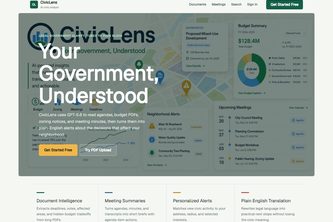
CivicLens is an AI-powered platform described by its author as a "personal civic analyst" that processes local government documents (e.g., budgets, meeting minutes, zoning notices) into structured summaries for residents. The platform claims to offer features such as document analysis with fact preservation, personalized alerts based on location and interests, and administrative tools for municipal data ingestion.
The description states the project was built for the OpenAI 2026 hackathon, using TypeScript, React, Next.js, Cloudflare Workers, and GPT-5.6 via OpenAI’s Responses API. It includes a full-stack application with twelve routes covering resident and admin journeys, structured outputs, and fictional fixtures for judging.
There is no evidence of revenue, customers, or traction beyond the hackathon submission. The author describes the platform as an experimental prototype, not yet deployed in production or connected to real municipal data sources. The business model, pricing, and go-to-market strategy are not detailed.
The single most important open question
Is there a viable path from this hackathon prototype to a scalable, trustworthy civic transparency tool that can be adopted by cities or used by residents at scale?
What The Product Actually Is
- The description states CivicLens is an AI-powered local government transparency platform.
- It functions as a personal civic analyst rather than a general-purpose chatbot.
- Users upload PDFs (budgets, meeting packets, zoning notices) and receive structured summaries including:
- Executive summary
- Key facts and financial amounts
- Plain-English explanation
- Important dates and deadlines
- Resident action items
- Affected neighborhoods/services
- Proposal-versus-approval status
- The platform supports:
- Personalized civic alert inbox
- Searchable meeting transcripts
- Agenda-item summaries with decisions and votes
- Extracted financial amounts
- Civic document search with filters (type, date, location)
- Administrator console for configuring scrapers
- It uses GPT-5.6 through OpenAI’s Responses API to analyze documents.
- The system validates PDFs before processing and enforces strict JSON schema constraints on AI outputs.
- The application is built with React 19, Vinext, Vite, Next.js App Router, and deployed via Cloudflare Workers.
Inference The product appears to be a proof-of-concept prototype designed for demonstration in a hackathon setting. It includes structured output design and fact-preservation logic but lacks integration with live municipal data sources or persistent storage beyond session-based state.
Positioning & Claim Evolution
- The author positions CivicLens as an AI-powered tool that brings clarity to inaccessible civic information.
- The name combines "Civic" (citizens and local government) with "Lens" (a tool for seeing clearly).
- The platform aims to address the gap between publicly available but practically inaccessible government data and citizen understanding or participation.
Claim
Democracy suffers not only when information is hidden, but also when it's published in forms that are hard to understand or use.
- The description emphasizes that CivicLens does more than summarize — it preserves decision status, explains who is affected, surfaces deadlines, and gives actionable next steps.
- It is described as a "personal civic analyst" rather than a chatbot, suggesting a focus on structured, outcome-driven interaction.
Inference The positioning reflects an intent to create a tool that enhances democratic participation by making government decisions more accessible and understandable. However, the claim of being a “personal civic analyst” is unproven without evidence of real-world usage or adoption.
Target Customer & ICP
- The primary user group described is residents who want to understand local government decisions.
- These users are expected to:
- Upload civic documents (PDFs)
- Set a home address
- Choose topics they care about
- Configure an alert radius
- The platform personalizes content based on:
- Home address
- Chosen interests
- Affected neighborhoods/services
- Upcoming deadlines
- The secondary user group is municipal administrators, who can configure scrapers and observe data ingestion.
Inference The target customer segment seems to be individual residents seeking civic engagement tools, with municipal administrators as a potential future audience. There is no evidence of actual customers or user feedback beyond the hackathon context.
Business Model & Pricing Evidence
- No explicit business model or pricing information is provided in the description.
- The author mentions that the platform includes an administrator console for configuring scrapers and observing municipal data ingestion, implying a possible B2B component.
- There is no mention of monetization strategies, subscription tiers, or revenue streams.
Inference The business model remains undefined. While the platform could potentially be monetized through municipal partnerships or direct consumer subscriptions, there is no evidence to support either approach.
Technical & Delivery Signals
- Built with:
- Frontend: React 19, Vinext, Vite, Next.js App Router
- Backend: TypeScript, Node.js, Cloudflare Workers
- AI: GPT-5.6 via OpenAI Responses API
- Data persistence: Drizzle ORM, Cloudflare D1 (schema and migration documented)
- Deployment: OpenAI Sites
- Features include:
- Twelve product routes covering full resident and admin workflows
- Structured document analysis with strict JSON schema enforcement
- Fact-preservation logic for critical data elements (dates, amounts, votes)
- PDF validation checks before AI processing
- Prompt engineering focused on specific outputs like relevance scoring, meeting summaries, and action items
- Sample PDFs were created for judging purposes:
- City budget excerpt
- Zoning notice
- Meeting minutes
Inference The technical architecture shows a solid foundation for a scalable product. However, the current implementation is limited to a hackathon prototype with session-based state and fictional fixtures. Persistent storage and live data integration are described as future work.
Traction & Maturity Signals
- Not evidenced.
Absence of evidence
There is no mention of users, customers, revenue, or adoption metrics beyond the hackathon submission.
Inference The project has not yet demonstrated any traction or maturity in real-world usage. It remains a prototype with no evidence of product-market fit or user engagement.
Competitive Context
- Not evidenced.
Absence of evidence
No information is provided about competitors, market size, or competitive positioning.
Inference Without knowledge of existing platforms or tools in the civic transparency space, it's impossible to assess how CivicLens would differentiate itself or what its competitive advantages might be.
Open Questions & Risks
- Prototype vs. Product Gap: The platform is described as a hackathon prototype with session-based state and fictional fixtures. No evidence of production-ready features or integration with real municipal data.
- AI Dependency Risk: Reliance on GPT-5.6 for document analysis introduces risk if API availability or accuracy changes.
- Data Integrity Concerns: While the system enforces structured outputs and fact preservation, it is unclear how well these mechanisms would hold in production environments or against complex, unstructured civic documents.
- Scalability Limitations: The current architecture uses Cloudflare Workers and session-based state, which may not scale to large numbers of users or continuous data ingestion from multiple municipalities.
- Lack of Commercial Viability: No evidence of a monetization strategy or business model beyond the hackathon context.
Questions the description leaves open
- What is the plan for integrating with real municipal data sources?
- How will the platform handle large-scale document ingestion and processing?
- Is there any intention to move away from fictional fixtures toward real-world civic documents?
- What are the plans for persistent storage, user authentication, and long-term data retention?
- Are there any partnerships or pilot programs with local governments already underway?
- How does the team intend to validate the accuracy of AI-generated summaries in live use?
- What is the roadmap for expanding support to more cities or regions?
Overall Assessment
- Not evidenced.
Absence of evidence
No financial data, funding history, valuation, or investor interest is available beyond the hackathon submission.
Inference Given that this is a hackathon prototype with no demonstrated traction, revenue, or customer base, it does not appear to be a viable investment opportunity at this stage. However, if the team can demonstrate progress toward connecting to real municipal data and building a sustainable product, there may be potential for future interest.
The project shows promise in concept and technical execution but lacks commercial viability or scalability indicators. It would require significant development and validation before becoming a serious candidate for investment or partnership.
User Stories BotA demo video on every pull request
Get a demo video on every new feature
GitHub App that watches your pull requests and records a narrated, captioned demo.
Save time on demo prep and make informed decisions faster with a video walkthrough of every new feature.
Source
Submitted to the OpenAI 2026 hackathon on Devpost. Project home on Devpost. Back to the full gallery on Devpost.
This competitive analysis was produced by top-founders.com (opens in a new tab)
Generated by a language model from this project's public Devpost page — its tagline, the author's own write-up and any built-with tags listed there — as captured in August 2026. Short quotations are the author's words. It is an opinion on the idea as a business, not on the people behind it, and it reflects the description as published then. If the project has moved on, request a correction below. The analysis is not independent research and contains no verified traction, revenue or customer data.
An independent guide by KFG International LLC — not affiliated with, endorsed by, or connected to Devpost or OpenAI.