

Archive position — measured, not model output
0 likes on Devpost
2,263 of the 7,850 archived projects have more likes, and 5,587 share exactly 0 — so this project's #6,683 place in the like-ranked listing is a tie-break inside that group, not a ranking.
Projects (log scale)
Likes on Devpost. ▲ marks this project's group.
Show the figures
| Likes | Projects | Share of archive |
|---|---|---|
| 0 | 5,587 | 71.2% |
| 1 | 1,758 | 22.4% |
| 2 | 284 | 3.6% |
| 3–4 | 132 | 1.7% |
| 5–9 | 75 | 1.0% |
| 10+ | 14 | 0.2% |
 User Stories BotA demo video on every pull request
Get a demo video on every new feature
GitHub App that watches your pull requests and records a narrated, captioned demo.
Save time on demo prep and make informed decisions faster with a video walkthrough of every new feature.
Executive Summary
Company: sidethink
Self-reported basis: The analysis is based entirely on the author's own description of the project, submitted as part of a Devpost entry for the OpenAI 2026 hackathon. No external verification or independent sources are available.
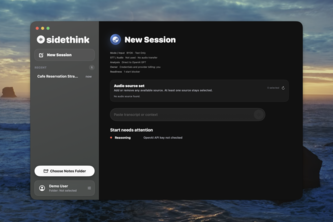
What it appears to be: A macOS application that listens to real-time voice or text during meetings and generates structured insights — such as missing discussion points, fact-checking claims, and creative thinking support — using AI-powered natural language processing and reasoning.
What changed: The project is described as a beta version built with Codex (a code generation tool) and deployed via FastAPI backend. It was submitted to a hackathon, suggesting early-stage development.
Single most important open question: Is there sufficient evidence of user need or adoption to justify further investment or development beyond the author's personal use case?
What The Product Actually Is
The description states that sidethink is an app that:
- Receives real-time voice or text during meetings.
- Uses speech-to-text (via Apple’s local STT or Soniox API).
- Converts the transcribed text into “claims” — clear, organized opinions.
- Generates “insight cards” from these claims to find missing discussion points, fact-check claims, or support creative thinking.
- Sorts insight cards by importance for quick reference during live meetings.
The app is built as a macOS application and has two modes:
- BYOK (Bring Your Own Keys), allowing users to control their data via API keys.
- A backend server built with FastAPI for on-demand use and enhanced reasoning.
Inference: The product appears to be a real-time meeting assistant that leverages AI to enhance discussion quality, but it is not yet proven in the market or adopted by users beyond the developer’s own use.
Positioning & Claim Evolution
The author states:
- The inspiration came from wanting to identify missing points or verify claims during meetings.
- The app aims to help guide discussions more effectively and support better decision-making.
- It is described as a "realtime thinking buddy" for meaningful discussion.
Inference: The positioning is that of a productivity tool aimed at individuals in meeting-heavy roles, with an emphasis on real-time AI assistance. However, no evidence exists of how this compares to existing tools or whether it addresses a widespread pain point.
Target Customer & ICP
The description does not clearly define the target customer or ideal customer profile (ICP). The author mentions:
- Using a laptop for online meetings.
- Building for macOS users.
- Noting that the app is currently in beta and tested internally.
Inference: The likely user base is individuals who attend frequent remote meetings, particularly those using macOS. However, no evidence of actual users or market segmentation exists.
Business Model & Pricing Evidence
The description does not mention:
- A pricing model.
- Revenue streams.
- Monetization strategy.
- Customer acquisition plans.
Inference: No business model is evident from the self-reported description. The app appears to be a personal project, not yet monetized or intended for sale.
Technical & Delivery Signals
The author states:
- Built using Codex 5.6 Sol Extra High.
- Backend server built with FastAPI.
- Frontend built in Swift (macOS).
- Uses Apple’s local STT or Soniox API for transcription.
- The app has two modes: BYOK and backend use.
Inference: The technical stack suggests a lightweight, developer-focused tool. However, no evidence of scalability, performance, or robustness is provided.
Traction & Maturity Signals
The description states:
- The project is in beta.
- It was submitted to the OpenAI 2026 hackathon.
- The author built it using Codex and refined workflows.
- A TestFlight build is planned for internal closed beta testing.
- Golden test datasets were created, but more data is needed.
Inference: There is no evidence of user adoption or revenue. The product is in early development and has not yet been tested with real users beyond the developer’s own use.
Competitive Context
The description does not mention:
- Competitors.
- Market analysis.
- How sidethink differs from existing tools (e.g., meeting summarizers, AI assistants).
Inference: No competitive positioning or market differentiation is evident. The author does not reference existing solutions in the space.
Open Questions & Risks
- No traction or revenue: The project is described as a beta version with no evidence of user adoption.
- Unproven value proposition: The app’s utility depends on generating “meaningful insights,” but there is no data to support this.
- Developer-centric tool: Built for personal use, not yet designed for broader market appeal or scalability.
- Limited technical depth: Reliance on Codex and GPT-based tools may limit control over output quality or long-term maintainability.
- No monetization strategy: No indication of how the product will be sold or funded.
Questions the description leaves open
- What specific user problems are you solving, and how do you know they exist?
- Have you conducted any user research or interviews to validate demand?
- How do you plan to scale beyond a single developer’s use case?
- What is your roadmap for monetization or product-market fit?
- What are the key limitations of the current AI tools (e.g., Codex) that affect this product?
- How will you collect and improve data for better reasoning over time?
Overall Assessment
Not evidenced: There is no evidence of revenue, customer traction, or commercial viability beyond the author’s personal project.
Confidence level: Low — based on self-reported information only, with no external validation or market data.
Assessment: This is a personal hackathon project in early beta stage. It has not yet demonstrated product-market fit, user adoption, or scalability. Further due diligence would require evidence of user testing, feedback, and commercial traction.
User Stories BotA demo video on every pull request
Get a demo video on every new feature
GitHub App that watches your pull requests and records a narrated, captioned demo.
Save time on demo prep and make informed decisions faster with a video walkthrough of every new feature.
Source
Submitted to the OpenAI 2026 hackathon on Devpost. Project home on Devpost. Back to the full gallery on Devpost.
This competitive analysis was produced by top-founders.com (opens in a new tab)
Generated by a language model from this project's public Devpost page — its tagline, the author's own write-up and any built-with tags listed there — as captured in August 2026. Short quotations are the author's words. It is an opinion on the idea as a business, not on the people behind it, and it reflects the description as published then. If the project has moved on, request a correction below. The analysis is not independent research and contains no verified traction, revenue or customer data.
An independent guide by KFG International LLC — not affiliated with, endorsed by, or connected to Devpost or OpenAI.