

Archive position — measured, not model output
0 likes on Devpost
2,263 of the 7,850 archived projects have more likes, and 5,587 share exactly 0 — so this project's #6,682 place in the like-ranked listing is a tie-break inside that group, not a ranking.
Projects (log scale)
Likes on Devpost. ▲ marks this project's group.
Show the figures
| Likes | Projects | Share of archive |
|---|---|---|
| 0 | 5,587 | 71.2% |
| 1 | 1,758 | 22.4% |
| 2 | 284 | 3.6% |
| 3–4 | 132 | 1.7% |
| 5–9 | 75 | 1.0% |
| 10+ | 14 | 0.2% |
 User Stories BotA demo video on every pull request
Get a demo video on every new feature
GitHub App that watches your pull requests and records a narrated, captioned demo.
Save time on demo prep and make informed decisions faster with a video walkthrough of every new feature.
Executive Summary
What the company appears to be
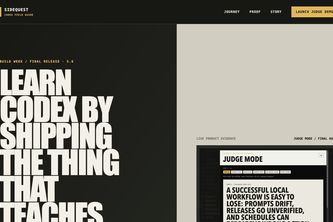
Sidequest — The Ship Loop is a self-reported local-first Codex apprenticeship tool designed for learning how to use Codex (specifically GPT-5.6) through guided, bounded workflows. It presents itself as an interactive educational platform that teaches Codex usage via hands-on practice with real repository changes and evidence-based verification.
What changed
The project description indicates a major extension of an existing Sidequest repository, adding a structured curriculum for learning Codex through six phases. This includes features like Prompt Clinic, Flight Recorder, Ship with Sites, Browser Proof, Safe Automations, Package the Workflow, Final Flight, and Judge Mode.
Single most important open question
Is there any evidence that this tool has been used by learners beyond its own developers or in a production context? The description states it is a “playable apprenticeship” but does not provide data on adoption, usage frequency, or learner outcomes.
What The Product Actually Is
The description states that Sidequest — The Ship Loop is a local-first Codex apprenticeship with an interactive companion app. It teaches practical workflows through outcomes, exercises, and reflection. It includes:
- A six-phase Build Week curriculum
- Features such as Prompt Clinic, Flight Recorder, Ship with Sites, Browser Proof, Safe Automations, Package the Workflow, Final Flight, and Judge Mode
It is built using zero-dependency HTML, CSS, and JavaScript, supported by a Node.js standard-library development server. Progress is persisted locally, with export/import support.
Inference The tool appears to be a prototype or proof-of-concept for teaching Codex usage in a safe, repeatable way, using real repository changes and evidence-based verification.
Positioning & Claim Evolution
The description states that Sidequest was inspired by the challenge of learning Codex from scratch. It positions itself as a guided apprenticeship that turns the first move into a structured learning experience.
It distinguishes between practice and verified evidence, emphasizing that it does not overclaim what a dry run or local action means in terms of real-world automation or deployment.
The project evolved from an existing repository to include a structured curriculum and new features like Safe Automations, Flight Recorder, and Judge Mode. It is described as a “complete, playable apprenticeship”, but no evidence of external adoption or impact is provided.
Inference The positioning reflects a focus on safe, bounded learning with emphasis on evidence-based workflows, not on commercial traction or product-market fit.
Target Customer & ICP
The description states that Sidequest is designed for new learners of Codex, particularly those who find it intimidating to start using Codex from scratch. It aims to teach Codex through practical, bounded workflows and hands-on experience.
It targets users who want to learn how to use Codex in a safe, guided environment where they can see real repository changes, verify results, and reflect on their progress.
Inference The ICP is likely technical learners or developers interested in mastering Codex through structured, interactive practice. No evidence of specific personas, segments, or user types beyond this general description.
Business Model & Pricing Evidence
The description does not state anything about a business model or pricing. It describes the tool as a self-contained educational platform with no mention of monetization, subscriptions, or fees.
Inference There is no evidence of any commercial model or pricing structure.
Technical & Delivery Signals
The project is built using:
- Zero-dependency HTML, CSS, and JavaScript
- Node.js standard-library development server
- Local-first persistence with export/import support
- Automated tests (282 passing)
- Deterministic receipts for replayable workflows
- Browser verification and responsive layouts
- Support for accessibility, keyboard, console-health checks
It uses Codex to inspect repositories, edit files, run tests, operate the browser, verify served identity, check responsive layouts, and package evidence.
Inference The tool is technically self-contained and designed for local-first, deterministic workflows, with a focus on replayability and safety. It does not appear to rely on external APIs or cloud infrastructure beyond local execution.
Traction & Maturity Signals
The description states that the project includes:
- A coherent six-phase Build Week extension
- 282 passing automated tests
- A deterministic Flight Recorder and receipt system
- Responsive desktop and mobile layouts
- Browser, keyboard, persistence, accessibility, and console-health checks
- Safe automation design with explicit approval boundaries
- A reusable Ship Loop skill
- A public hosted app and demo video
However, there is no evidence of actual users, customer feedback, or adoption metrics beyond the authors’ own claims.
Inference The tool shows technical maturity in its implementation but lacks evidence of real-world traction or user engagement.
Competitive Context
The description does not provide any information about competitors or market positioning. It does not mention existing tools for learning Codex or teaching AI workflows.
Inference No competitive context is evident from the description.
Open Questions & Risks
- No evidence of real-world usage or adoption: The tool is described as a playable apprenticeship but lacks data on learners, engagement, or outcomes.
- Self-reported only: All claims are unverified and based solely on the author’s own account.
- No commercial model: No indication of how this would be monetized or scaled.
- Limited scope: It appears to be a prototype or hackathon project, not a product with a defined market or go-to-market strategy.
Inference The tool is likely in early-stage development and lacks evidence of product-market fit or commercial viability.
Questions the description leaves open
- What is the intended user base for this tool beyond the developers?
- Have you tested it with actual learners or users, and what feedback did you get?
- How do you plan to scale beyond a single developer’s prototype?
- Is there any intention to monetize or commercialize this tool?
- What are the key assumptions about how Codex will be used in practice that this tool is trying to validate?
Overall Assessment
The description states that Sidequest — The Ship Loop is a self-contained, local-first Codex apprenticeship built as part of an OpenAI hackathon project. It includes a structured curriculum and technical features designed for safe, repeatable learning.
However, there is no evidence of revenue, customers, or traction beyond the authors’ own claims. The tool appears to be a prototype or proof-of-concept with no indication of commercial viability or market demand.
Assessment Not evidenced as a viable investment or partnership opportunity at this stage. It lacks commercial signals and user data to support further due diligence.
User Stories BotA demo video on every pull request
Get a demo video on every new feature
GitHub App that watches your pull requests and records a narrated, captioned demo.
Save time on demo prep and make informed decisions faster with a video walkthrough of every new feature.
Source
Submitted to the OpenAI 2026 hackathon on Devpost. Project home on Devpost. Back to the full gallery on Devpost.
This competitive analysis was produced by top-founders.com (opens in a new tab)
Generated by a language model from this project's public Devpost page — its tagline, the author's own write-up and any built-with tags listed there — as captured in August 2026. Short quotations are the author's words. It is an opinion on the idea as a business, not on the people behind it, and it reflects the description as published then. If the project has moved on, request a correction below. The analysis is not independent research and contains no verified traction, revenue or customer data.
An independent guide by KFG International LLC — not affiliated with, endorsed by, or connected to Devpost or OpenAI.