

Archive position — measured, not model output
0 likes on Devpost
2,263 of the 7,850 archived projects have more likes, and 5,587 share exactly 0 — so this project's #6,663 place in the like-ranked listing is a tie-break inside that group, not a ranking.
Projects (log scale)
Likes on Devpost. ▲ marks this project's group.
Show the figures
| Likes | Projects | Share of archive |
|---|---|---|
| 0 | 5,587 | 71.2% |
| 1 | 1,758 | 22.4% |
| 2 | 284 | 3.6% |
| 3–4 | 132 | 1.7% |
| 5–9 | 75 | 1.0% |
| 10+ | 14 | 0.2% |
 User Stories BotA demo video on every pull request
Get a demo video on every new feature
GitHub App that watches your pull requests and records a narrated, captioned demo.
Save time on demo prep and make informed decisions faster with a video walkthrough of every new feature.
Executive Summary
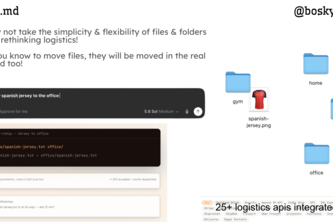
The description states that ship.md is a macOS file-monitoring application that interprets filesystem operations (like mv) as triggers for physical-world logistics workflows. The author describes it as an early prototype built in Python, with a local watcher, SQLite-backed inventory, and webhook integrations. It uses Markdown files to define context, contacts, and routing for physical deliveries.
The product is positioned as a reimagining of logistics through the lens of file system operations — where moving a file corresponds to moving a physical object. The author claims it works with agents, shell scripts, desktop users, and other programs using the same interface, without requiring a separate agent-only protocol.
It is unclear whether this has moved beyond an experimental or hackathon prototype stage. No revenue, customers, or traction data are provided. The project appears to be a personal endeavor by one individual (Bosky Kode), with no evidence of funding, partnerships, or commercial adoption.
The single most important open question
Is the abstraction of physical logistics through filesystem operations viable beyond a demo or proof-of-concept, and how does it handle real-world complexity like confirmation, rollback, and failure handling?
What The Product Actually Is
- The description states that ship.md is a macOS file-monitoring app.
- It observes filesystem changes (e.g.,
mvcommands) and interprets them as physical delivery actions. - It uses Markdown files (
ship.md) in folders to define inventory, contacts, location context, and webhook integrations. - The system includes:
- A local filesystem watcher
- SQLite-backed inventory
- JSON audit trail
- Admin interface
- Manifest-driven webhook adapters
- A packaged macOS DMG
- It is built primarily in Python, with support for codex, mac, sol, and sqlite technologies.
- The author describes it as a prototype that works with agents, shell scripts, desktop users, and other programs through the same interface.
Inference The product appears to be an early-stage prototype or proof-of-concept, not a production-ready SaaS offering. It is described as a macOS app but does not appear to have any commercial or monetization features beyond a pricing page mentioned in the write-up.
Positioning & Claim Evolution
- The author positions ship.md as a tool that rethinks logistics by using the filesystem as an interface.
- The tagline: “Moving files in folders, move things in the real world.” suggests a conceptual shift from digital to physical workflows.
- The inspiration is rooted in the idea that “everything you see around you was shipped there by someone.”
- The author claims it works without needing proprietary interfaces or agents — any program capable of manipulating the filesystem can initiate workflows.
- It is described as a system where:
- Folders represent places
- Files represent things
- Markdown provides context and configuration
Inference The positioning is conceptual and experimental. There is no evidence that this has evolved into a commercial product or platform with defined value propositions beyond the author’s own use case.
Target Customer & ICP
- The description does not identify specific customer segments.
- The author states that it works for:
- Agents
- Shell scripts
- Desktop users
- Other programs
- It is presented as a tool for people who are comfortable with filesystem operations and Markdown.
- The author mentions a pricing page at shipmd.app, suggesting an intent to attract customers or users — but no actual customer base is described.
Inference The ICP appears to be technical users or developers who are familiar with command-line tools, file systems, and scripting. There is no evidence of non-technical or enterprise adoption.
Business Model & Pricing Evidence
- The author mentions a pricing page at shipmd.app.
- No details about pricing tiers, monetization strategy, or revenue model are provided.
- The project is described as an early prototype with no commercial traction or customer data.
Inference There is no evidence of a functioning business model. The pricing page may be speculative or for user feedback purposes only.
Technical & Delivery Signals
- Built in Python, using macOS APIs and SQLite.
- Includes:
- Local filesystem watcher
- SQLite-backed inventory
- JSON audit trail
- Admin interface
- Manifest-driven webhook adapters
- Packaged DMG for macOS
- The code is available on GitHub (github.com/bosky101/ship.md).
- Courier integrations are described as ordinary API calls configured through manifests.
- No special partnerships or proprietary integrations are claimed.
Inference The technical stack is basic and likely not production-grade. It is a prototype built for personal use or demonstration, with no evidence of scalability or enterprise delivery capabilities.
Traction & Maturity Signals
- The project was submitted to the OpenAI 2026 hackathon.
- It is described as an early prototype.
- No revenue, customers, or adoption data are provided.
- The author mentions “many rough edges” and ongoing questions about confirmation, rollback, and lifecycle states.
- There is no evidence of user feedback, product iteration, or growth.
Inference The project is at a very early stage. It has not demonstrated any traction or maturity beyond an experimental build.
Competitive Context
- No competitors are named or described in the write-up.
- The author does not reference existing logistics or file-monitoring tools.
- The product’s conceptual uniqueness lies in its use of filesystem operations as a coordination interface for physical delivery — which is not a mainstream approach.
Inference There is no evidence of competitive analysis or awareness of existing solutions. The project appears to be an original idea with no known market context.
Open Questions & Risks
- The author explicitly states that the abstraction of physical logistics through file moves raises questions around:
- Confirmation
- Failure handling
- Idempotency
- Permissions
- Recovery from accidental moves
- It is described as a “deliberately simple” abstraction, but the real world behind it is not.
- No evidence of safety mechanisms or rollback models for accidental file moves.
- The project is a solo effort with no team or funding.
- The pricing page may be speculative and not indicative of a functioning product.
Inference The core conceptual model has significant unresolved technical and operational challenges. It appears to be an experimental idea, not a scalable or safe solution.
Questions the description leaves open
- What are the key assumptions about how physical logistics can be modeled through filesystem operations?
- How does the system handle confirmation of delivery, failure recovery, and accidental moves?
- Is there any user feedback or testing with real workflows beyond the prototype stage?
- What is the intended evolution from this prototype to a commercial product?
- Are there plans for cross-platform support (e.g., Windows, Linux)?
- How does the system manage permissions and security in physical delivery workflows?
Overall Assessment
- The project is described as an early-stage prototype built by one person.
- There is no evidence of revenue, customers, or traction.
- It is positioned as a conceptual experiment rather than a commercial product.
- No funding, partnerships, or team structure are evident.
Inference This is not a viable investment or partnership opportunity at this stage. It is an experimental idea with significant unresolved technical and operational challenges. The author may be seeking feedback or early adopters, but there is no evidence of a scalable or monetizable product.
User Stories BotA demo video on every pull request
Get a demo video on every new feature
GitHub App that watches your pull requests and records a narrated, captioned demo.
Save time on demo prep and make informed decisions faster with a video walkthrough of every new feature.
Source
Submitted to the OpenAI 2026 hackathon on Devpost. Project home on Devpost. Back to the full gallery on Devpost.
This competitive analysis was produced by top-founders.com (opens in a new tab)
Generated by a language model from this project's public Devpost page — its tagline, the author's own write-up and any built-with tags listed there — as captured in August 2026. Short quotations are the author's words. It is an opinion on the idea as a business, not on the people behind it, and it reflects the description as published then. If the project has moved on, request a correction below. The analysis is not independent research and contains no verified traction, revenue or customer data.
An independent guide by KFG International LLC — not affiliated with, endorsed by, or connected to Devpost or OpenAI.