

Archive position — measured, not model output
0 likes on Devpost
2,263 of the 7,850 archived projects have more likes, and 5,587 share exactly 0 — so this project's #6,638 place in the like-ranked listing is a tie-break inside that group, not a ranking.
Projects (log scale)
Likes on Devpost. ▲ marks this project's group.
Show the figures
| Likes | Projects | Share of archive |
|---|---|---|
| 0 | 5,587 | 71.2% |
| 1 | 1,758 | 22.4% |
| 2 | 284 | 3.6% |
| 3–4 | 132 | 1.7% |
| 5–9 | 75 | 1.0% |
| 10+ | 14 | 0.2% |
 User Stories BotA demo video on every pull request
Get a demo video on every new feature
GitHub App that watches your pull requests and records a narrated, captioned demo.
Save time on demo prep and make informed decisions faster with a video walkthrough of every new feature.
Executive Summary
What the company appears to be
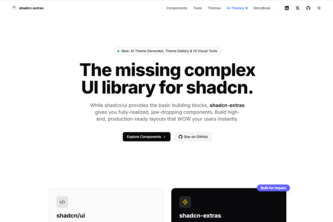
The description states that shadcn-extras is a design toolkit built on top of shadcn/ui, offering animated components, theme galleries, an AI-powered theme generator, and visual developer tools. It is presented as a self-contained project by one individual (Nayan Radadiya), built for developers using Next.js, Tailwind CSS, React, and TypeScript.
What changed
The author describes the project as a response to a perceived gap in the market — that shadcn/ui lacks unique design options and that AI tools are not yet integrated into real, production-ready component libraries. The project was developed to bridge this gap by offering a toolkit with AI-generated themes and pre-built components.
Single most important open question
Is there any evidence of user adoption, revenue, or traction beyond the author’s own development? The description is entirely self-reported and lacks any data on customers, usage, or monetization.
What The Product Actually Is
The description states that shadcn-extras is a design toolkit built on top of shadcn/ui. It includes:
- 25+ animated components (e.g., WebGL parallax galleries, holographic cards)
- A theme gallery with 11 hand-crafted themes
- An AI theme generator powered by Google Gemini
- 14 visual developer tools for generating UI elements like buttons and gradients
- A Storybook-style playground with 50+ interactive stories
The author describes the core engine as a shared ThemePreset type that standardizes how themes are defined, enabling both hand-crafted and AI-generated themes to be compatible.
Evidence
- The project is described as built using Next.js 14, Tailwind CSS v4, Radix UI, Framer Motion, Three.js, and Google Gemini API.
- It uses a scoped
<style>tag with CSS variables for live theme previews. - AI outputs are normalized server-side to ensure compatibility with Tailwind.
Inference The toolkit is presented as plug-and-play, allowing developers to install components via CLI and preview themes in real-time. The author emphasizes that it is designed for production use.
Positioning & Claim Evolution
The description states that the project was inspired by the lack of unique design options in shadcn/ui projects, where everything looks the same. The author positions shadcn-extras as a solution to this problem — offering not just UI components but also AI-powered theming and customization.
Key claims
- “Every shadcn website looks the same.”
- “AI could design your theme for you, and instantly apply it to real, production-ready components.”
- “What if AI could design your theme for you, and instantly apply it to real, production-ready components — not just a mockup?”
Evidence
- The author frames the project as solving a gap in the market.
- It is presented as an extension of shadcn/ui with added functionality.
Inference The positioning suggests that shadcn-extras targets developers who want to build visually distinct UIs without starting from scratch. It positions itself as a tool for rapid, AI-assisted design customization.
Target Customer & ICP
The description states that the project is built for developers using shadcn/ui and Tailwind CSS. The author’s own write-up implies that it is intended for those who want to avoid repetitive UI patterns and seek unique, customizable themes.
Evidence
- The toolkit is described as being built on top of shadcn/ui.
- It includes tools like a theme gallery, AI generator, and visual developer tools — all aimed at developers building UIs.
Inference The primary customer is likely frontend developers or design teams working with React, Next.js, and Tailwind CSS. The ICP appears to be self-contained developers or small teams looking for rapid UI customization.
Business Model & Pricing Evidence
Not evidenced.
Evidence
- No mention of pricing, monetization strategy, or business model.
- The project is described as a personal development effort submitted to a hackathon.
Inference There is no indication that the product is currently monetized or has a defined revenue path. It appears to be an open-source or prototype offering.
Technical & Delivery Signals
The description states that:
- The stack includes Next.js 14, Tailwind CSS v4, Radix UI, Framer Motion, Three.js, and Google Gemini API.
- Themes are generated using a shared
ThemePresettype to ensure compatibility. - AI outputs are normalized server-side for safety and correctness.
- Live previews are scoped via CSS variables.
- React portals are handled by passing theme tokens through data attributes.
Evidence
- The author describes technical challenges and solutions, including handling AI output format mismatches, scoping live previews, and securing API keys.
- The system is designed to be production-ready with one-click exports and CLI installation.
Inference The project shows a strong understanding of frontend architecture and developer tooling. It demonstrates attention to detail in UI consistency, performance, and security.
Traction & Maturity Signals
Not evidenced.
Evidence
- The project is described as a personal effort by one individual (Nayan Radadiya).
- No mention of users, customers, or adoption.
- No revenue, ARR, or usage data provided.
Inference There is no evidence of traction beyond the author’s own development. It appears to be a prototype or proof-of-concept submitted to a hackathon.
Competitive Context
Not evidenced.
Evidence
- The description does not mention competitors or similar products.
- No reference to existing tools in the UI component or theming space.
Inference The project is positioned as solving a gap, but there is no evidence of competitive analysis or awareness of existing solutions.
Open Questions & Risks
- No traction or monetization: The project is described as a personal effort with no evidence of adoption or revenue.
- Single-person development: The team size is listed as 1, which may limit scalability and long-term maintenance.
- AI dependency risks: Reliance on Google Gemini API introduces potential issues around availability, cost, and output consistency.
- Limited scope: The project appears to be a developer tool with no clear path to broader market adoption or commercialization.
Evidence
- No mention of users, customers, or revenue.
- One-person team.
- AI integration is central but not guaranteed to be stable or scalable.
Questions the description leaves open
- What is the current status of the project? Is it being used by anyone beyond the author?
- Are there any plans for monetization or commercialization?
- How does the AI theme generator handle edge cases or failures in input (e.g., ambiguous image uploads)?
- What are the long-term maintenance plans for the project, given its reliance on external APIs like Google Gemini?
- Has the author considered how to scale beyond a single developer?
Overall Assessment
Not evidenced.
Evidence
- No financials, traction, or commercial strategy provided.
- The project is described as a hackathon submission with no indication of investment readiness or partnership potential.
Inference At this stage, there is insufficient evidence to assess whether the project is ready for investment or partnership. It appears to be an early-stage prototype with no demonstrated market traction or business model.
User Stories BotA demo video on every pull request
Get a demo video on every new feature
GitHub App that watches your pull requests and records a narrated, captioned demo.
Save time on demo prep and make informed decisions faster with a video walkthrough of every new feature.
Source
Submitted to the OpenAI 2026 hackathon on Devpost. Project home on Devpost. Back to the full gallery on Devpost.
This competitive analysis was produced by top-founders.com (opens in a new tab)
Generated by a language model from this project's public Devpost page — its tagline, the author's own write-up and any built-with tags listed there — as captured in August 2026. Short quotations are the author's words. It is an opinion on the idea as a business, not on the people behind it, and it reflects the description as published then. If the project has moved on, request a correction below. The analysis is not independent research and contains no verified traction, revenue or customer data.
An independent guide by KFG International LLC — not affiliated with, endorsed by, or connected to Devpost or OpenAI.