

Archive position — measured, not model output
0 likes on Devpost
2,263 of the 7,850 archived projects have more likes, and 5,587 share exactly 0 — so this project's #6,628 place in the like-ranked listing is a tie-break inside that group, not a ranking.
Projects (log scale)
Likes on Devpost. ▲ marks this project's group.
Show the figures
| Likes | Projects | Share of archive |
|---|---|---|
| 0 | 5,587 | 71.2% |
| 1 | 1,758 | 22.4% |
| 2 | 284 | 3.6% |
| 3–4 | 132 | 1.7% |
| 5–9 | 75 | 1.0% |
| 10+ | 14 | 0.2% |
 User Stories BotA demo video on every pull request
Get a demo video on every new feature
GitHub App that watches your pull requests and records a narrated, captioned demo.
Save time on demo prep and make informed decisions faster with a video walkthrough of every new feature.
Executive Summary
What the company appears to be
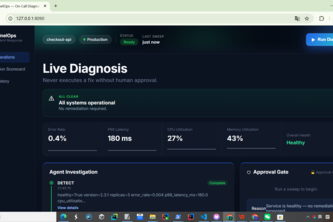
SentinelOps is a self-reported autonomous incident-diagnosis agent for production services, built as a hackathon project. It uses GPT-5.6 via OpenAI's function-calling API to detect and diagnose issues, propose one remediation, and enforce a human approval gate before any action is taken. The system includes an audit ledger and a web dashboard with CLI support.
What changed
This is a single-person hackathon project submitted to the OpenAI 2026 hackathon. It does not appear to have moved beyond prototype or demonstration stage.
Single most important open question
Is there any evidence of traction, revenue, customers, or product-market fit beyond the self-reported author's account?
Analysis basis
The entire report is based on the self-reported description provided by the project author. No external verification, archived data, or third-party sources are available.
What The Product Actually Is
The description states that SentinelOps is an autonomous incident-diagnosis agent for production services. It runs a six-step loop: DETECT → DIAGNOSE → PROPOSE → GATE → ACT → VERIFY.
- It reads telemetry and logs from a target service.
- It uses GPT-5.6 via OpenAI’s function-calling API to diagnose root causes and propose one remediation.
- A human must approve or reject the proposed action through a web dashboard or CLI before any system change occurs.
- If approved, a server-side allow-list double-checks that the action is within bounds.
- The agent re-verifies recovery after execution.
- If the service is already healthy, no action is taken.
- Every decision is written to an append-only audit ledger.
Inference The product is described as a diagnostic tool with a strict approval gate. It is not a fully autonomous system that makes changes without human oversight.
Positioning & Claim Evolution
The author states the inspiration was to solve the problem of engineers spending time finding fixes rather than implementing them, and to address skepticism around AI SRE tools that confidently fix things without testing whether they can be talked into doing the wrong thing.
The product is positioned as an agent that never fixes anything without human say-so — emphasizing control and safety over automation.
Claim
The system enforces a strict approval gate to prevent unintended actions.
Inference This positioning reflects a response to perceived risks in AI-driven SRE tools, particularly around prompt injection and uncontrolled execution.
Target Customer & ICP
The description states that SentinelOps is built for on-call engineers managing production services. It targets environments where incident diagnosis and remediation are critical but time-consuming.
Claim
The target audience is on-call engineers.
Inference The product appears designed to reduce the time spent diagnosing incidents, not to replace human judgment or decision-making.
Business Model & Pricing Evidence
Not evidenced. The description does not mention any pricing model, monetization strategy, or business model.
Finding
No evidence of business model or pricing structure.
Technical & Delivery Signals
The system is built using:
- GPT-5.6 via OpenAI Python SDK function-calling
- FastAPI for backend and dashboard
- Server-Sent Events (SSE) for live trace streaming
- JavaScript, HTML5, CSS3 for UI
- JSON for structured output
- Codex for development
It includes:
- A deliberately faulty FastAPI checkout service with four fault types and one "everything's fine" state.
- An evaluation harness that grades 18 scenarios × 3 trials = 54 runs against a ground truth.
- A CLI and web dashboard with approval gates.
Claim
The system uses structured function calling to enforce the approval gate.
Inference The use of OpenAI’s native function-calling API is highlighted as key to enabling the human approval mechanism.
Traction & Maturity Signals
Not evidenced. There is no mention of revenue, customers, users, or product adoption beyond the author's own account.
Finding
No evidence of traction or maturity beyond a hackathon prototype.
Competitive Context
The description mentions skepticism toward most "AI SRE" projects that show agents confidently fixing things without testing whether they can be talked into doing the wrong thing. SentinelOps is positioned as addressing this gap by enforcing a strict approval gate.
Claim
The product differentiates itself from other AI SRE tools by requiring human approval.
Inference It appears to address a perceived lack of safety in current AI-driven SRE solutions.
Open Questions & Risks
- Unverified claims: All evidence is self-reported and unverified.
- No traction or revenue: No data on customers, usage, or monetization.
- Single-person project: The team size is listed as one person — no indication of scaling or team structure.
- Hackathon prototype: The product was built for a hackathon, not for production use.
- Limited scope: The evaluation harness only tests 18 scenarios × 3 trials = 54 runs; no real-world data or long-term performance metrics are provided.
Finding
The project is a prototype with no evidence of commercial viability or product-market fit.
Questions the description leaves open
- What is the actual use case for this tool in production environments?
- How does it integrate with existing SRE tools and workflows?
- Has there been any testing beyond the hackathon environment?
- Are there plans to move beyond a prototype into a product or service?
- What are the technical limitations of using GPT-5.6 for this use case at scale?
Overall Assessment
Not evidenced.
Finding
No evidence of commercial traction, revenue, or customer base. The project is described as a hackathon submission with no indication of further development or market readiness.
User Stories BotA demo video on every pull request
Get a demo video on every new feature
GitHub App that watches your pull requests and records a narrated, captioned demo.
Save time on demo prep and make informed decisions faster with a video walkthrough of every new feature.
Source
Submitted to the OpenAI 2026 hackathon on Devpost. Project home on Devpost. Back to the full gallery on Devpost.
This competitive analysis was produced by top-founders.com (opens in a new tab)
Generated by a language model from this project's public Devpost page — its tagline, the author's own write-up and any built-with tags listed there — as captured in August 2026. Short quotations are the author's words. It is an opinion on the idea as a business, not on the people behind it, and it reflects the description as published then. If the project has moved on, request a correction below. The analysis is not independent research and contains no verified traction, revenue or customer data.
An independent guide by KFG International LLC — not affiliated with, endorsed by, or connected to Devpost or OpenAI.