

Archive position — measured, not model output
1 like on Devpost
505 of the 7,850 archived projects have more likes, and 1,758 share exactly 1 — so this project's #1,892 place in the like-ranked listing is a tie-break inside that group, not a ranking.
Projects (log scale)
Likes on Devpost. ▲ marks this project's group.
Show the figures
| Likes | Projects | Share of archive |
|---|---|---|
| 0 | 5,587 | 71.2% |
| 1 | 1,758 | 22.4% |
| 2 | 284 | 3.6% |
| 3–4 | 132 | 1.7% |
| 5–9 | 75 | 1.0% |
| 10+ | 14 | 0.2% |
 User Stories BotA demo video on every pull request
Get a demo video on every new feature
GitHub App that watches your pull requests and records a narrated, captioned demo.
Save time on demo prep and make informed decisions faster with a video walkthrough of every new feature.
Executive Summary
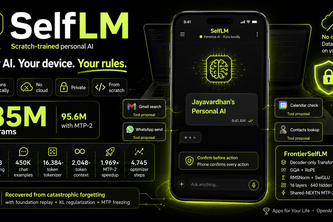
SelfLM, as described by its author, is a language model project built from scratch and designed to run privately on mobile devices (specifically Android). It claims to take action across apps and integrates with services like Google, Gmail, WhatsApp, and others. The project was submitted to the OpenAI 2026 hackathon and is attributed to a single team member, Jayavardhan Kolla.
The description provides no evidence of revenue, customers, traction or commercial adoption. It is self-reported, unverified, and based on limited information — primarily a tagline, a list of technologies used, and a submission context (hackathon). The author states the product runs "privately" on phones and takes action across apps, but does not clarify what that means in practice or how it functions.
The single most important open question
What is the actual functionality of SelfLM? How does it take action across apps, and what problem does it solve for users?
What The Product Actually Is
The description states:
"SelfLM a language model built from scratch that runs privately on your phone and takes action across your apps."
This suggests:
- A language model (LM) is being developed.
- It is built from scratch, not using pre-trained models or frameworks as a base.
- It runs privately on your phone, implying local execution, not cloud-based.
- It takes action across apps, which implies automation or integration capabilities.
However:
- No technical specification of the language model (e.g., architecture, size, training data) is provided.
- The phrase “takes action” is not defined — it could mean task automation, app interaction, or something else entirely.
- There is no evidence of a working prototype or demo.
Inference: The product appears to be an experimental or early-stage project focused on private, mobile-based language model execution and cross-app automation. It is not evidenced as functional or tested in real-world use.
Positioning & Claim Evolution
The description states:
"SelfLM a language model built from scratch that runs privately on your phone and takes action across your apps."
This is a self-stated positioning — the author describes what they are building, but does not explain:
- Why this approach matters.
- How it differs from existing solutions.
- What user pain points it solves.
There is no evidence of prior claims or evolution in positioning. The project appears to be a one-off submission with no prior history or marketing narrative.
Inference: The positioning is minimal and self-explanatory, lacking differentiation or market context. It is not evident that the author has evolved a clear value proposition or strategic direction.
Target Customer & ICP
The description does not state:
- Who the intended users are.
- What personas or segments it targets.
- Whether this is for individual users, developers, enterprises, or internal use.
It only says the model runs on phones and takes action across apps — but no customer profile is given.
Inference: The target customer is not evidenced. It may be a developer or tech-savvy user, but that is speculative without further detail.
Business Model & Pricing Evidence
The description does not mention:
- How the product will generate revenue.
- Whether it is free, paid, or subscription-based.
- Any pricing model or monetization strategy.
Inference: No business model or pricing evidence is provided. The project appears to be a prototype or hackathon submission with no commercial plan evident.
Technical & Delivery Signals
The author lists technologies used:
"android, api, calendar, cloud, compose, database, executorch, fastapi, firebase, gmail, google, identity, jetpack, json, keystore, kotlin, messaging, openai, python, pytorch, retrofit, schema, services, whatsapp"
This suggests:
- The project is built for Android.
- It uses Python, Kotlin, and PyTorch — common in ML development.
- It integrates with Google services, Gmail, WhatsApp, and others.
- It uses Firebase, FastAPI, ExecutorCH, and Jetpack Compose — indicating a modern, mobile-first stack.
However:
- No evidence of actual model architecture or performance metrics.
- No mention of how the language model is trained or deployed.
- No indication of whether it’s open-source or proprietary.
Inference: The technical stack suggests a developer-focused, mobile-based project using modern tools. However, no delivery or implementation details are provided to assess feasibility or scalability.
Traction & Maturity Signals
The description states:
"This project was submitted to the OpenAI 2026 hackathon."
This is the only signal of traction or maturity:
- It is a hackathon submission.
- It has no evidence of:
- Customers
- Revenue
- Product-market fit
- Adoption
- Iteration beyond initial concept
Inference: The project is at an early stage, likely conceptual or prototype-level. No traction or maturity indicators are evident.
Competitive Context
The description does not mention:
- Competitors.
- Market positioning relative to others.
- How it compares to existing language models or automation tools.
No competitive analysis or differentiation is provided.
Inference: The competitive context is not evidenced. It is unclear how SelfLM fits into the broader landscape of mobile AI, private LMs, or cross-app automation.
Open Questions & Risks
Key risks and open questions based on the description:
- Lack of clarity: The phrase “takes action across apps” is vague — no definition or example.
- Unproven concept: Built from scratch, not validated in real-world use.
- Single founder: No team or organizational support.
- No evidence of traction or adoption.
- No commercial model or pricing.
- No demonstration or prototype.
Inference: The project is highly speculative and lacks any evidence of viability or market relevance. It appears to be an early-stage idea, not a product in development.
Questions the description leaves open
- What does “takes action across apps” mean in practice?
- How is the language model trained and deployed locally on phones?
- What are the specific use cases or workflows it supports?
- Is this project intended for personal use, developers, or enterprise customers?
- Are there any plans to monetize or scale this beyond a hackathon submission?
- What are the technical limitations of running a language model on mobile devices?
- How does it differ from existing tools like AutoHotkey, Shortcuts, or AI assistants?
Overall Assessment
The description provides no evidence of:
- Revenue
- Customers
- Product-market fit
- Traction
- Commercial viability
It is a self-reported hackathon submission, with no indication that the project has moved beyond concept or prototype stage.
Inference: At this point, there is no basis for investment or partnership consideration. The project is not evidenced as a viable business or product. It may be an early idea or proof-of-concept, but it lacks any commercial due-diligence foundation.
User Stories BotA demo video on every pull request
Get a demo video on every new feature
GitHub App that watches your pull requests and records a narrated, captioned demo.
Save time on demo prep and make informed decisions faster with a video walkthrough of every new feature.
Source
Submitted to the OpenAI 2026 hackathon on Devpost. Project home on Devpost. Back to the full gallery on Devpost.
This competitive analysis was produced by top-founders.com (opens in a new tab)
Generated by a language model from this project's public Devpost page — its tagline and any built-with tags listed there, since the author published no write-up — as captured in August 2026. Short quotations are the author's words. It is an opinion on the idea as a business, not on the people behind it, and it reflects the description as published then. If the project has moved on, request a correction below. The analysis is not independent research and contains no verified traction, revenue or customer data.
An independent guide by KFG International LLC — not affiliated with, endorsed by, or connected to Devpost or OpenAI.