

Archive position — measured, not model output
1 like on Devpost
505 of the 7,850 archived projects have more likes, and 1,758 share exactly 1 — so this project's #1,894 place in the like-ranked listing is a tie-break inside that group, not a ranking.
Projects (log scale)
Likes on Devpost. ▲ marks this project's group.
Show the figures
| Likes | Projects | Share of archive |
|---|---|---|
| 0 | 5,587 | 71.2% |
| 1 | 1,758 | 22.4% |
| 2 | 284 | 3.6% |
| 3–4 | 132 | 1.7% |
| 5–9 | 75 | 1.0% |
| 10+ | 14 | 0.2% |
 User Stories BotA demo video on every pull request
Get a demo video on every new feature
GitHub App that watches your pull requests and records a narrated, captioned demo.
Save time on demo prep and make informed decisions faster with a video walkthrough of every new feature.
Executive Summary
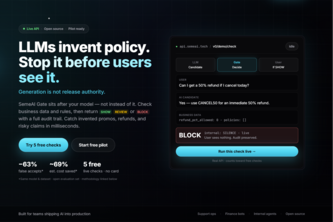
The company appears to be a single-person project (Anton Semenenko) building an LLM output governance tool called SemeAI Gate. The author describes it as a "secure runtime gate and SaaS API layer" designed to intercept LLM outputs before they reach end users, applying compliance rules, prompt injection checks, and coherence evaluation. It operates under a "Silence-as-Control" model, returning one of three semantic decisions: PROCEED, NEEDS_REVIEW, or SILENCE.
What changed
The project was submitted as part of the OpenAI 2026 hackathon, indicating an early-stage development effort with no evidence of prior traction or commercial deployment.
The single most important open question
Is there any evidence that this tool has been used in production environments, or that it has been adopted by enterprises seeking LLM governance? The description is self-reported and lacks any data on usage, revenue, customers, or market validation.
What The Product Actually Is
- The description states that SemeAI Gate is a secure runtime gate and SaaS API layer for LLM output governance.
- It is built as a three-repository ecosystem, including:
silence-as-control: the core research library for release logic.semeai-gate-basic: the production-ready runtime adapter and SaaS API service.semeai.tech: a public interface with registration and live playground features.
- It implements a "Silence-as-Control" (SaC) model, evaluating outputs against compliance rules, prompt injection vectors, and logical coherence.
- The system returns one of three semantic decisions: PROCEED, NEEDS_REVIEW, or SILENCE.
Note
This is a self-reported description. No evidence exists for actual product functionality, deployment, or performance in real-world use cases.
Positioning & Claim Evolution
- The author positions SemeAI Gate as a governance gate for LLMs, ensuring compliance, context coherence, and safety.
- It is framed as a checkpoint that prevents raw LLM outputs from reaching end users unless they pass strict evaluation.
- The project claims to separate generative intelligence from release control, which it says improves system reliability.
- The positioning implies a compliance-first approach for enterprise adoption of LLMs, especially in contexts where hallucinations or unpredictable outputs are risky.
Inference The author’s framing suggests an intent to address enterprise concerns around LLM governance, but no evidence supports prior market traction or customer validation.
Target Customer & ICP
- The description implies a target audience of enterprises hesitant to automate workflows due to risks like hallucinations and compliance issues.
- It is positioned for use in production systems, particularly where strict output control is required.
- The product is described as a SaaS API layer, suggesting it's intended for integration into existing applications or workflows.
Not evidenced No explicit customer names, personas, or use cases are provided. The description does not indicate whether the target is internal teams, developers, or C-suite decision-makers.
Business Model & Pricing Evidence
- The project is described as a SaaS API layer, implying a potential usage-based pricing model.
- It includes a public service interface (
semeai.tech) with registration and live playground features, which may suggest a freemium or trial model. - No pricing information, tiers, or monetization strategy is stated.
Inference If this becomes a commercial product, it likely will be priced based on API usage or enterprise compliance needs. However, no evidence supports current or planned pricing.
Technical & Delivery Signals
- Built with:
- Next.js, Node.js, Python, TypeScript
- OpenAI integration
- AI safety and SaaS tags
- The architecture is described as a three-repository ecosystem:
silence-as-control(research)semeai-gate-basic(runtime + API)semeai.tech(public interface)
- Challenges mentioned include balancing latency with semantic evaluation, and optimizing for enterprise concurrency.
Inference The architecture suggests a modular, scalable design. However, no evidence of actual deployment, performance metrics, or production readiness is provided.
Traction & Maturity Signals
- Submitted to the OpenAI 2026 hackathon, indicating an early-stage project.
- No evidence of:
- Revenue
- Customers
- Product adoption
- Market traction
- Deployment in real-world systems
- Any form of user feedback or usage data
Not evidenced The project is not shown to have moved beyond the prototype or hackathon stage.
Competitive Context
- The description does not mention any competitors.
- It positions itself as a solution for LLM governance, which overlaps with tools like:
- Prompt engineering platforms
- AI safety and compliance frameworks
- LLM output filtering systems
- No evidence of existing market players or competitive differentiation is provided.
Inference The space is crowded, but no context on how SemeAI Gate differentiates itself from other governance solutions is given.
Open Questions & Risks
- Single-person team: The project is built by one individual (Anton Semenenko), raising questions about scalability and long-term maintenance.
- No commercial traction or revenue: No evidence of customers, usage, or monetization.
- Self-reported only: All claims are unverified and lack third-party corroboration.
- Early-stage hackathon project: The product is not yet proven in production or enterprise settings.
- Unproven market fit: No data on customer needs or demand for such a governance tool.
Inference If this were to become a commercial product, it would face high risk of technical and market failure without validation.
Questions the description leaves open
- What specific compliance rules or enterprise use cases does SemeAI Gate support?
- Has the system been tested in real-world LLM workflows? If so, what were the results?
- How is latency managed in high-concurrency enterprise environments?
- Are there any existing partnerships or pilot customers?
- What is the plan for monetization and pricing?
- Is there a roadmap for product maturity beyond the current hackathon prototype?
Overall Assessment
- Not evidenced: No data on revenue, customers, or market traction supports an investment or partnership case.
- The project is described as a single-person hackathon submission, with no indication of commercial viability or scalability.
- It is positioned in a highly competitive and rapidly evolving space (LLM governance), where early-stage tools often fail to gain traction without proven demand.
Assessment Based on the self-reported description, there is no evidence to support an investment or partnership case. The project appears to be at a very early stage with no demonstrated product-market fit or commercial traction.
User Stories BotA demo video on every pull request
Get a demo video on every new feature
GitHub App that watches your pull requests and records a narrated, captioned demo.
Save time on demo prep and make informed decisions faster with a video walkthrough of every new feature.
Source
Submitted to the OpenAI 2026 hackathon on Devpost. Project home on Devpost. Back to the full gallery on Devpost.
This competitive analysis was produced by top-founders.com (opens in a new tab)
Generated by a language model from this project's public Devpost page — its tagline, the author's own write-up and any built-with tags listed there — as captured in August 2026. Short quotations are the author's words. It is an opinion on the idea as a business, not on the people behind it, and it reflects the description as published then. If the project has moved on, request a correction below. The analysis is not independent research and contains no verified traction, revenue or customer data.
An independent guide by KFG International LLC — not affiliated with, endorsed by, or connected to Devpost or OpenAI.