

Archive position — measured, not model output
0 likes on Devpost
2,263 of the 7,850 archived projects have more likes, and 5,587 share exactly 0 — so this project's #3,857 place in the like-ranked listing is a tie-break inside that group, not a ranking.
Projects (log scale)
Likes on Devpost. ▲ marks this project's group.
Show the figures
| Likes | Projects | Share of archive |
|---|---|---|
| 0 | 5,587 | 71.2% |
| 1 | 1,758 | 22.4% |
| 2 | 284 | 3.6% |
| 3–4 | 132 | 1.7% |
| 5–9 | 75 | 1.0% |
| 10+ | 14 | 0.2% |
 User Stories BotA demo video on every pull request
Get a demo video on every new feature
GitHub App that watches your pull requests and records a narrated, captioned demo.
Save time on demo prep and make informed decisions faster with a video walkthrough of every new feature.
Executive Summary
Company
Echo Canvas
Self-reported basis
The description is entirely self-reported and unverified, based on a Devpost submission for an OpenAI 2026 hackathon project. No external corroboration, revenue, customer data or traction evidence is available.
What it appears to be
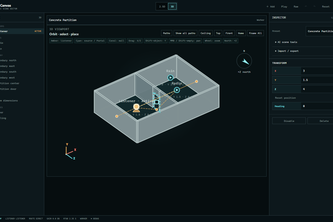
A browser-based workbench for spatial audio authoring that allows users to simulate and hear interactive acoustic environments before committing to a game engine pipeline. It integrates AI (GPT-5.6) for scene generation and explanation, with deterministic audio processing in the browser using Web Audio API and Web Workers.
What changed
This is a hackathon submission; no prior version or commercial product is evidenced.
Single most important open question
Is there any evidence of traction, revenue, or customer adoption beyond the author's own description?
What The Product Actually Is
The description states that Echo Canvas is a browser workbench for authoring, hearing, and explaining interactive spatial acoustics. It supports:
- Switching between 2.5D and Hybrid 3D projects.
- Manual scene creation or natural language input via GPT-5.6.
- Editing of room dimensions, listeners, point sources, walls, portals, materials, and vertical bounds.
- Direct viewport manipulation and numeric input.
- One active listener with support for multiple listeners.
- Local audio rendering in the browser using Web Audio API and HRTF.
- AI-assisted authoring with schema validation and deterministic acoustic calculations.
- Export and import of scenes via versioned JSON.
The tool is built with Next.js, React, TypeScript, and uses Web Workers for deterministic audio processing and GPT-5.6 through an API with structured output constraints.
Inference The product appears to be a prototype or proof-of-concept, not a commercial offering. It is not evidenced to have been released beyond the hackathon context.
Positioning & Claim Evolution
The description states that Echo Canvas aims to "provide the acoustic equivalent of a visual wireframe", allowing early-stage exploration of spatial audio without committing to a game engine. The author claims:
- Early evaluation of spatial audio is usually done late in development, making communication slow and abstract.
- The tool enables fast, concrete, and structured exploration of acoustics.
Inference The positioning is that of an early-stage design tool for sound designers and developers, intended to improve collaboration and reduce iteration time. It is not positioned as a replacement for game engines or middleware but as a pre-production authoring environment.
Target Customer & ICP
The description states that Echo Canvas targets:
- Level designers
- Sound designers
- Developers
- Clients
These users are described as needing to evaluate spatial audio early in the development process, before committing to a game engine pipeline.
Inference The ICP (Ideal Customer Profile) likely includes teams working on interactive media projects such as games or virtual environments, where early acoustic feedback is valuable. However, no evidence of actual customers or usage beyond the author’s own account is provided.
Business Model & Pricing Evidence
Not evidenced.
The description does not mention any pricing model, monetization strategy, or business model. It is a hackathon project with no indication of commercial intent or revenue streams.
Technical & Delivery Signals
The product uses:
- Next.js, React, TypeScript for frontend and server routes.
- Web Workers for deterministic acoustic calculations.
- Web Audio API for rendering audio with HRTF.
- GPT-5.6 via a structured API with schema validation.
- Codex for implementation and documentation.
- SVG-based orthographic viewports for direct manipulation.
- Schema and domain validators to prevent invalid inputs.
The tool supports:
- Real-time audio rendering
- Deterministic path tracing
- A/B comparison modes
- Diagnostics that explain changes in sound
- Versioned JSON exports
Inference The technical stack suggests a browser-based, deterministic, and AI-assisted workflow. It is not evidenced to be production-ready or scalable beyond the prototype stage.
Traction & Maturity Signals
Not evidenced.
There is no evidence of revenue, customers, user adoption, or product maturity beyond the hackathon submission. No metrics, usage data, or feedback from users are provided.
Competitive Context
Not evidenced.
The description does not mention any competitors or existing tools in the spatial audio authoring space. No market positioning or competitive differentiation is described.
Open Questions & Risks
- Unverified claims: The product is a hackathon submission with no external validation.
- No traction: No evidence of revenue, customers, or adoption.
- AI dependency: Reliance on GPT-5.6 and structured outputs may be fragile without stable API access.
- Prototype nature: Not evidenced to be production-ready or scalable.
- Limited scope: The tool is described as a workbench for early-stage acoustic design, not a full middleware solution.
Questions the description leaves open
- What is the intended use case beyond the hackathon?
- Are there any plans to commercialize this product or integrate it into existing workflows?
- How does the tool handle performance and scalability in larger projects?
- Has the team considered how to validate acoustic accuracy against real-world measurements?
- What are the limitations of the current deterministic audio processing compared to full DSP engines?
- Are there any partnerships or early adopters in the game/audio design industry?
Overall Assessment
Not evidenced.
There is no evidence of a commercial product, traction, or financials to support an investment or partnership decision. The project is described as a hackathon submission with no indication of future development or market readiness. Any potential for investment or partnership would depend on further development and validation beyond the current self-reported description.
User Stories BotA demo video on every pull request
Get a demo video on every new feature
GitHub App that watches your pull requests and records a narrated, captioned demo.
Save time on demo prep and make informed decisions faster with a video walkthrough of every new feature.
Source
Submitted to the OpenAI 2026 hackathon on Devpost. Project home on Devpost. Back to the full gallery on Devpost.
This competitive analysis was produced by top-founders.com (opens in a new tab)
Generated by a language model from this project's public Devpost page — its tagline, the author's own write-up and any built-with tags listed there — as captured in August 2026. Short quotations are the author's words. It is an opinion on the idea as a business, not on the people behind it, and it reflects the description as published then. If the project has moved on, request a correction below. The analysis is not independent research and contains no verified traction, revenue or customer data.
An independent guide by KFG International LLC — not affiliated with, endorsed by, or connected to Devpost or OpenAI.