

Archive position — measured, not model output
0 likes on Devpost
2,263 of the 7,850 archived projects have more likes, and 5,587 share exactly 0 — so this project's #5,818 place in the like-ranked listing is a tie-break inside that group, not a ranking.
Projects (log scale)
Likes on Devpost. ▲ marks this project's group.
Show the figures
| Likes | Projects | Share of archive |
|---|---|---|
| 0 | 5,587 | 71.2% |
| 1 | 1,758 | 22.4% |
| 2 | 284 | 3.6% |
| 3–4 | 132 | 1.7% |
| 5–9 | 75 | 1.0% |
| 10+ | 14 | 0.2% |
 User Stories BotA demo video on every pull request
Get a demo video on every new feature
GitHub App that watches your pull requests and records a narrated, captioned demo.
Save time on demo prep and make informed decisions faster with a video walkthrough of every new feature.
Executive Summary
What the company appears to be
ParallelPilot is a command-line tool (CLI) that automatically parallelizes serial Python code using AI agents—specifically Codex and GPT-5.6. The tool analyzes input code, identifies loops suitable for parallelization, generates optimized versions, verifies numerical correctness, measures speedup, and outputs performance reports.
What changed
The project was submitted to the OpenAI 2026 hackathon by a single founder, Jaret Eduardo Gonzalez Carrasco. It represents an experimental prototype built in a short timeframe with no evidence of prior traction or commercialization.
Single most important open question
Is there any evidence that ParallelPilot has been used beyond the hackathon context, or that it has achieved meaningful adoption among data scientists or engineers who might benefit from its functionality?
What The Product Actually Is
The description states that ParallelPilot is a CLI tool designed to automate parallelization of serial Python code. It uses:
- Codex (in headless mode) for autonomous code generation and testing.
- GPT-5.6 for high-level reasoning, strategy selection, and report writing.
- A dual-agent architecture where Codex handles execution and retries while GPT-5.6 guides the approach.
It claims to:
- Identify parallelizable loops in Python scripts.
- Generate optimized code using multiprocessing or joblib.
- Verify numerical correctness within user-defined tolerance.
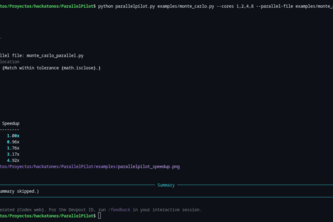
- Measure real speedup across core counts.
- Output performance reports with visual curves and explanations.
Inference The tool is built for scientific computing, simulations, and data preprocessing tasks where single-threaded execution is inefficient.
Positioning & Claim Evolution
The author positions ParallelPilot as a solution to the inefficiency of serial Python code in HPC contexts. It aims to democratize access to parallel computing by removing the need for manual intervention or deep expertise.
Key claims:
- “Brings high-performance computing (HPC) to every data scientist, regardless of their parallel programming expertise.”
- “Automatically generates an optimized version using multiprocessing or joblib.”
- “Achieved real speedups of 4x–8x on tested simulation scripts without any manual code modification.”
Inference The positioning is focused on accessibility and automation for a niche but high-value audience—data scientists and engineers working with computationally heavy Python code.
Target Customer & ICP
The description does not name specific customers or personas. However, it implies:
- Data scientists and engineers in scientific computing.
- Users who run simulations, Monte Carlo methods, or data preprocessing on single-core systems.
- Developers seeking to improve performance without deep knowledge of parallelism.
Inference The ideal customer profile likely includes individuals or teams using Python for compute-intensive tasks but lacking time or expertise to manually optimize code.
Business Model & Pricing Evidence
There is no evidence in the description of a business model or pricing structure. The project was submitted as part of a hackathon and lacks any indication of monetization, licensing, or commercial deployment plans.
Not evidenced
Technical & Delivery Signals
The tool is built using:
- Python
- multiprocessing / joblib
- Codex (headless mode)
- GPT-5.6
- click (CLI framework)
- pandas and matplotlib for reporting
It uses a dual-agent system:
- Codex handles iterative code generation and testing.
- GPT-5.6 selects strategies and writes reports.
Inference The architecture suggests an experimental, AI-driven approach to code optimization with strong integration between LLMs and execution environments.
Traction & Maturity Signals
No evidence of traction or maturity beyond the hackathon submission:
- No revenue data.
- No customer base.
- No production usage.
- No public deployment or distribution channels.
- No mention of follow-up development or product iteration post-hackathon.
Not evidenced
Competitive Context
The description does not reference existing tools or competitors. However, based on the stated functionality:
- Tools like Numba, Cython, and joblib already exist for parallelizing Python code.
- These tools typically require manual intervention or configuration.
- ParallelPilot claims to automate this process using AI.
Inference If successful, it could disrupt or complement existing tools by offering a no-code solution for parallelization. But there is no evidence of competitive positioning or market awareness.
Open Questions & Risks
- Unverified technology stack: GPT-5.6 does not exist; this is likely a placeholder or misstatement.
- No commercial viability: No evidence of product-market fit, revenue, or user feedback beyond the hackathon.
- Limited scope: Currently focused only on Python and CPU-based parallelization.
- Dependency on proprietary APIs: Reliance on Codex and GPT-5.6 implies potential dependency risks.
- Unproven scalability: Speedups claimed (4x–8x) are not independently verified or contextualized.
Questions the description leaves open
- What is the actual model version used for Codex? Is it a real API or placeholder?
- How does the tool handle edge cases in loop dependencies and floating-point precision?
- Has the tool been tested on real-world datasets or production code?
- Are there any plans to support other languages beyond Python?
- What is the roadmap for monetization or commercial deployment?
- Is there any internal testing or feedback from users outside the hackathon?
Overall Assessment
Not evidenced
The project is a hackathon submission with no evidence of traction, revenue, or customer adoption. While the concept shows promise in addressing a real pain point—automating parallelization for Python developers—the lack of any commercial or technical validation makes it difficult to assess its viability as an investment or partnership opportunity.
This is an early-stage idea with potential but insufficient evidence to support further due diligence or investment decisions at this time.
User Stories BotA demo video on every pull request
Get a demo video on every new feature
GitHub App that watches your pull requests and records a narrated, captioned demo.
Save time on demo prep and make informed decisions faster with a video walkthrough of every new feature.
Source
Submitted to the OpenAI 2026 hackathon on Devpost. Project home on Devpost. Back to the full gallery on Devpost.
This competitive analysis was produced by top-founders.com (opens in a new tab)
Generated by a language model from this project's public Devpost page — its tagline, the author's own write-up and any built-with tags listed there — as captured in August 2026. Short quotations are the author's words. It is an opinion on the idea as a business, not on the people behind it, and it reflects the description as published then. If the project has moved on, request a correction below. The analysis is not independent research and contains no verified traction, revenue or customer data.
An independent guide by KFG International LLC — not affiliated with, endorsed by, or connected to Devpost or OpenAI.