

Archive position — measured, not model output
0 likes on Devpost
2,263 of the 7,850 archived projects have more likes, and 5,587 share exactly 0 — so this project's #6,589 place in the like-ranked listing is a tie-break inside that group, not a ranking.
Projects (log scale)
Likes on Devpost. ▲ marks this project's group.
Show the figures
| Likes | Projects | Share of archive |
|---|---|---|
| 0 | 5,587 | 71.2% |
| 1 | 1,758 | 22.4% |
| 2 | 284 | 3.6% |
| 3–4 | 132 | 1.7% |
| 5–9 | 75 | 1.0% |
| 10+ | 14 | 0.2% |
 User Stories BotA demo video on every pull request
Get a demo video on every new feature
GitHub App that watches your pull requests and records a narrated, captioned demo.
Save time on demo prep and make informed decisions faster with a video walkthrough of every new feature.
Executive Summary
What the company appears to be
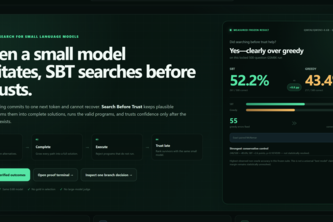
A single-person project submitted to the OpenAI 2026 hackathon, titled Search Before Trust: Auditable Decoding for Small LLMs. The author describes a 0.6b parameter model that improves performance on GSM8K by branching where it hesitates, and claims every number in its demo is recomputed from a frozen receipt — changing one digit causes the app to refuse to start.
What changed
This is a hackathon submission with no evidence of prior development or commercial traction. The description does not indicate any evolution from an earlier version or prior work; it is presented as a novel idea for a single project.
The single most important open question
Is this a proof-of-concept or prototype that could evolve into a product, or is it a one-off hackathon experiment with no commercial viability?
Note
This analysis is based solely on the self-reported, unverified description provided by the author. No revenue, customers, funding, headcount, or third-party validation are evidenced.
What The Product Actually Is
The description states:
- A 0.6b parameter language model
- It improves performance on GSM8K (a benchmark for grade-school math problems) from 43.4% to 52.2%
- It uses a method called “auditable decoding” that branches where the model hesitates
- Every number in its demo is recomputed from a frozen receipt — changing one digit causes the app to refuse to start
Inference The product appears to be a research or prototype tool focused on improving reasoning and trustworthiness of small language models through branching logic and deterministic outputs. It is not described as a commercial product, but rather a technical demonstration.
Claim
The author states that this is a model for small LLMs with auditable decoding.
Evidence Yes, from the project description.
Inference This is a prototype or proof-of-concept tool, not a finished product.
Positioning & Claim Evolution
The description states:
- The tagline: “A 0.6b model goes 43.4% → 52.2% on GSM8K by branching where it hesitates.”
- Every number in the demo is recomputed from a frozen receipt — change one digit and the app refuses to start
Inference The positioning is focused on trust, auditability, and performance improvement for small language models. It does not appear to have evolved from prior work or a previous product; it is a new idea presented as a hackathon submission.
Claim
The author positions this as an auditable decoding method that improves reasoning in small LLMs.
Evidence Yes, from the tagline and description.
Inference No evidence of prior positioning or evolution — this is a new concept for a single project.
Target Customer & ICP
The description does not state:
- Who the target customer is
- What the ideal customer profile (ICP) is
- Whether it targets developers, enterprises, or end-users
Inference The product is likely aimed at researchers or developers working with small language models, but this is not explicitly stated.
Claim
Not evidenced.
Evidence No mention of target customers or ICP in the description.
Business Model & Pricing Evidence
The description does not state:
- How the product would be monetized
- Whether it has a pricing model
- If there are any commercial plans or revenue streams
Inference There is no evidence of a business model or pricing structure — this is a hackathon submission, not a commercial offering.
Claim
Not evidenced.
Evidence No mention of monetization or pricing in the description.
Technical & Delivery Signals
The description states:
- A 0.6b parameter language model
- Improves performance on GSM8K from 43.4% to 52.2%
- Uses “auditable decoding” that branches where it hesitates
- Every number in the demo is recomputed from a frozen receipt — change one digit and the app refuses to start
Inference The project shows technical innovation in model reasoning and output determinism, but no evidence of delivery or production readiness.
Claim
The author states this is a working prototype with deterministic outputs.
Evidence Yes, from the description.
Inference No evidence of deployment, scalability, or production use — it's a demo.
Traction & Maturity Signals
The description does not state:
- Any revenue or ARR
- Customer adoption or usage
- Product maturity or development stage beyond hackathon submission
- Any traction metrics or growth indicators
Inference This is a single-person hackathon project with no evidence of traction or commercialization.
Claim
Not evidenced.
Evidence No mention of traction, customers, or product maturity in the description.
Competitive Context
The description does not state:
- Who the competitors are
- What existing solutions address similar problems
- Whether this is a novel approach or part of an existing category
Inference No competitive context is provided — it's unclear if this is a new idea or part of an existing field.
Claim
Not evidenced.
Evidence No mention of competitors or market positioning in the description.
Open Questions & Risks
- Single-person team: The project has only one member, which may limit execution capacity.
- Hackathon submission: This is a prototype, not a product — no commercial viability is evident.
- No evidence of traction or monetization: No signs of revenue, customers, or business model.
- Unverified claims: The description does not provide verifiable data on performance improvements or technical implementation.
Inference This project appears to be a proof-of-concept with no commercial viability or scalability.
Questions the description leaves open
- What is the technical architecture of the “auditable decoding” method?
- How does this approach generalize beyond GSM8K?
- Is there any plan for production deployment or scaling?
- What are the limitations of this model in real-world use cases?
- Are there any plans to commercialize this idea, and if so, how?
- Has this been tested with other benchmarks or datasets beyond GSM8K?
Overall Assessment
Assessment Not evidenced.
Claim
The description does not provide sufficient evidence to assess investment or partnership potential.
Evidence No revenue, customers, traction, or commercialization plans are mentioned.
Inference This is a hackathon project with no indication of commercial viability or scalability.
User Stories BotA demo video on every pull request
Get a demo video on every new feature
GitHub App that watches your pull requests and records a narrated, captioned demo.
Save time on demo prep and make informed decisions faster with a video walkthrough of every new feature.
Source
Submitted to the OpenAI 2026 hackathon on Devpost. Project home on Devpost. Back to the full gallery on Devpost.
This competitive analysis was produced by top-founders.com (opens in a new tab)
Generated by a language model from this project's public Devpost page — its tagline and any built-with tags listed there, since the author published no write-up — as captured in August 2026. Short quotations are the author's words. It is an opinion on the idea as a business, not on the people behind it, and it reflects the description as published then. If the project has moved on, request a correction below. The analysis is not independent research and contains no verified traction, revenue or customer data.
An independent guide by KFG International LLC — not affiliated with, endorsed by, or connected to Devpost or OpenAI.